
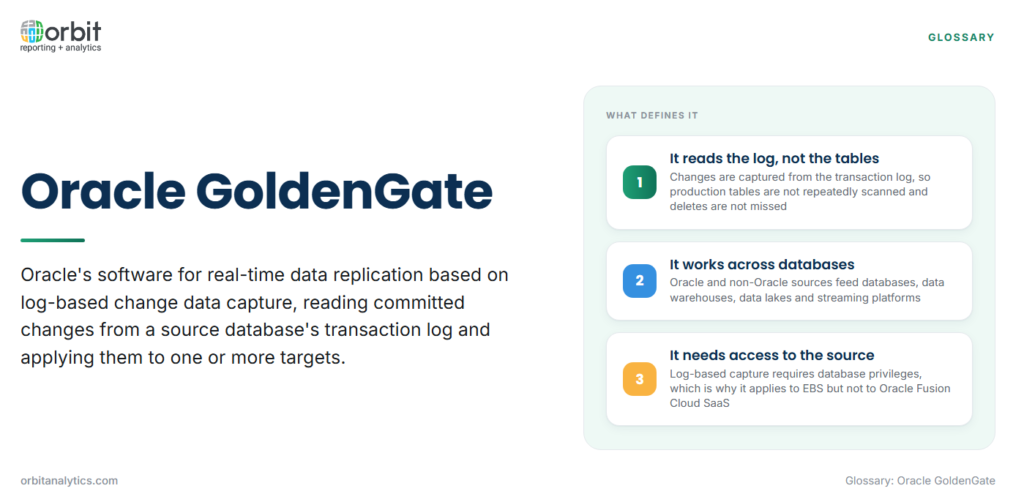
Oracle GoldenGate is Oracle’s software for real-time data replication based on log-based change data capture (CDC). It reads committed changes from a source database’s transaction log and applies them to one or more targets within seconds, without repeatedly querying the source tables.
It works across heterogeneous systems: Oracle Database and a range of non-Oracle databases on the source side, and targets that include other databases, data warehouses, data lakes and streaming platforms. Because it moves only the changes rather than full copies, it is widely used where a target must stay current with a busy production system.
How Oracle GoldenGate Works
A GoldenGate replication stream follows the same path from source to target.
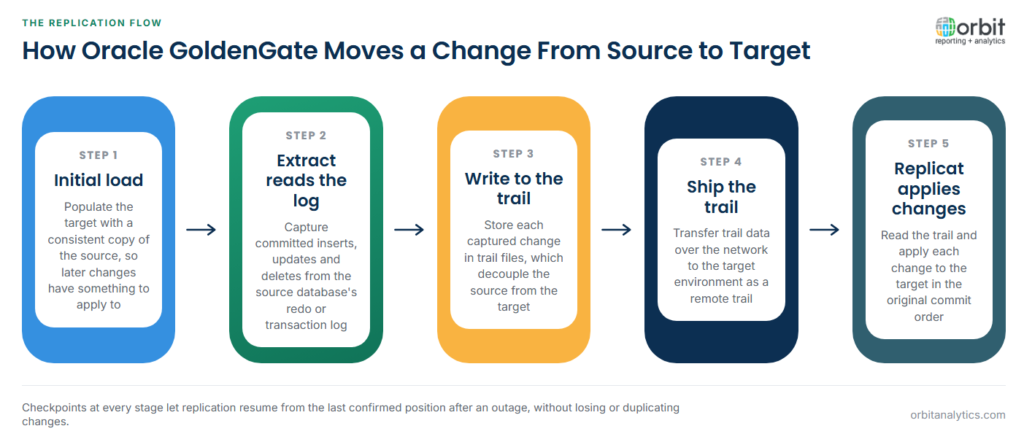
- Initial load. The target is first populated with a consistent copy of the source data, so that later changes have something to apply to.
- Extract reads the transaction log. The Extract process reads inserts, updates and deletes from the source database’s redo or transaction log as they are committed.
- Changes are written to a trail. Extract writes each captured change to trail files, a sequence of files in GoldenGate’s own format.
- The trail is shipped to the target. The trail is transferred over the network to the target environment, where it is written to a remote trail.
- Replicat applies the changes. The Replicat process reads the trail and applies each change to the target in the original commit order.
Each process records checkpoints, so after an outage replication resumes from the last confirmed position rather than starting again or losing changes.
Key Components of Oracle GoldenGate
- Extract: the capture process on the source. It can also filter tables, columns and rows so only the data a target needs is captured.
- Trail files: the staging format between capture and delivery, which decouples the source from the target. If the target is unavailable, changes queue in the trail.
- Distribution (Data Pump): the component that moves trail data to remote systems. The classic architecture uses a secondary Extract called a data pump; the Microservices Architecture uses a Distribution Service and a Receiver Service.
- Replicat: the delivery process on the target, which converts trail records into operations the target database understands.
- Checkpoints: position markers that make recovery precise and prevent duplicated or skipped transactions.
Newer releases are managed through the Microservices Architecture, with web-based administration and REST APIs, while the classic architecture is administered from a command-line interface.
Log-Based Change Data Capture Explained
Change data capture is any method of identifying rows that changed since the last load. Log-based CDC does this by reading the database’s own transaction log, the record the database keeps for recovery, instead of querying tables.
That approach has three practical consequences:
- Low impact on the source: no repeated full-table scans or timestamp queries against production tables.
- Deletes are captured: a query-based incremental load often misses deleted rows, while the log records them.
- DML and DDL: GoldenGate captures data changes (inserts, updates, deletes) and, for supported databases, structural changes such as new columns.
The trade-off is access. Log-based capture needs privileges on the source database and its logs, which matters a great deal for SaaS applications.
Common Uses of Oracle GoldenGate
- Near-zero-downtime migrations and upgrades: keep a new database in sync with the old one until cutover.
- Real-time feeds to data warehouses and lakes: deliver transactional changes to analytical targets continuously rather than overnight.
- High availability and active-active replication: keep two or more databases in step, with conflict detection and resolution for bidirectional setups.
- Offloading reporting: run heavy queries against a replica so production performance is protected.
- Streaming to event platforms: publish change events to streaming systems such as Kafka for downstream applications.
Deployment Options
GoldenGate can be installed and managed on customer infrastructure, on-premises or in any cloud. Oracle also offers OCI GoldenGate, a fully managed service on Oracle Cloud Infrastructure that removes installation, patching and scaling from the customer’s list of tasks while keeping the same Extract and Replicat model.
Oracle GoldenGate With Oracle EBS and Oracle Fusion Cloud
This is the distinction that matters most for Oracle ERP teams, and it is often glossed over.
Oracle E-Business Suite runs on an Oracle Database that the customer (or its hosting partner) administers. GoldenGate can therefore capture changes from the EBS database logs, subject to Oracle’s support guidance, which makes real-time replication of EBS tables a practical option. The underlying Oracle ERP database is reachable.
Oracle Fusion Cloud is a SaaS application. Oracle operates the database, and customers are not given access to it or to its transaction logs, so log-based CDC tools, GoldenGate included, cannot be pointed at a customer’s Fusion instance. Fusion data is instead extracted through Oracle’s governed interfaces: BI Cloud Connector (BICC) for bulk and incremental extracts, BI Publisher reports and REST APIs.
Orbit Analytics works on both sides of this line, connecting to EBS data directly and to Fusion Cloud data through those Oracle-supported interfaces, so reporting does not depend on log access that SaaS does not provide.
Where GoldenGate Fits in an Analytics Pipeline
Replication and transformation are different jobs. GoldenGate delivers an up-to-date copy of source tables, in source structure, to the target. It does not decide what “revenue” or “open receivables” means, combine ledgers, or build the fact and dimension tables reporting tools expect.
That modelling still happens downstream, in an ETL or ELT layer on the target. Orbit Analytics provides a data pipeline with 200+ pre-built connectors that extracts Oracle Fusion Cloud and EBS data, handles schema changes, and delivers curated, analysis-ready tables to warehouses such as Snowflake, Databricks, Redshift and Azure.
Oracle GoldenGate vs Batch ETL and API-Based Extraction
The three approaches move ERP data, but they differ in latency, in what access they need, and in where they apply.
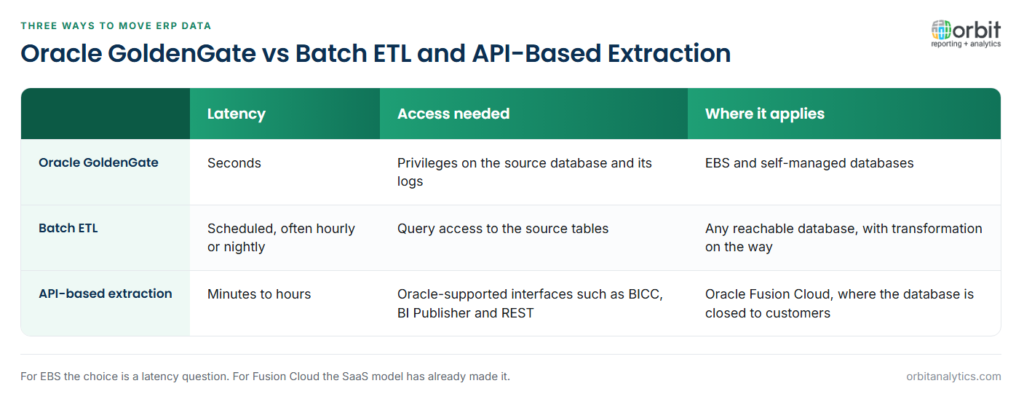
GoldenGate gives the lowest latency, measured in seconds, but requires access to the source database’s logs. Batch ETL runs on a schedule, often nightly or hourly, queries the source directly and usually transforms data on the way. API-based extraction (BICC, BI Publisher, REST) works where the database is closed to customers, as in Fusion Cloud, trading latency for access through supported interfaces.
For EBS and self-managed databases, the choice is a latency question. For Fusion Cloud, it has been made by the SaaS model.
Frequently Asked Questions
Q1. What is Oracle GoldenGate used for?
It is used to replicate database changes in real time: for migrations with minimal downtime, high availability, feeding data warehouses and lakes, and offloading reporting from production systems. It captures changes from transaction logs rather than querying tables.
Q2. Is Oracle GoldenGate an ETL tool?
Not in the usual sense. GoldenGate captures and delivers changes with light filtering and mapping, but it is not designed to model data for reporting. Most analytics architectures pair it with a separate transformation layer.
Q3. What is the difference between Extract and Replicat?
Extract runs on the source side, reads the transaction log and writes changes to trail files. Replicat runs on the target side, reads those trail files and applies the changes to the target database.
Q4. Can Oracle GoldenGate replicate data from Oracle Fusion Cloud?
Not directly from the Fusion Cloud database, because Oracle does not give SaaS customers access to it or its logs. Fusion data is extracted through BICC, BI Publisher or REST APIs, and GoldenGate can then replicate between databases the customer controls.
Q5. What is OCI GoldenGate?
OCI GoldenGate is Oracle’s fully managed GoldenGate service on Oracle Cloud Infrastructure. It provides the same capture and delivery model without the customer installing or maintaining the software.
Real-time replication and reporting-ready data are two different problems, and Oracle ERP teams usually need both. Orbit Analytics delivers curated Oracle Fusion Cloud and EBS data to reporting and cloud warehouses through Oracle-supported interfaces. Request a demo to see how it fits your data architecture.
