
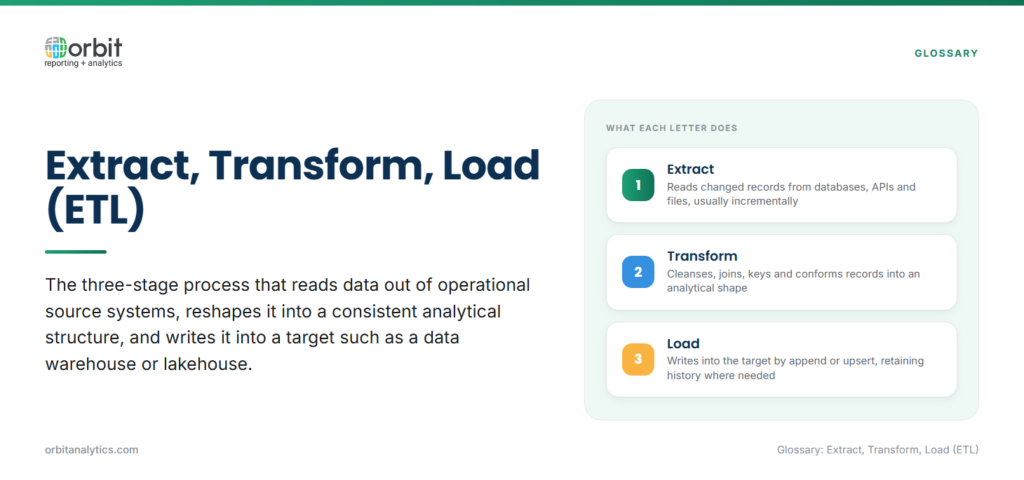
Extract, transform, load (ETL) is the three-stage process that reads data out of operational source systems, reshapes it into a consistent analytical structure, and writes it into a target such as a data warehouse or lakehouse. The three letters name the stages in the order they run.
The pattern exists because operational systems and analytical systems want opposite things. An ERP is designed to record one transaction quickly and correctly, so its tables are normalized and its keys are internal. A reporting system needs to scan millions of rows across subject areas. ETL is the layer that converts one shape into the other.
Whoever owns a pipeline, and that is usually a data engineer, it is production software: it runs unattended on a schedule, and something downstream breaks when it fails.
The Extract Stage: Reading Data Out of Source Systems
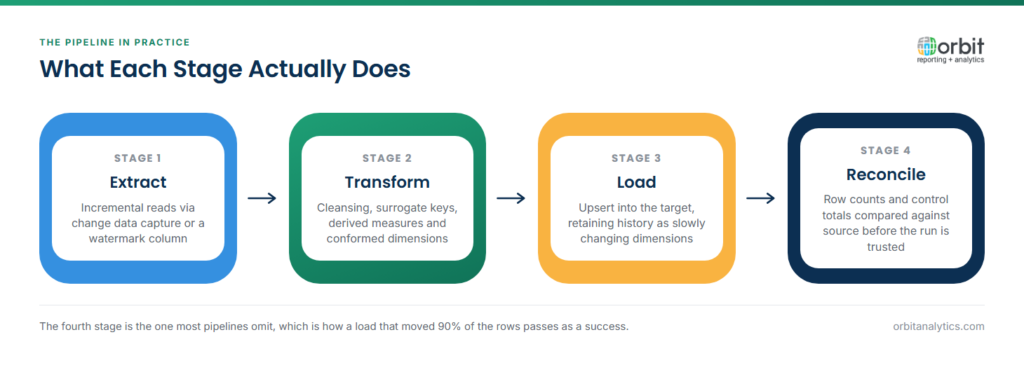
- Full versus incremental extracts. A full extract re-reads everything and is simple but expensive. An incremental extract reads only what changed, which is what any pipeline at real volume must do.
- Change data capture and watermarks. CDC reads the database’s own change log, catching updates and deletes. A watermark column, typically a last-updated timestamp, is simpler but misses hard deletes and any row updated without touching the timestamp.
- Databases, APIs, and flat files. Each imposes its own limits: a database gives you SQL, an API gives you pagination and rate limits, a file gives you whatever the producer decided to include.
- Where it breaks on an ERP. Deletes that leave no trace, timestamps maintained inconsistently across modules, and extract windows that are too short for the volume.
The Transform Stage: Turning Raw Records Into Usable Data
The transform stage is where most of the logic and nearly all of the debugging lives.
- Cleansing, deduplication, and type casting. Trimming and standardizing values, resolving duplicate records to one, and casting text into dates and numbers that will sort correctly.
- Joins, lookups, and surrogate keys. Source systems identify a customer by their own internal id. A surrogate key gives the warehouse one identifier that survives a source system being replaced.
- Business rules and derived measures. Where “net revenue” or “on-time delivery” becomes a definition applied consistently rather than recalculated per report.
- Conforming dimensions. The hardest part when several sources describe the same thing. Two systems’ product hierarchies have to be reconciled to one before either can be reported on.
The Load Stage: Writing Data Into the Target
- Full load, append, and upsert. Full load replaces the table, append adds new rows, and upsert updates matching rows and inserts the rest. Upsert is the common choice and the one that needs a reliable key.
- Slowly changing dimensions. When a customer moves region, retaining history means keeping both the old and new values with effective dates, so last year’s numbers still reconcile.
- Partitioning, indexing, and the load window. Loads are scheduled around when the warehouse is idle and when the source is quiet, and the window is a hard constraint rather than a preference.
- Where the data lands. A warehouse, a lakehouse, or a set of marts. The destination is covered in data warehousing.
ETL vs. ELT: Where the Transform Runs
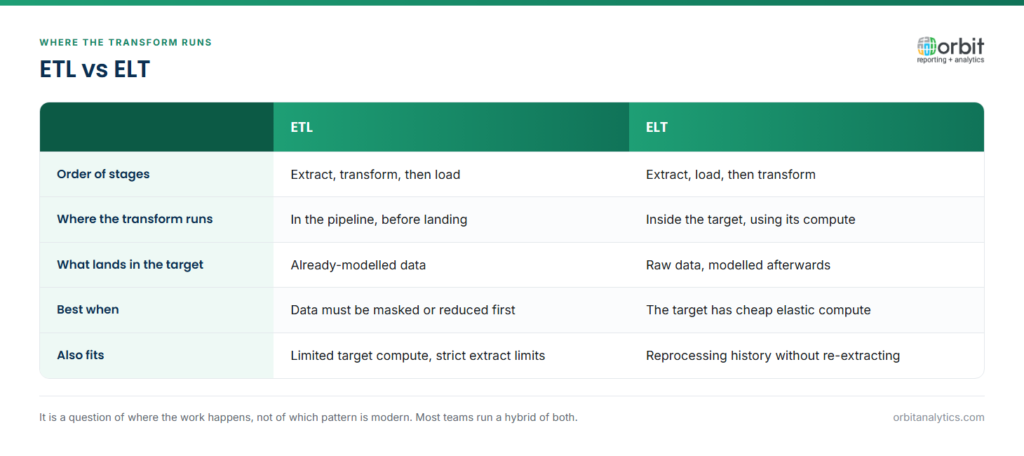
ELT reverses the last two stages: raw data is loaded first, then transformed inside the target using its own compute. That is the entire difference, and it is a question of where the work happens rather than which approach is modern.
Cloud warehouses made ELT practical by making compute cheap and elastic, so transforming a billion rows in the target stopped being prohibitive. ETL still fits in three situations: when data must be masked or filtered before it lands anywhere, when the target has limited compute, and when the source imposes extract limits severe enough that reducing volume early is the only way through.
Most teams run a hybrid without naming it that way: light transformation in flight to reduce volume and mask sensitive fields, heavier modelling in the warehouse afterwards.
Batch ETL vs. Streaming Data Integration
Batch, micro-batch, and streaming sit on one continuum, and latency requirements decide the position:
- Scheduled batch. Nightly or several times daily, in a defined window. Still the default for financial reporting, where a consistent point-in-time view matters more than freshness.
- Micro-batch. Every few minutes, giving near-real-time data without the operational weight of streaming.
- Event-driven and streaming ingestion. Records processed as they arrive, appropriate where a decision has to happen within seconds.
- How to choose. Ask what decision the latency enables. Most Oracle ERP estates run scheduled incremental loads, because the close calendar, not the second, is the unit of time that matters.
Where ETL Gets Hard on Oracle ERP Data
Generic ETL content assumes a tidy relational source. An Oracle ERP is not that.
- Normalized schemas at scale. Tens of thousands of tables, where one business concept spans several and the correct join is not inferable from names.
- Multi-org, multi-ledger, and flexfields. Operating units and ledgers determine which rows belong to which entity, and descriptive flexfields carry real business meaning in generically named columns, so ATTRIBUTE7 means something different in each implementation.
- Extract ceilings on Fusion Cloud. Row caps and throttling on Fusion extracts mean the extract has to be designed around the limit rather than discovering it in production.
- Quarterly patches. An ERP update can change a view or a column, and a pipeline that silently drifts is worse than one that fails loudly.
Orbit Analytics is Oracle-native for exactly this reason: its DataJump pipelines read the Fusion Cloud and E-Business Suite data model directly, handling multi-org structures and flexfields without hand-built extract logic, and moving that data into Snowflake, Databricks, Redshift, Microsoft Fabric, or Oracle Autonomous Data Warehouse. The Oracle data pipeline is the delivery mechanism for it.
Data Quality and Error Handling Inside a Pipeline
- Validation and reconciliation counts. Compare source row counts and control totals against what landed. A load that succeeded and moved 90% of the rows is a failure that looks like a success.
- Rejected rows and quarantine tables. Bad records are set aside with the reason, so the load completes and the exceptions are still visible.
- Idempotency and safe reruns. A pipeline must be safe to run twice. Without that, every failure becomes a manual cleanup before the retry.
- Lineage and observability. When a figure is wrong, someone has to trace it to the record that produced it, which means logging what ran, when, and with what result.
Orbit Analytics supports scheduled incremental loads with reconciliation and monitoring, so teams see a failed load when it happens rather than discovering it in a report, with 200+ pre-built connectors covering the common source systems.
ETL vs. Adjacent Data Concepts
Several terms sit close enough to be confused with it. ETL is one pattern within the broader idea of a data pipeline; an AI data pipeline is the modern superset that adds feature engineering and model-serving stages. Data integration is the wider discipline of making systems share data, and replication copies data without reshaping it, so replication is not ETL.
Data wrangling and data mining are analyst-side activities that happen after the load: wrangling is interactive preparation for a specific question, mining is searching prepared data for patterns. Neither is a pipeline stage.
Frequently Asked Questions
Q1. What does ETL stand for?
Extract, transform, load. It names the three stages in the order they run: read data from source systems, reshape it, then write it into the analytical target.
Q2. What is the difference between ETL and ELT?
Where the transform runs. ETL reshapes data in flight before loading it; ELT loads raw data first and transforms it inside the target using the target’s compute. ELT became practical with cheap cloud warehouse compute, and both patterns remain in use.
Q3. Is ETL the same thing as a data pipeline?
No. ETL is a specific three-stage pattern. A data pipeline is any automated flow of data between systems, which may use ETL, ELT, streaming, or plain replication. ETL is one kind of pipeline, not a synonym for the category.
Q4. What is the difference between full and incremental extraction?
A full extract re-reads the entire source each run: simple, and expensive at volume. An incremental extract reads only what changed since last time, using change data capture or a watermark column, which is what production pipelines rely on.
Q5. Why is extracting data from an ERP harder than from a flat file?
Because the data model is built for transactions, not analysis. Tens of thousands of normalized tables, multi-org and multi-ledger structures, flexfields carrying meaning in generic columns, and extract row limits all mean the extract has to be designed around the source rather than simply pointed at it.
ETL on Oracle ERP data is mostly a problem of understanding the source, not of moving bytes. Request a demo to see how Orbit Analytics extracts Oracle Fusion Cloud and E-Business Suite data into the platform of your choice with reconciliation built in.
