
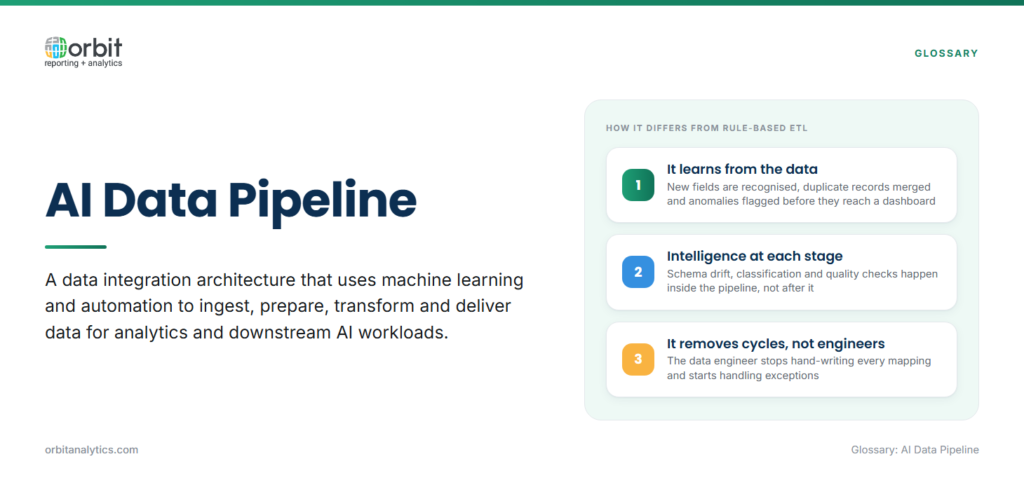
An AI data pipeline is a data integration architecture that uses machine learning and automation to ingest, prepare, transform, and deliver data for analytics and downstream AI workloads. It handles the same job a traditional ETL pipeline does, but applies intelligence at each stage, auto-detecting schema changes, classifying data, identifying quality issues, and routing data to the right serving layer.
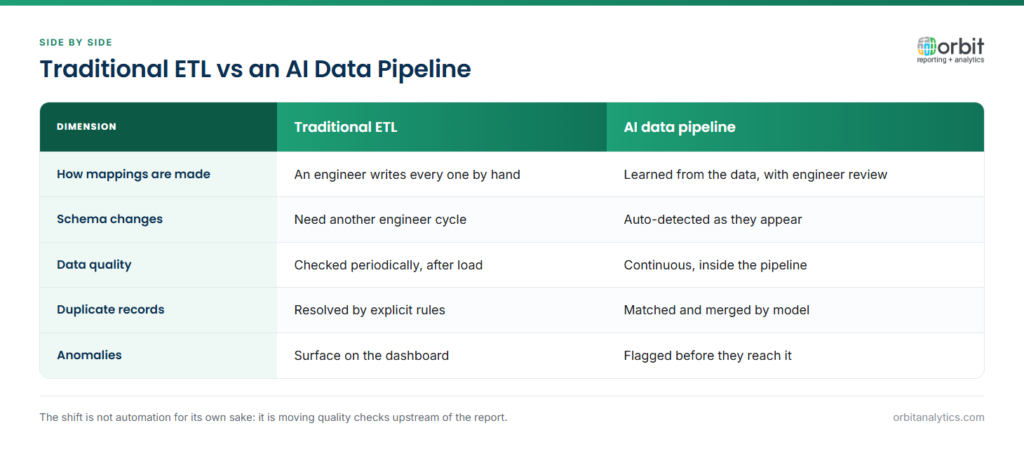
Traditional ETL is rule-based: an engineer writes every mapping, and each change needs another engineer cycle. An AI data pipeline learns from the data, new fields are recognized, duplicate customer records merged, and anomalies flagged before they hit a dashboard. The role of AI here is practical: not replacing the data engineer, but removing the repetitive work that pulls them off higher-value problems.
Why Are AI Data Pipelines Important?
Four shifts make AI-driven pipelines necessary rather than optional:
- Unstructured and semi-structured data is the norm. JSON payloads, log files, contract PDFs, and free-text feedback are formats rule-based ETL handles poorly.
- Real-time and streaming analytics are baseline expectations. Overnight batch is not enough when a CFO wants live cash visibility.
- Data quality has to be continuous, not periodic. AI monitors for drift and anomalies as data flows, rather than at month-end reconciliation.
- Machine learning workloads need a different pipeline shape. Training data, feature engineering, and model retraining were never on the original ETL design brief.
What Are the Key Components of an AI Data Pipeline?
A production AI data pipeline has five layers:
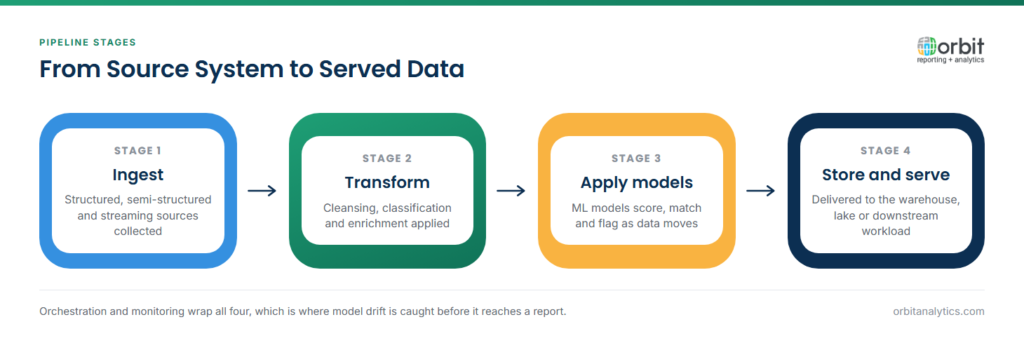
- Data ingestion and collection. Connectors to source systems (ERP, CRM, applications, files, APIs, streams) that handle both batch loads and change data capture. The ingestion layer should be configuration-driven, not code-driven.
- Data transformation and enrichment. Cleansing, normalization, deduplication, and enrichment with external data. AI suggests transformations and flags records that do not match expected patterns.
- AI and ML model integration. Embedded models for classification, anomaly detection, entity resolution, and forecasting that run inline as data moves through.
- Data storage and serving layer. Curated tables published to a warehouse, lakehouse, or operational store, partitioned for analytics performance.
- Orchestration and monitoring. Scheduling, dependency management, retry logic, observability, and lineage tracking.
For Oracle ERP customers, the platform layer that handles this end-to-end is Orbit Analytics, AI-powered data pipeline solutions with pre-built connectors for Oracle Fusion Cloud, EBS, NetSuite, and PeopleSoft, plus ML-driven schema mapping and automated quality monitoring.
What Are Common AI Data Pipeline Architectures?
Four architectural patterns cover most production workloads:
- Batch processing pipelines: scheduled extractions on hourly, daily, or weekly cadence. Still the right choice for slow-changing dimensions and historical reporting.
- Real-time streaming pipelines: continuous data flow with sub-second latency for use cases like fraud detection, cash positioning, and inventory tracking.
- Lambda and Kappa architectures: hybrid patterns that combine batch and streaming layers. Lambda runs both in parallel; Kappa treats batch as a special case of streaming.
- Hybrid cloud architectures: pipelines that span on-prem systems (often Oracle EBS) and cloud destinations (Snowflake, Databricks, BigQuery, Redshift). The pipeline handles the network, security, and consistency challenges between the two.
The right choice depends on latency requirements and source-system characteristics. Most enterprises end up running a mix.
What Are the Benefits of AI Data Pipelines?
Industry studies and customer benchmarks consistently show data teams spending 60 to 80 percent of their time on preparation when using rule-based ETL. An AI data pipeline collapses much of that work and delivers in four directions:
- Less manual prep time: Pattern recognition for schema mapping, ML-based deduplication, and anomaly detection give the team back hours for analysis.
- Intelligent data quality: The pipeline catches schema drift, outliers, and reference data mismatches as they happen, not at the next month-end reconciliation.
- Self-optimizing scale: Workflows tune themselves as volume grows, instead of breaking at the next 10x increase.
- Shorter time-to-insight: A new metric that used to take two weeks to wire up takes a day.
What Challenges Do AI Data Pipelines Face?
Three challenges show up in nearly every program:
- Data quality and governance. A pipeline without master data governance, lineage tracking, and audit trails will automate bad decisions faster than the manual version did.
- Integration complexity. Enterprise data lives in dozens of systems with different APIs and schemas.
- Model drift. The ML components degrade as data patterns change, so they need retraining and monitoring.
The fix is to start with a governed core and expand: pick one or two source systems, instrument them end-to-end, then add more once the pattern is proven.
What Are AI Data Pipeline Best Practices?
Four practices keep production pipelines healthy as they grow:
- Design for scalability from day one. Pipelines that work on 10 GB collapse at 10 TB, and the rewrite usually costs more than building it right the first time.
- Implement governance up front. Lineage, access control, classification, and PII handling are easier to bake in than to retrofit. A clean data management layer underneath the pipeline keeps master data consistent and the AI components honest.
- Build in observability. Every stage should emit metrics on throughput, latency, error rate, and data quality. Without these, debugging a failed run is guesswork.
- Automate testing and validation. Schema tests, row-count checks, referential integrity tests, and business-rule validations should run on every change, not just when something breaks.
How Do You Build an AI Data Pipeline?
A disciplined four-step approach avoids the orphan-infrastructure trap:
- Define the business objectives and the data sources that serve them. Pipelines built without a clear analytical outcome become orphan infrastructure within a year.
- Select the right tools. For Oracle ERP customers, the pragmatic path is a platform that ships with Oracle connectors, pre-built data models, and a self-service reporting layer on top, so pipeline outputs reach the business without a separate BI project.
- Design the architecture. Pick the batch, streaming, or hybrid pattern that fits the latency requirements and source constraints. Document the layers and the contracts between them.
- Implement one source and one use case first. Prove the quality and governance, then add the next.
Orbit Analytics combines pre-built Oracle connectors with AI-driven schema mapping and a governed serving layer that pushes curated data into Snowflake, Databricks, Redshift, or Azure, so the pipeline output is portable rather than locked to a single visualization tool.
Frequently Asked Questions
Q1. What is an AI data pipeline in simple terms?
An AI data pipeline is a data integration architecture that uses machine learning and automation to ingest, prepare, and deliver data for analytics. It does the same job as traditional ETL but applies intelligence at each stage, schema detection, data quality, deduplication, so engineers spend less time on repetitive preparation work.
Q2. How does an AI data pipeline differ from traditional ETL?
Traditional ETL is rule-based; every transformation, mapping, and quality check is hand-coded by an engineer. An AI data pipeline learns from the data, recognizing new fields, merging duplicate records, and flagging anomalies automatically. The engineer’s role shifts from writing every rule to supervising a system that proposes them.
Q3. Can AI data pipelines handle real-time data?
Yes. Modern AI data pipelines support batch, near-real-time, and streaming workloads in the same architecture. Change data capture from source systems combined with streaming transformation lets data flow with sub-second latency where the use case (cash positioning, fraud detection, inventory) requires it.
Q4. Can AI data pipelines connect to Oracle ERP systems?
Yes. Pre-built connectors for Oracle Fusion Cloud, EBS, NetSuite, and PeopleSoft handle extraction, schema mapping, and incremental refresh against the standard ERP modules. The connector takes care of the API and security work so the pipeline can focus on transformation.
Q5. How does AI improve data quality in pipelines?
AI components run inline, detecting schema drift, classifying records, identifying outliers, and resolving entity matches. Issues surface as they happen rather than at month-end reconciliation.
Q6. What is the difference between batch and streaming pipelines?
Batch pipelines process data in scheduled chunks, typically hourly or daily. Streaming pipelines process records as they arrive, with sub-second latency. Most enterprises run a mix.
Ready to give your data team back the hours they spend on manual prep? Request a demo to see how Orbit Analytics combines Oracle ERP expertise with AI-driven automation.
