
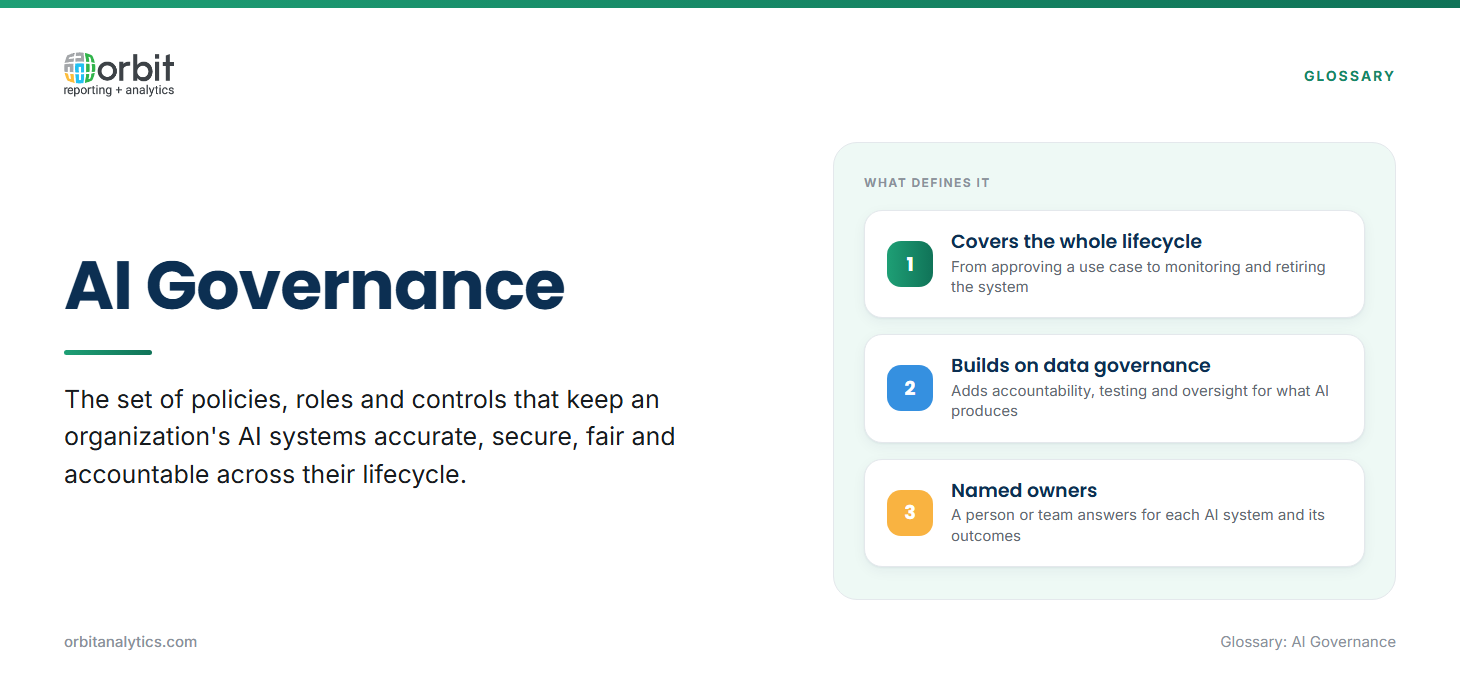
AI governance is the set of policies, roles and controls that keep an organization’s AI systems accurate, secure, fair and accountable across their whole lifecycle. It decides which AI may be used, on what data, for which decisions, and who answers for the result.
Governance runs across the AI lifecycle: approving a use case, choosing or building the model, connecting it to data, testing it, putting it into use, monitoring it and eventually retiring it. A control that only applies at launch misses most of the risk, because data, models and usage all change afterwards.
Ownership is usually shared. A cross-functional group, often drawing on risk, legal, IT, data and the business, sets policy, while the team that uses an AI system is accountable for how it is used day to day.
Why AI Governance Matters for Enterprise Data
For most enterprises, the first AI they need to govern is not a model they built. It is an AI tool that answers questions from their data:
- AI answers become business decisions: a figure from an AI assistant can end up in a forecast, a board pack or a supplier negotiation within minutes.
- Errors look confident: AI hallucination produces wrong answers in the same fluent tone as right ones, so the reader cannot tell them apart without a check.
- Regulators and auditors are asking: new AI rules and existing audit standards both expect organizations to show how an AI-assisted number was produced.
Core Principles of AI Governance
Most frameworks and corporate policies share five principles:
- Transparency: people know when AI is involved and can see what an answer was based on.
- Accountability: a named person or team owns each AI system and its outcomes.
- Fairness: outputs are checked for bias against people or groups, especially in hiring, lending and pricing.
- Privacy and security: AI sees only the data its users are allowed to see, and personal data is protected.
- Human oversight: people can review, override or stop AI decisions that matter.
AI Governance Frameworks
Three frameworks come up most often. Each is a primary text worth reading in full, and none of the summaries below is legal advice:
| Framework | Type | What it covers |
|---|---|---|
| The EU AI Act | Law in the European Union, in force since August 2024 with obligations phased in over several years | Sorts AI uses into risk categories, bans some uses and sets duties for high-risk systems |
| The NIST AI Risk Management Framework | Voluntary US guidance, published in January 2023 | Four functions for managing AI risk: govern, map, measure and manage |
| ISO/IEC 42001 | International standard, published in December 2023 | Requirements for an AI management system that an organization can be certified against |
AI Governance vs Data Governance
Data governance already covers who owns data, what it means, how good it is and who may access it. AI governance builds on that foundation and adds three things: accountability for AI outputs, testing of those outputs, and human oversight of decisions an AI informs.
The two meet at the data itself. An AI answer can only be as accurate and as secure as the data and access rules beneath it, which is why weak data governance shows up first as untrustworthy AI.
Governing AI Answers on ERP Data
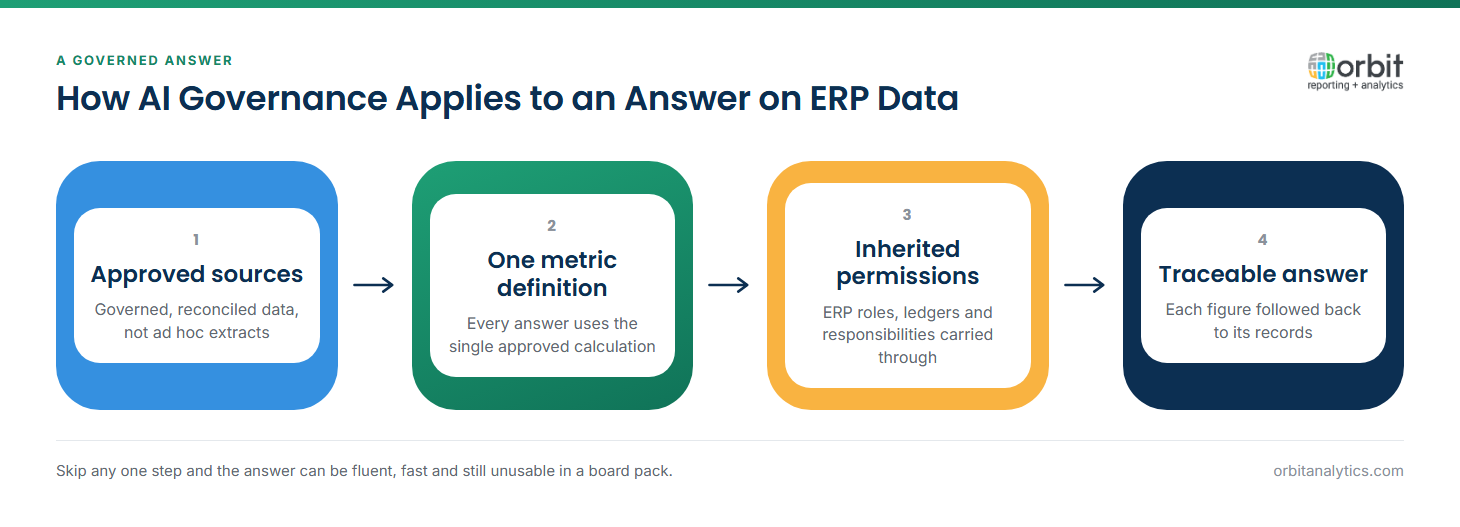
When AI answers questions from ERP data, four controls do most of the work:
- Approved sources only: the AI answers from governed, reconciled data, not from ad hoc extracts or spreadsheets.
- One definition per metric: “revenue”, “headcount” and “days sales outstanding” each have a single approved calculation that every answer uses.
- Inherited permissions: ERP roles, ledger access and responsibilities carry through to the AI, so it never shows a user more than the ERP would.
- Traceable answers: every figure can be followed back to the records behind it.
Teams that use AI to access Oracle EBS data have a ready-made permission model in EBS responsibilities, and governance means the AI answer respects it rather than bypassing it. Orbit Analytics designs its EBS ThinkBoxes to answer from governed data models, with existing EBS responsibilities, data access and governance kept as part of the architecture.
Practical AI Governance Controls
Policy becomes real through a short list of controls:
- An inventory of AI use cases: list every AI system in use, including tools bought from vendors, with its owner, data sources and purpose.
- Logging and audit trails: record questions, answers and actions, so that an audit trail exists for any AI-assisted figure.
- Testing answers against known results: check AI answers against figures the finance team has already reconciled, before and after each change.
- Human review for high-impact outputs: require a person to approve anything that goes to a regulator, a board or an external party.
Orbit Analytics supports the traceability side of this with ThinkBoxes, which let users move from an answer to the underlying numbers and work from shared metric definitions rather than each user’s own KPI versions.
Common AI Governance Challenges
Three problems recur:
- Shadow AI: staff paste data into AI tools nobody approved, which no policy covers until it is found.
- Rules that slow useful work: approval processes designed for high-risk models get applied to low-risk tools, so people route around them.
- Keeping up with model changes: vendors update models without notice, so an answer that tested well last quarter may behave differently now.
The common answer to all three is proportion. Light rules for low-risk tools, with stricter review reserved for AI that informs financial, legal or people decisions, keep governance usable without leaving the important cases uncovered.
AI Governance vs Responsible AI vs Model Risk Management
The three terms overlap but are not the same:
- Responsible AI, the principles: the values an organization commits to, such as fairness, transparency and safety.
- AI governance, the operating model: the policies, roles and controls that put those principles into practice.
- Model risk management, the banking discipline: a long-established practice in financial services, shaped in the US by supervisory guidance SR 11-7, for validating and monitoring models used in decisions.
In practice, responsible AI says what an organization believes, AI governance says how it acts on that belief, and model risk management is one mature, regulated example of the operating model applied to a single industry.
Frequently Asked Questions
Q1. What is AI governance in simple terms?
It is the set of rules, roles and checks that make sure an organization’s AI is accurate, secure, fair and accountable. It covers which AI can be used, on what data and who is responsible.
Q2. What is the difference between AI governance and data governance?
Data governance manages the data itself: ownership, quality, meaning and access. AI governance builds on it and adds accountability, testing and human oversight for what AI produces.
Q3. What are the main AI governance frameworks?
The most cited are the EU AI Act, the NIST AI Risk Management Framework and ISO/IEC 42001. Each is worth reading in its original text.
Q4. How do you govern AI answers on financial data?
Restrict the AI to approved sources, use one definition per metric, carry ERP permissions through to every answer and make each figure traceable to its source records.
Q5. Does AI governance apply to AI tools bought from vendors?
Yes. A purchased tool that answers questions from your data needs the same controls on sources, permissions, testing and oversight as one built in-house.
Q6. Who is responsible for AI governance in an organization?
Policy is usually set by a cross-functional group drawing on risk, legal, IT and data teams. Each business team that uses an AI system remains accountable for how it is used and for the decisions it informs.
Governed AI starts with governed data and inherited permissions. Orbit Analytics answers plain-language questions on Oracle Fusion and EBS data from governed data models, with traceable figures. Request a demo to see it on your own data.
