
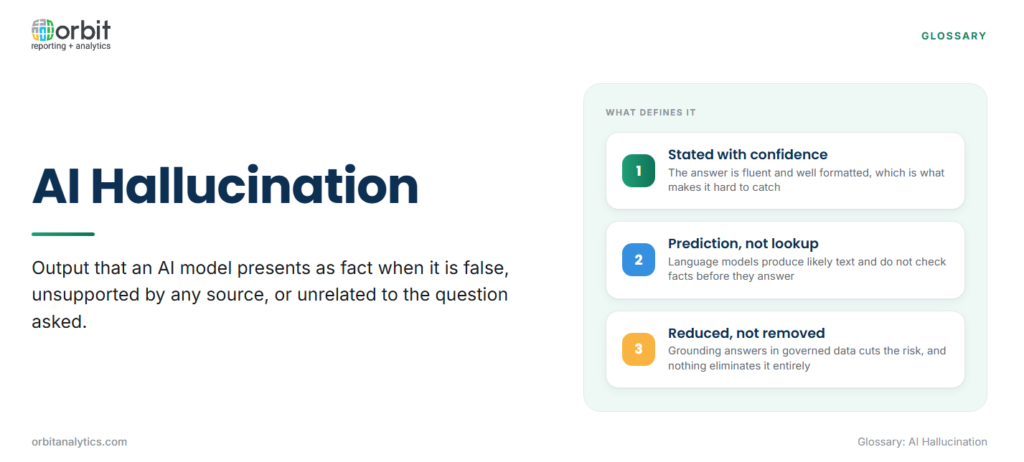
An AI hallucination is output that an artificial intelligence model presents as fact when it is false, unsupported by any source, or unrelated to the question asked. The answer is usually fluent, well formatted and stated with complete confidence, which is exactly what makes it hard to catch.
The term is most often applied to large language models (LLMs), the systems behind chat assistants and the AI features in business software. A model might quote a figure that appears in no report or cite a paper nobody wrote. The word “hallucination” stuck because the model is not lying deliberately: it produces something that fits a pattern, whether or not it is real.
Why Language Models Hallucinate
Hallucination follows directly from how language models produce text.
- Prediction, not lookup: a language model generates each word by predicting what is most likely to come next, based on patterns learned in training. It has no database of facts to consult, so a plausible sentence and a true one come from the same process.
- Gaps in training data: when a question touches something rare, recent or private, such as last quarter’s revenue for one business unit, the model has little to draw on. It still answers, filling in from patterns that look similar.
- Prompts that invite a guess: questions that assume a false premise (“why did margins fall in March?” when they rose), ask for a precise number, or leave no room to say “I don’t know” push the model towards inventing one.
The model’s confidence is not a guide to accuracy: fluency is what it was trained to produce, and truth is a property it cannot check.
Common Types of AI Hallucination
Hallucinations take a few recognizable forms:
| Type | What it looks like | Example in a business setting |
|---|---|---|
| Fabricated facts and figures | A specific number, date or name with no source | Stating a days sales outstanding figure that was never calculated |
| Invented sources and citations | References, policies or documents that do not exist | Quoting an internal policy or a standard paragraph that was never written |
| Wrong calculations presented confidently | Arithmetic or aggregation errors stated as results | Regional totals that do not add up to the stated group total |
| Answers to a question that was not asked | A correct-sounding response to a subtly different question | Reporting booked orders when the user asked about shipped revenue |
The last type is the easiest to miss, because every figure may be accurate for the question the model chose to answer.
Why Hallucination Matters in Business Analytics
A hallucinated sentence in an essay often reads oddly. A hallucinated number in a report does not: it has the same format and label as a real one, so the usual cues for spotting an error are missing.
- A wrong number looks like a right one: “Operating margin: 14.2%” carries no marker of whether it came from the ledger or from the model’s guess.
- Decisions made on plausible output: a figure that falls inside the expected range is rarely questioned, so a hallucinated result can drive a pricing, staffing or inventory decision before anyone checks it.
- Compliance and audit exposure: figures in board packs, filings or audit evidence must be traceable to source records, and an answer with no source cannot be defended.
A drafting assistant that invents a phrase costs an edit; a reporting assistant that invents a figure can cost a decision.
How Hallucinations Are Detected
Detection works best when it is built into the workflow rather than left to instinct.
- Check against the source data. Compare the figure with the system of record. Routine data validation rules, such as totals that must reconcile or values that must fall within a range, catch many fabricated or miscalculated figures automatically.
- Ask the model to show its working. Require the query, filters and source tables behind each answer. A figure that cannot be traced to a query is a figure to distrust.
- Apply human review to high-stakes output. Anything going into a financial close or an external report should be reviewed by someone who knows what the number ought to look like.
How to Reduce AI Hallucination
No technique removes hallucination entirely, but several reduce it sharply by limiting how much the model has to invent.
- Grounding answers in governed data: the model answers only from approved, current business data rather than from what it absorbed in training. A semantic layer supports this by giving every metric one governed definition, so “revenue” means the same thing to the model as it does to finance.
- Retrieval-augmented generation (RAG): the system retrieves relevant documents or records and passes them to the model, so the answer is built from evidence rather than memory.
- Generating queries instead of answers: the model translates a question into a database query, and the database returns the figure. The model can still misread the question, but it cannot invent the number. Orbit Analytics follows this pattern: plain-language questions are answered from governed Oracle data models, so the figure comes from the data rather than from text the model composes, which is the same principle behind conversational analytics built for business data.
- Constraining what the model can say: limiting answers to defined metrics, permitted tables and fixed output formats, and letting the model reply “no data available” rather than forcing a guess.
AI Hallucination in Oracle ERP Reporting
Oracle Fusion Cloud and Oracle EBS data is a hard test for a general-purpose AI assistant. Tables use cryptic names, flexfields carry meaning in configuration rather than in column names, and words like “period” or “balance” mean different things in different modules.
An ungrounded assistant goes wrong in predictable ways: it guesses which table holds a figure, invents a join between modules, ignores ledger or currency, or answers from how ERP systems usually work rather than how this one is configured. The result can be a revenue figure that is correctly formatted, close to expectations and wrong.
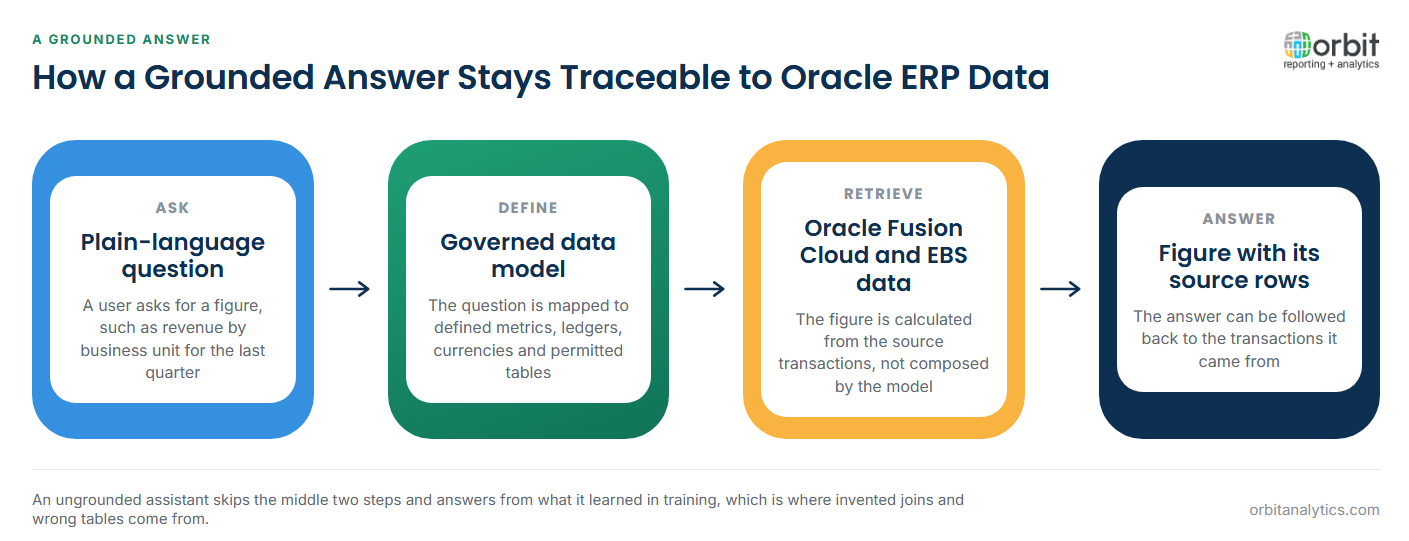
Orbit Analytics approaches this through augmented analytics that answers from governed Oracle Fusion Cloud and EBS data, so each figure traces back to the source rows it was calculated from. When a number can be followed to the transactions behind it, a hallucination is far easier to catch.
AI Hallucination vs Model Bias vs Data Errors
Three different problems produce wrong AI output, and each has a different fix.
| Problem | What happens | Where the fix lies |
|---|---|---|
| Hallucination | The model invents content with no basis in its sources | Grounding, retrieval and query generation |
| Model bias | Output is systematically skewed by unbalanced training data or design | Better training data, evaluation and oversight |
| Data error | The model faithfully repeats a value that is wrong in the source | Data quality and validation at the source |
Telling them apart matters. A data error repeated by an AI assistant is not a hallucination, and treating it as a model fault leaves the bad record in place for the next report.
Frequently Asked Questions
Q1. What is an AI hallucination in simple terms?
It is when an AI model states something as fact that is false or has no source. The answer usually sounds confident and well written, which is why it can be hard to spot.
Q2. Why do large language models hallucinate?
They generate text by predicting likely words from patterns in their training data, not by looking facts up. When the right information is missing or the question invites a guess, the most plausible-sounding answer wins, whether or not it is true.
Q3. Can AI hallucinations be eliminated completely?
Not with current language models. Grounding, retrieval and query generation reduce the risk considerably, and human review catches much of what remains, but any system that generates text can still produce something unsupported.
Q4. What is grounding in AI?
Grounding means constraining a model to answer from specific, trusted sources, such as governed business data or approved documents, rather than from its general training. A grounded answer can be checked against the source it was built from.
Q5. How can analysts check whether an AI answer is correct?
Ask for the query and source tables behind the figure, then reconcile it with a trusted report or the system of record. A figure that cannot be traced to its data should not be used in a decision.
An AI answer is only as trustworthy as the data it can be traced to. Orbit Analytics grounds AI-assisted reporting in governed Oracle Fusion Cloud and EBS data, so every figure leads back to its source. Request a demo to see it on your own data.
