
A trial balance is a listing of every account in the general ledger with its closing balance, arranged in two columns so that total debits can be compared against total credits. Under double-entry bookkeeping the two totals must agree. When they do, the ledger is arithmetically sound. When they do not, something has been posted once instead of twice, or posted with the wrong figure on one side.
The trial balance is a working document rather than a published statement. Nobody files it, and it is not one of the primary financial statements. Its job is narrower and more useful than that: it is the checkpoint an accountant runs before trusting the ledger enough to build anything on top of it.
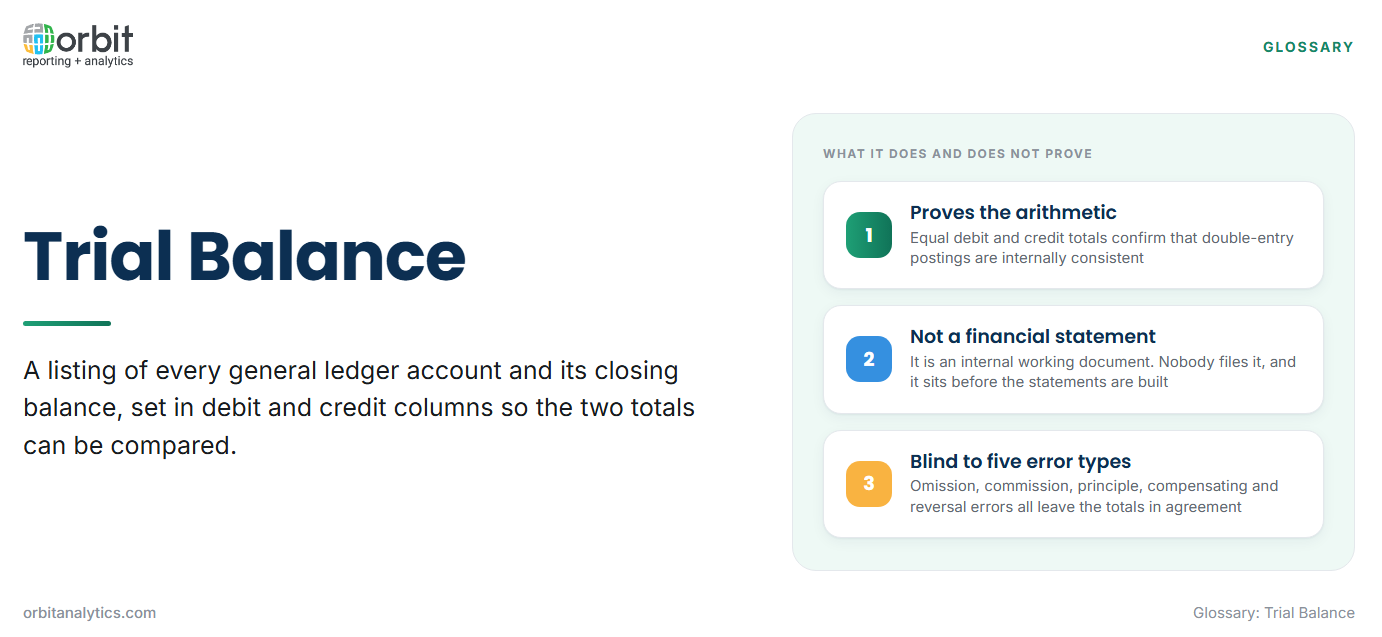
Image title: What Is a Trial Balance? Definition and What It Proves
Alt text: Definition card explaining a trial balance as a listing of every general ledger account and its closing balance in debit and credit columns, with three points: it proves the arithmetic of double entry, it is an internal working document rather than a financial statement, and it is blind to five classes of error that leave the totals in agreement.
Asset: https://drive.google.com/file/d/1YyQxoenRAgyGBY8h54r7QWJCzGeexnIH/view
What a trial balance contains
Every line represents one general ledger account, and the report as a whole represents one ledger at one moment in time.
- Account code and account name: the natural account from the chart of accounts, usually with the full accounting flexfield available behind it.
- Debit and credit columns: each account’s balance appears in exactly one column. Asset and expense accounts normally carry debit balances; liability, equity and revenue accounts normally carry credit balances.
- Period, ledger and currency context: a trial balance is meaningless without knowing which ledger, which period and which currency it was run for.
- Column totals: the two figures the whole report exists to compare.
A small worked example makes the shape obvious. Cash 40,000 debit, Accounts Receivable 25,000 debit, Accounts Payable 18,000 credit, Share Capital 30,000 credit, Revenue 42,000 credit, Operating Expenses 25,000 debit. Debits total 90,000 and credits total 90,000, so the ledger balances.
The three types of trial balance
The same report appears three times in a close cycle, and the differences are about timing rather than format.
- Unadjusted trial balance. Run after all routine journal entries have been posted but before any period-end adjustments. This is the starting point for the close.
- Adjusted trial balance. Run after accruals, prepayments, depreciation, provisions and any correcting entries have been posted. The financial statements are built from this version.
- Post-closing trial balance. Run after revenue and expense accounts have been closed to retained earnings. Only permanent balance sheet accounts remain, which makes it the opening position for the next period.
How a trial balance is prepared
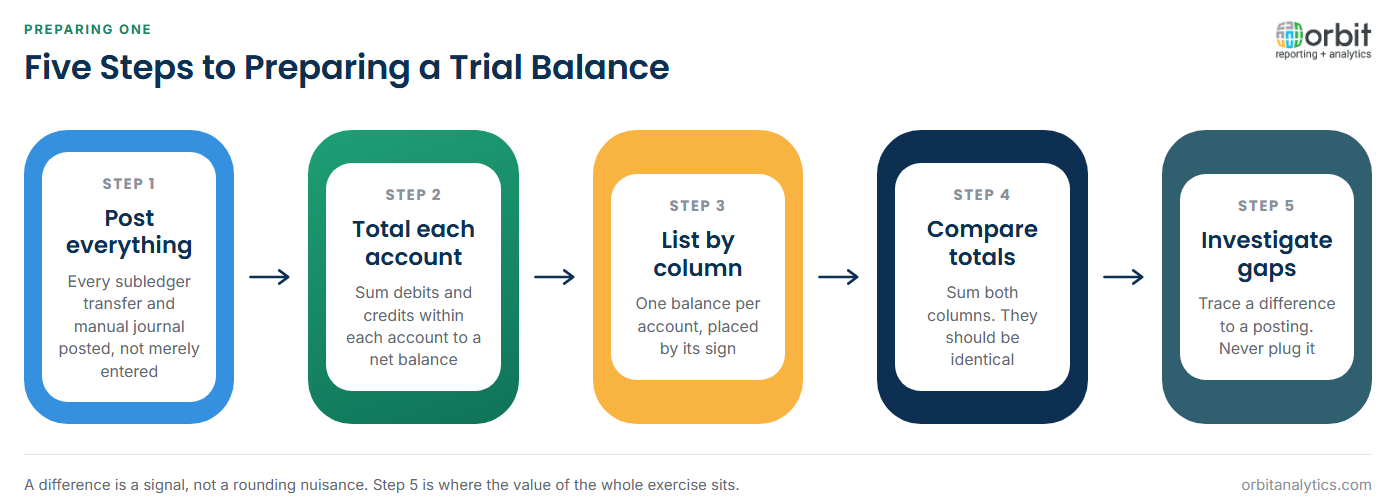
- Post all journal entries. Every subledger transfer and manual journal for the period must be posted, not merely entered.
- Total each ledger account. Sum the debits and credits within each account to arrive at a net balance.
- List the balances in the correct column. One balance per account, placed in the debit or credit column according to its sign.
- Sum both columns and compare. The two totals should be identical.
- Investigate any difference. A difference is a signal, not a rounding nuisance, and it should be traced to a specific posting rather than plugged.
Errors a trial balance will not catch
This is the most important limitation to understand, because a balanced report is routinely mistaken for a correct one. A trial balance only proves that debits equal credits. It says nothing about whether the entries were right.
- Errors of omission: a transaction never entered at all. Both sides are missing, so the totals still agree.
- Errors of commission: the correct amount posted to the wrong account of the same type, such as the wrong customer within receivables.
- Errors of principle: a transaction posted to a fundamentally wrong category, such as capital expenditure recorded as a repair.
- Compensating errors: two independent mistakes that happen to cancel each other out.
- Errors of original entry and reversal: the wrong figure posted to both sides, or the correct figure posted with debit and credit swapped.
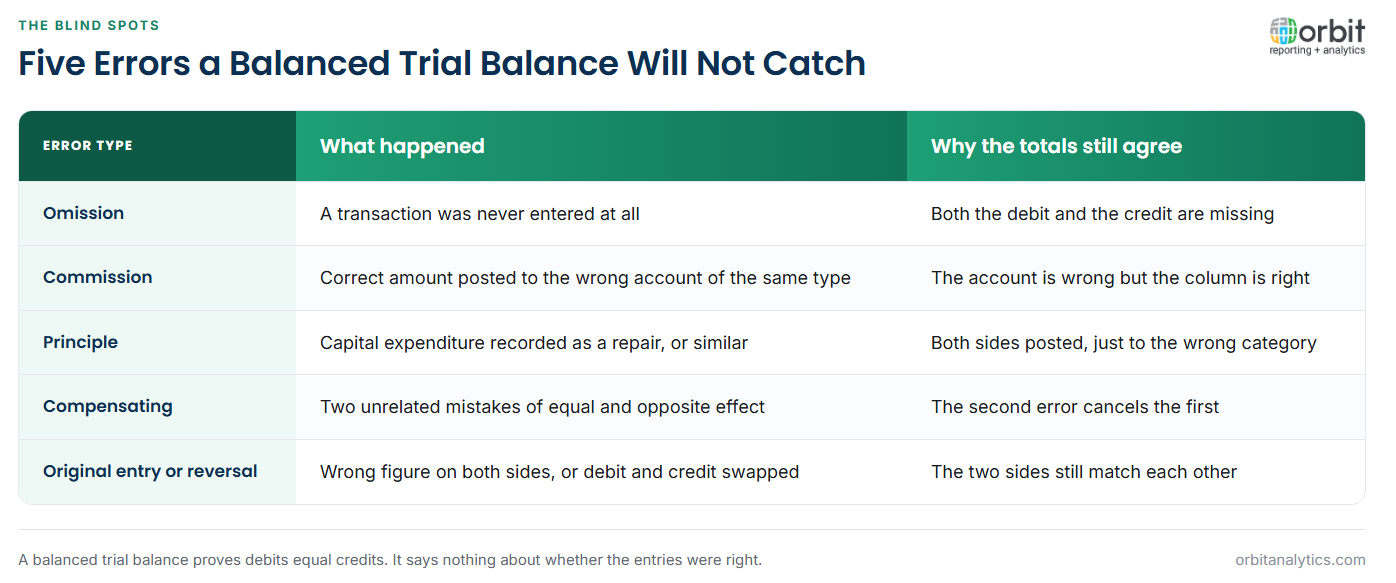
Image title: Five Errors a Balanced Trial Balance Will Not Catch
Alt text: Table of five errors a balanced trial balance cannot detect: errors of omission where a transaction was never entered, errors of commission where the right amount went to the wrong account of the same type, errors of principle where an item was posted to the wrong category, compensating errors that cancel each other out, and errors of original entry or reversal where both sides carry the wrong figure or the debit and credit are swapped.
Asset: https://drive.google.com/file/d/1dZSKyYy-GVVi28PsKOqzCjNxYb6Z7qGw/view
Common reasons a trial balance does not balance
When the columns disagree, the cause is usually one of a small set of familiar problems. One-sided postings from an interface or a manual journal are the most frequent. Transposition differences, where 5,400 is entered as 4,500, produce a gap divisible by nine, which is a quick diagnostic worth knowing.
Timing gaps between subledgers and the general ledger account for many apparent differences at period end: invoices sitting in payables that have not yet transferred to the ledger will make the two sources disagree without either being wrong. Multi-currency translation differences are the fourth common cause, particularly where a rate has been revised after posting. Orbit Analytics supports automated reporting that refreshes on a schedule, which helps here because the same subledger to ledger reconciliation is produced every day rather than only at close.
The trial balance in Oracle ERP systems
In Oracle E-Business Suite and Oracle Fusion Cloud the trial balance is a standard general ledger report, available by ledger, by period and by currency. Organizations running several ledgers, or running EBS and Fusion Cloud side by side, need the same report across all of them on a consistent basis, which is where the standard reports start to strain.
The practical requirement is drill-down. A balance on a trial balance line is only useful if the reviewer can move from that figure to the journals behind it, and from those journals to the source transactions. Orbit Analytics provides general ledger reporting that reads live Oracle balances and preserves that path from a summarized figure back to the underlying detail, across multiple ledgers in one view.
Trial balance vs. balance sheet vs. general ledger
These three are frequently confused, and the distinction is about scope and audience.
| What it is | Level of detail | Who reads it | |
| General ledger | The complete record of every posted transaction | Transaction level | Accountants, auditors |
| Trial balance | A listing of closing balances by account | Account level | Accountants, close team |
| Balance sheet | A formal statement of position at a date | Grouped and classified | Management, external users |
The general ledger holds everything. The trial balance summarizes it to one line per account. The balance sheet takes those balances, groups them into presentation categories and reports only assets, liabilities and equity, leaving revenue and expenses to the income statement. Producing that final layer is the subject of financial reporting more broadly.
Frequently Asked Questions
Q1. What is a trial balance in accounting?
It is a listing of every general ledger account with its closing balance, split into debit and credit columns. The two column totals should be equal, which confirms that double-entry postings are arithmetically consistent.
Q2. Does a balanced trial balance mean the books are correct?
No. It only proves that debits equal credits. Omitted transactions, postings to the wrong account, misclassified items and compensating errors all leave the totals in agreement while the accounts remain wrong.
Q3. What are the three types of trial balance?
Unadjusted, run before period-end adjustments. Adjusted, run after them and used to build the statements. Post-closing, run after revenue and expense accounts have been closed, leaving only balance sheet accounts.
Q4. What is the difference between a trial balance and a balance sheet?
The trial balance is an internal working list of all accounts at account level. The balance sheet is a formal statement showing only assets, liabilities and equity, grouped into presentation categories for external readers.
Q5. What does it mean when a trial balance does not balance?
It means at least one posting is incomplete or incorrect. Common causes are one-sided journal entries, transposed figures, subledger transfers not yet posted, and currency translation differences.
Q6. How often should a trial balance be run?
At minimum once per accounting period as part of the close. Many finance teams run it weekly or daily during the close window so that differences are found while they are still small and traceable.
Reviewing a trial balance is only as fast as the ability to move from a balance to the transactions behind it. Orbit Analytics delivers that drill-down across Oracle EBS and Fusion Cloud ledgers without exporting to spreadsheets first. Request a demo to see it against your own general ledger.
