
Financial reporting is the process of turning recorded transactions into statements and reports that show an organization’s financial position and performance, for readers inside and outside the business. It covers both the statutory filings external audiences receive and the management packs internal teams use to run the month.
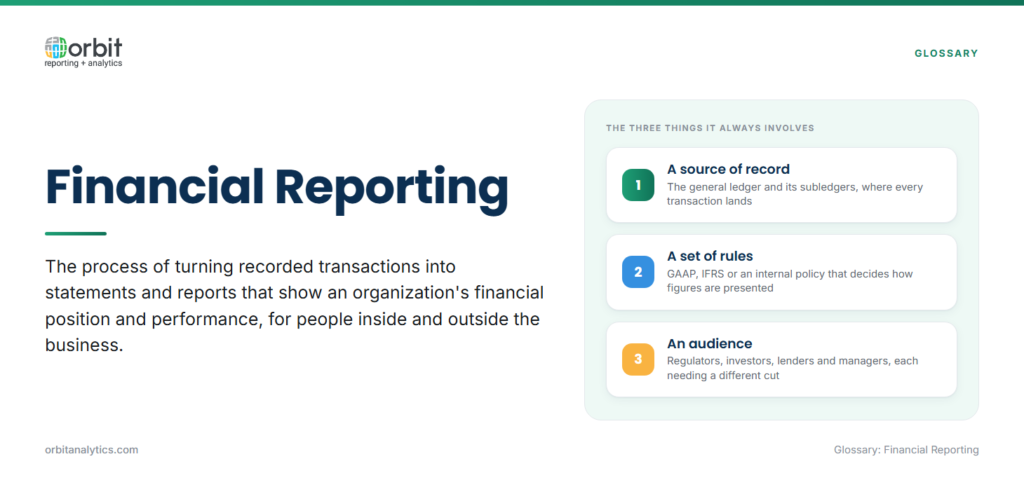
Three elements are always involved: a source of record (the general ledger and its subledgers), a set of rules (GAAP, IFRS, or internal policy) deciding how figures are presented, and an audience needing a particular cut of the same numbers. Change any one and the report changes, though the transactions do not.
That is where accounting ends and reporting begins. Accounting records what happened; reporting decides how it is presented, to whom, and on what schedule. Accountability usually splits three ways: the controller owns accuracy, the CFO signs off, an FP&A team produces the output.
The Main Types of Financial Reporting
The cleanest way to organize the category is by who sets the rules. Statutory reporting is prescribed by accounting standards and filing requirements, so the format and calendar are both fixed. Management reporting answers internal questions, so it changes when the questions do.
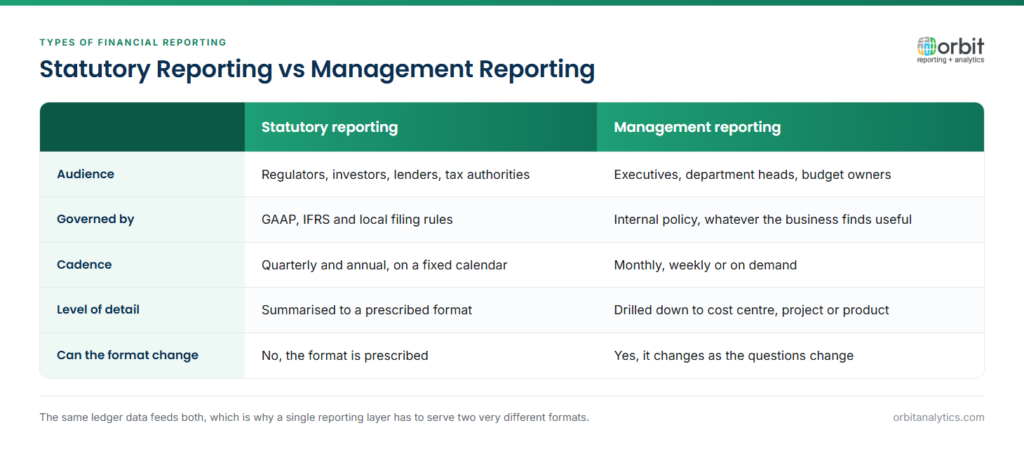
Read across any row and the same ledger balance appears twice in different clothing: a prescribed line item for the regulator, a cost centre breakdown for the manager who owns the spend.
Two further types sit alongside those:
- Regulatory and tax reporting: Filings in formats set by a tax authority or regulator, drawn from the same ledger but reconciled on different rules.
- Ad hoc financial analysis: One-off questions from the board or a business unit, produced without a template and rarely repeated.
Who Reads Financial Reports and What They Need From Them
One set of numbers, four very different expectations. No single report satisfies everyone.
| Reader | What they need | Typical output |
| Executives and the board | Trend, variance against plan, and the story behind both | Monthly management pack |
| Investors, lenders, and auditors | Comparability, disclosure, traceability to the transaction | Published statements, audit schedules |
| Budget owners and department heads | Their slice of spend against their own budget | Cost centre and project reports |
| Regulators and tax authorities | A prescribed format, filed on a prescribed date | Statutory filings, tax returns |
Auditors are the demanding case: they must walk a published figure back to the journal and source document behind it.
The Financial Reporting Cycle, From Transaction to Published Report
Financial reporting is a cycle, not a document. The same sequence runs every period, and each stage gates the next.
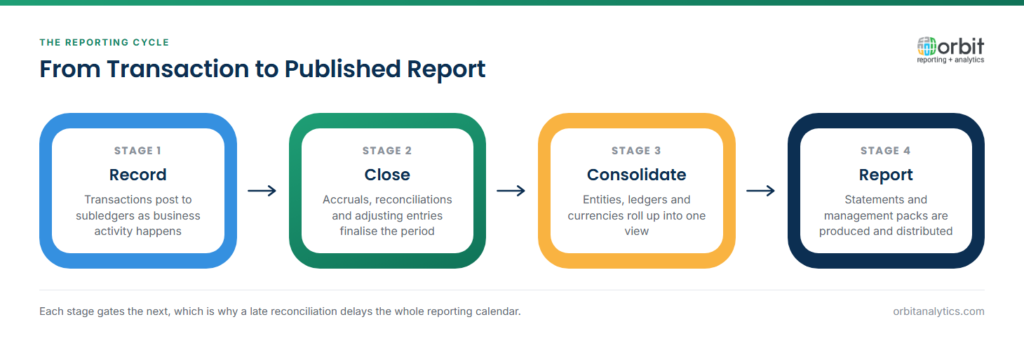
The diagram compresses the period into four stages: record, close, consolidate, report.
- Transaction capture in the subledgers. Payables, receivables, assets, and projects post activity as it happens, then transfer to the general ledger.
- Period close and journal adjustments. Accruals, prepayments, allocations, and reconciliations bring the period to a state the controller will sign.
- Consolidation and currency translation. Entities and ledgers roll up, intercompany balances are eliminated, and foreign balances are translated.
- Review, sign-off, and distribution. Statements and management packs are approved and delivered to each audience in the format it expects.
The cycle usually slips at stage two or three: one unreconciled subledger account, or one late intercompany confirmation, delays every report downstream.
The Rules and Standards That Shape Financial Reporting
External reporting is constrained tightly; internal reporting is not:
- GAAP and IFRS: Two frameworks that fix how transactions are recognised, measured, and disclosed. US filers generally follow GAAP, most other jurisdictions IFRS, and multinationals often both.
- Materiality, consistency, comparability: Report what would change a reader’s decision, apply the same treatment period after period, and present figures so this year compares with last.
- Audit trails and internal controls: Every reported figure must trace back to a transaction, and whoever posts an entry should not approve it.
- Fewer rules internally: Management packs can define margin or contribution however the business finds useful, provided the definition holds steady across periods.
Where Financial Reporting Data Lives in an ERP
Producing a report is rarely an accounting problem. It is a data-access problem, because the figures sit across the ERP:
- The general ledger and chart of accounts: The system of record for balances, structured by segments such as company, cost centre, account, and project.
- Subledgers: Payables, receivables, fixed assets, and projects hold the transaction detail that summarises into the GL.
- Ledgers, legal entities, and business units: Larger organizations run several ledgers across entities and currencies, each with its own calendar and rules.
- Several sources for one number: Revenue can be read from the GL, from receivables, or from order management, and the three rarely tie without a reconciliation.
Why Financial Reporting Is Hard in an Oracle ERP Environment
Oracle E-Business Suite and Fusion Cloud both hold excellent financial data. Getting a report out of them is the friction point:
- Native reports stop at the standard layout. Anything beyond the delivered format means a new report definition, often a development ticket.
- Spreadsheet rework after every export. Export limits push analysts into stitching extracts together in Excel each period, reintroducing the error the ERP was meant to remove.
- Requests queued behind IT. A layout change the controller wants this week competes with the rest of the backlog.
- Reconciling across EBS and Fusion Cloud. Organizations mid-migration run both, and matching figures across two estates becomes a monthly exercise.
Orbit Analytics addresses that last problem directly: it reads EBS and Fusion Cloud through 200+ pre-built connectors and ships 1,000+ pre-built reports, so finance can report across both estates from one layer, starting from purpose-built Oracle Fusion financial reporting content rather than a blank canvas.
How Financial Reporting Gets Produced in Practice
Most finance teams use some mix of three approaches:
- Native Oracle tools. FR Studio, Smart View, BI Publisher, and OTBI cover standard statutory outputs well, but strain on cross-module reporting, refresh latency, and export volume.
- Spreadsheets and manual assembly. Fast to build and impossible to govern. Version control, broken links, and undocumented formulas are the recurring costs.
- A dedicated reporting layer on the ERP. Reports are built once against live ledger and subledger data, then refreshed on a schedule rather than rebuilt each period.
Orbit Analytics sits in that third category, an Oracle Gold Partner with 150,000+ users worldwide and ISO 27001 certification. Its GL Sense module delivers financial reporting for Oracle ERP by reading the GL and subledgers directly, so statements and management packs are built against live data instead of an export. Automation does not change the accounting; it stops the close calendar absorbing days of report assembly.
Financial Reporting vs. Adjacent Reporting Terms
Several neighbouring terms overlap with this one:
| Term | How it differs from financial reporting |
| Financial statements | The artifacts (balance sheet, income statement, cash flow statement), not the process that produces and distributes them |
| Management accounting | The internal discipline of costing, budgeting, and analysis that supplies much of the input |
| Enterprise reporting | Reporting across every function, including HR, supply chain, and sales, with finance as one domain among several |
| Narrative reporting | The commentary and disclosure wrapped around the numbers in an annual report |
| Executive reporting | The summarised, decision-focused view for leadership, drawn from financial and operational sources alike |
Frequently Asked Questions
Q1. What is financial reporting in simple terms?
It is the process of turning recorded transactions into statements and reports that show how an organization is performing. The output goes to external readers such as regulators and lenders, and to internal readers such as executives and budget owners.
Q2. What is the difference between financial reporting and financial statements?
Financial statements are the documents: the balance sheet, income statement, and cash flow statement. Financial reporting is the wider process that produces them, along with management packs, filings, and ad hoc analysis. Statements are one output, not the whole of it.
Q3. What is the difference between statutory and management reporting?
Statutory reporting follows a prescribed format on a fixed calendar, governed by GAAP, IFRS, or local filing rules. Management reporting follows internal policy, appears as often as the business needs, and drills down to cost centre or project.
Q4. What are the stages of the financial reporting cycle?
Transactions are recorded in the subledgers, the period is closed with accruals and reconciliations, entities and currencies are consolidated, then reports are signed off and distributed. Each stage gates the next, so an early delay pushes every downstream report back.
Q5. Why is financial reporting difficult in an ERP system?
The accounting is rarely the hard part. Figures sit across the general ledger, several subledgers, and often multiple ledgers and legal entities, while native ERP tools impose fixed layouts and export limits.
Financial reporting improves when the reporting layer reads the ERP directly instead of waiting on exports. Request a demo to see how Orbit Analytics produces statutory statements and management reports from live Oracle Fusion Cloud, EBS, NetSuite, and PeopleSoft data on one platform.
