
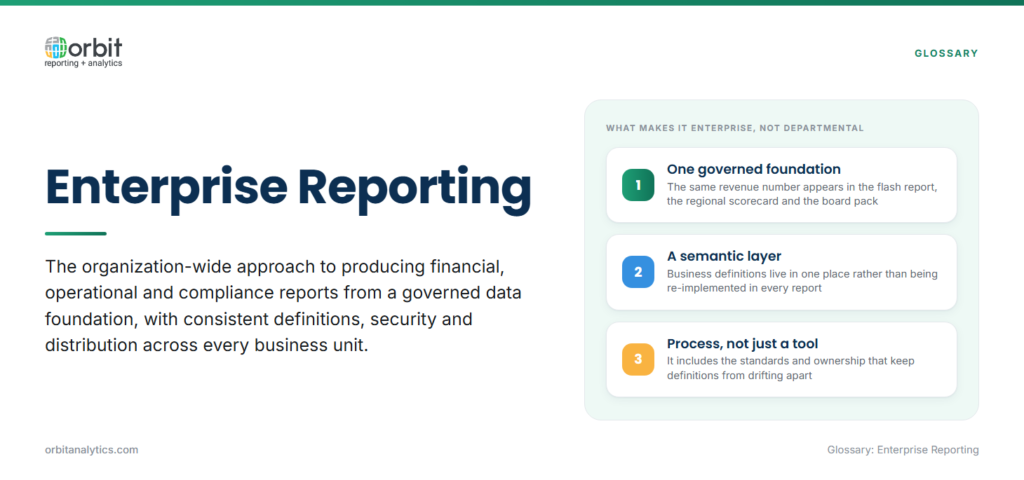
Enterprise reporting is the systematic, organization-wide approach to producing financial, operational, and compliance reports from a governed data foundation, with consistent definitions, security, and distribution across every business unit. It is broader than any single tool and includes the people, processes, and standards that govern reporting end to end.
Departmental reporting solves one team’s question with one team’s data: finance running a P&L, supply chain pulling on-time delivery, HR tracking attrition. Enterprise reporting unifies those threads. The same revenue number appears in the CFO’s flash report, the regional VP’s scorecard, and the board pack, because every report draws from one definition.
The discipline has evolved with the technology. The first generation was IT-built static reports on a data warehouse. The current generation pushes governed self-service to the business user while keeping the trusted foundation intact, with AI and natural-language interfaces layered on top.
Why Large Organizations Need Enterprise Reporting
Three pressures make enterprise reporting non-negotiable at scale:
- Single source of truth. Without it, every meeting begins with a reconciliation argument. Functions stop trusting each other’s numbers, and decisions slow.
- Compliance. SOX, IFRS, GDPR, and industry regulators all expect documented data lineage from source transaction to published number. A patchwork of departmental tools cannot evidence that lineage under audit.
- Executive decision support. The CEO and CFO need 8 to 15 KPIs they can interrogate at any time, with a clear drill path from headline to root cause. That is impossible without a unified reporting fabric across the business units.
Key Components of Enterprise Reporting
Effective enterprise reporting rests on four components:
- A centralized data foundation. A warehouse, lakehouse, or curated semantic layer over the operational systems. The point is one governed source, not one physical store; modern designs can read live from Oracle Fusion Cloud as easily as from a Snowflake warehouse.
- A semantic layer with business definitions. Revenue, margin, headcount, days-sales-outstanding: defined once and reused everywhere. This is where the “one truth” actually lives.
- Report distribution and scheduling. Subscribed reports, bursting by recipient, alerts on thresholds. Information has to find the user, not the other way around.
- Security and access management. Row-level and column-level controls that mirror ERP entitlements, so regional and functional users see only what they are authorized to see.
Orbit Analytics provides a pre-built semantic layer over Oracle Fusion Cloud and EBS that ships with 1,000+ certified reports, eliminating the multi-month modelling exercise that traditionally absorbs the first phase of enterprise reporting projects. That semantic layer is the single biggest determinant of how quickly the practice produces trusted output.
Benefits of Enterprise Reporting
The practice delivers in four directions:
- Consistent metrics: Functions can argue about decisions instead of numbers, because every report draws from the same definitions.
- Less silo and redundancy: Every report is built on the shared foundation rather than a private extract, so duplicate effort across teams disappears.
- Faster time-to-insight: Executive turnaround collapses from days to minutes when the question can be answered in the report itself.
- Scalable infrastructure: Reporting expands as new business units, acquisitions, and geographies join, instead of multiplying the tool count.
Common Challenges in Enterprise Reporting
Three challenges show up in nearly every program:
- Complex data integration. Multi-ERP estates, legacy on-prem systems, and SaaS sprawl all need to be unified before any report is trustworthy. The fix is a deliberate connector strategy with pre-built integrations for the dominant sources.
- Standardization versus flexibility. Too much standardization stifles legitimate local reporting needs; too little destroys the single source of truth. A governed core of certified reports plus a self-service layer for the rest is the established compromise.
- Change management and user adoption. Reporting platforms succeed or fail on adoption, and adoption is built through training, quick wins, and visible executive sponsorship rather than technology selection alone.
Enterprise Reporting Use Cases
- Financial consolidation and management reporting: monthly close packs, statutory statements, FP&A flash reports, often built using a financial reporting layer over the general ledger.
- Operational performance dashboards: plant OEE, supplier on-time delivery, ticket SLAs, refreshed throughout the day.
- Regulatory and compliance reporting: SOX evidence packs, IFRS disclosures, GDPR data-subject reporting.
- Board and investor reporting: quarterly decks, investor relations packs, ESG disclosures, with auditable lineage to source.
Enterprise Reporting Best Practices
Four practices separate mature programs from struggling ones:
- Establish a data governance framework first. Name owners for each domain, define stewards, set policies for definitions and changes, and back the whole thing with executive sponsorship.
- Define enterprise-wide metric definitions. Revenue, headcount, EBITDA, and DSO need a single calculation across the business. Publish the definitions in the semantic layer and treat changes as governed events.
- Implement tiered access controls. Use roles, not individual permissions, and tie those roles to ERP entitlements so a leaver loses reporting access at the same time they lose system access.
- Create a center of excellence. A small team of report designers, data engineers, and business analysts becomes the steward of standards and the multiplier across business units.
How to Get Started with Enterprise Reporting
A four-step rollout keeps the program funded and focused:
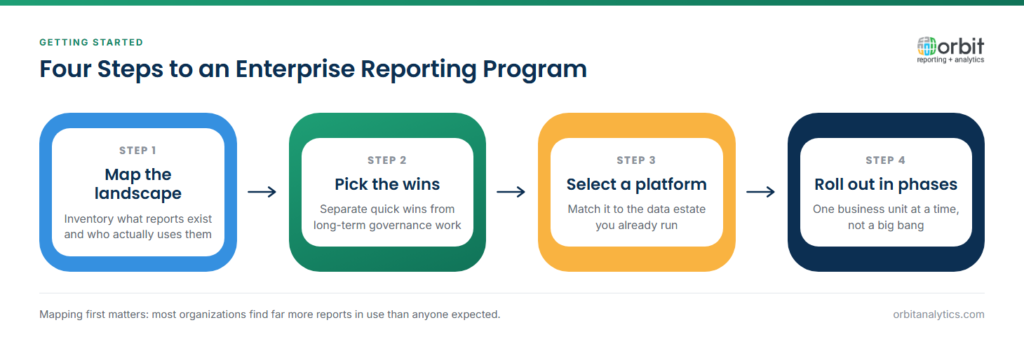
- Map the current reporting landscape. How many tools are in use? How many reports? How much shadow reporting is happening in spreadsheets? The picture is usually worse than expected and that becomes the burning platform for change.
- Identify quick wins and long-term goals. A 30-day deliverable, often a consolidated executive scorecard, builds credibility and funds the longer work on the semantic layer and governance.
- Select an enterprise-grade platform that fits your data estate. For Oracle-centric organizations, that means evaluating business intelligence platforms that come with native Fusion Cloud and EBS connectors rather than generic tools that need a custom integration project. Orbit Analytics is purpose-built for Oracle ERP, with 200+ pre-built connectors, an ISO 27001 certified stack, and a deployment pattern that brings production reports live in 8 to 12 weeks rather than 9 to 18 months.
- Plan a phased rollout. Pilot in one function, prove the model, document the wins, then extend. Avoid the big-bang rollout that has sunk so many enterprise BI programs.
Frequently Asked Questions
Q1. What is enterprise reporting in simple terms?
It is the organization-wide practice of producing financial, operational, and compliance reports from a governed data foundation, with consistent definitions across every function. The objective is one trusted set of numbers used by everyone from the analyst to the board.
Q2. What is the difference between enterprise reporting and business intelligence?
Enterprise reporting is focused on producing trusted, repeatable reports at organizational scale. Business intelligence is broader and includes ad hoc analysis, data exploration, predictive modelling, and visualization. Most modern programs run enterprise reporting as the foundation and layer BI capabilities on top.
Q3. What are examples of enterprise reports?
Monthly close packs, consolidated P&L and balance sheet, board scorecards, SOX evidence reports, plant OEE dashboards, supplier scorecards, regional sales pipelines, and headcount reports. The defining feature is that the same numbers appear consistently across each output.
Q4. Who is responsible for enterprise reporting?
Ownership typically sits with a CFO or CIO sponsor, with day-to-day delivery handled by a center of excellence that brings together finance, IT, and data engineering. Business unit owners are accountable for the local reports and for adoption within their function.
Q5. What is an enterprise reporting strategy?
It is the multi-year plan that defines the target architecture, governance model, tool stack, metric definitions, and rollout roadmap. A good strategy answers what gets reported, by whom, how often, from what data, and with what controls, and includes a clear plan for sunsetting legacy reporting.
Q6. Can enterprise reporting support self-service?
Yes, and it should. Modern enterprise reporting pairs a governed catalogue of certified reports with a self-service layer where business users build their own analyses against trusted datasets. The combination is what closes the gap between IT-built reports and ungoverned spreadsheets.
Ready to put a trusted enterprise reporting practice in place across your Oracle ERP estate? Request a demo to see how Orbit Analytics delivers consistent, governed reporting for finance, operations, and the executive team.
