
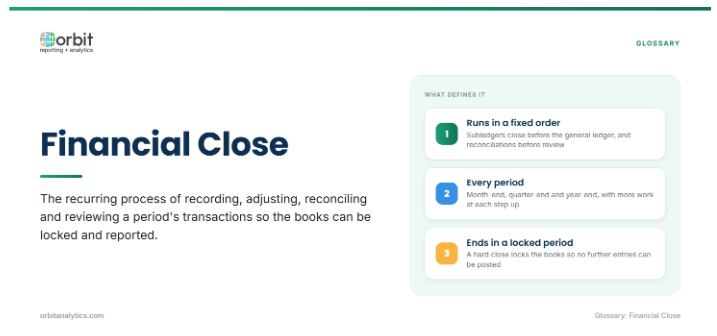
The financial close is the recurring process of recording, adjusting, reconciling and reviewing a period’s transactions so the books can be locked and financial statements issued. It runs at the end of every month, quarter and year, and its output is a set of figures that management, auditors and regulators can rely on.
Many teams distinguish a soft close from a hard close. A soft close produces management figures quickly, often with estimates and fewer reconciliations, and is common at month-end. A hard close is complete and fully reconciled, with the period locked so no further entries can be posted. Quarter-end and year-end are almost always hard closes.
The close is not one task but a chain of dependent ones. A delay at the start, such as a late subledger, pushes back every step after it.
Steps in the Financial Close Process
Most closes follow the same order, because each step depends on the one before:
- Cut-off and subledger close: transactions are recorded in the right period, and subledgers such as payables, receivables, fixed assets and inventory are closed and transferred to the general ledger.
- Accruals and adjustments: expenses incurred but not yet invoiced are accrued, prepayments are amortized, depreciation is posted and other period-end journals are entered.
- Account reconciliations: balance sheet accounts are compared with independent evidence, such as bank statements and subledger reports, and differences are investigated.
- Intercompany and consolidation: intercompany balances are matched and eliminated, foreign currency results are translated, and entities are combined into group figures.
- Review, lock and report: the trial balance and draft statements are reviewed, final adjustments are posted, the period is locked and reports are issued.
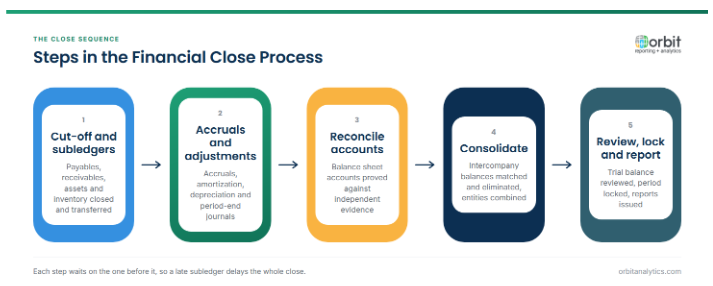
Not every company needs step four. A single-entity business with one currency moves straight from reconciliation to review.
Month-End, Quarter-End and Year-End Close
The same core steps run at each cadence, with more work added as the stakes rise:
| Cadence | Extra work on top of the monthly routine | Main output |
|---|---|---|
| Month-end | Usually the baseline: subledgers, accruals, key reconciliations | Management accounts and variance reporting |
| Quarter-end | Fuller reconciliations, tax provisions, review of estimates | Quarterly statements and, for listed companies, interim filings |
| Year-end | External audit, inventory counts, impairment testing, statutory disclosures | Audited annual financial statements |
Who Is Involved in the Close
The close crosses teams, which is part of why it is hard to speed up:
- Accounting operations: payables, receivables, fixed asset and payroll teams close their subledgers and post routine journals.
- The controller: owns the close calendar, reviews reconciliations and adjustments, and signs off the period.
- FP&A and business owners: supply accrual estimates and explain variances in their areas once figures are available.
- Auditors: review the year-end close in full and test interim periods, relying on reconciliations and supporting evidence.
Financial Close in Oracle Fusion Cloud and EBS
In Oracle Fusion Cloud and Oracle EBS, the close is governed by period statuses. Each ledger period moves through statuses such as Future Entry, Open, Closed and Permanently Closed, and subledger periods are managed separately for payables, receivables, assets and other modules. A Closed period can be reopened to post a late correction, which is why many teams treat reopening as a controlled exception that needs approval. A Permanently Closed period cannot be reopened at all.
The order matters. Subledger transactions must be accounted and transferred to the general ledger, and the subledger periods closed, before the general ledger period can close cleanly. A late subledger leaves the ledger incomplete, so the controller’s review starts on figures that are still moving.
The review step depends on seeing balances clearly before the period locks. Orbit Analytics provides general ledger reporting with real-time account analysis on Oracle Fusion Cloud and EBS. Drill-down from a GL balance to the subledger detail behind it lets the team investigate an unexpected balance while the period is still open.
Measuring Close Performance
Close performance is usually tracked with a small set of measures, alongside other accounting KPIs:
- Days to close: working days from period end to locked books or issued management accounts. It is the headline measure, but speed without accuracy is no gain.
- Post-close adjustments: entries needed after the period was considered closed. A high count suggests the review step is catching problems too late.
- Reconciliations completed on time: the share of balance sheet reconciliations finished and approved within the close calendar.
- Manual journal volume: the number of manually prepared journals per close. Manual journals are slower to prepare, review and audit than system-generated entries.
Common Financial Close Bottlenecks
The close usually stalls in the same few places:
- Late subledger data: invoices received after cut-off, unposted receipts or inventory adjustments hold up the ledger.
- Spreadsheet reconciliations: balances exported to workbooks, matched by hand and stored in shared folders take time and leave a weak audit trail. Orbit Analytics replaces the export step with financial statements and account reports in Excel refreshed from the ledger, so reconciliations start from current balances.
- Manual journals: recurring accruals and allocations typed in each month instead of generated by rules or templates.
- Unresolved intercompany differences: mismatched balances between entities that must be agreed before consolidation can finish.
Fixing the first bottleneck often does the most good, because every later step waits on it.
Financial Close vs Account Reconciliation vs Consolidation
The three terms are often used together, but they describe different scopes:
| Term | What it covers | Relationship |
|---|---|---|
| Financial close | The whole period-end process, from cut-off to locked books and reports | The umbrella process |
| Account reconciliation | Proving each balance sheet account against independent evidence | One step within the close |
| Consolidation | Combining entities, eliminating intercompany items and translating currencies | One step within the close, for multi-entity groups |
Account reconciliation and consolidation are both parts of the close. Closing the books means finishing all of them, then reviewing and locking the result.
Frequently Asked Questions
Q1. What is the financial close process?
It is the sequence of period-end steps: cut-off and subledger close, accruals and adjustments, reconciliations, intercompany and consolidation, then review, lock and reporting. Each step depends on the one before it.
Q2. How long does a month-end close take?
It varies with company size, the number of entities and how automated the process is. Close length is measured in working days from period end, and many teams track it as a KPI to shorten over time.
Q3. What is the difference between a soft close and a hard close?
A soft close produces management figures quickly, with estimates and fewer reconciliations. A hard close is fully reconciled and locks the period so no further entries can be posted.
Q4. What is a continuous close?
It is an approach that spreads close work across the period, such as reconciling accounts weekly and posting accruals as they become known, so less work is left for period end.
Q5. Who is responsible for the financial close?
The controller usually owns the close calendar and signs off the period. Accounting operations, FP&A and business owners each contribute steps, and auditors review the year-end close.
Q6. What happens after the books are closed?
The closed figures feed management reporting, variance analysis against budget and forecast, and, at quarter-end and year-end, external reporting and audit. Any correction found later is usually posted in the current open period, with the reason documented, rather than by reopening a locked one.
A faster close starts with seeing current ledger balances and their detail before the period locks. Orbit Analytics gives finance teams live GL and subledger reporting on Oracle Fusion Cloud and EBS. Request a demo to see it on your own ledger.
