
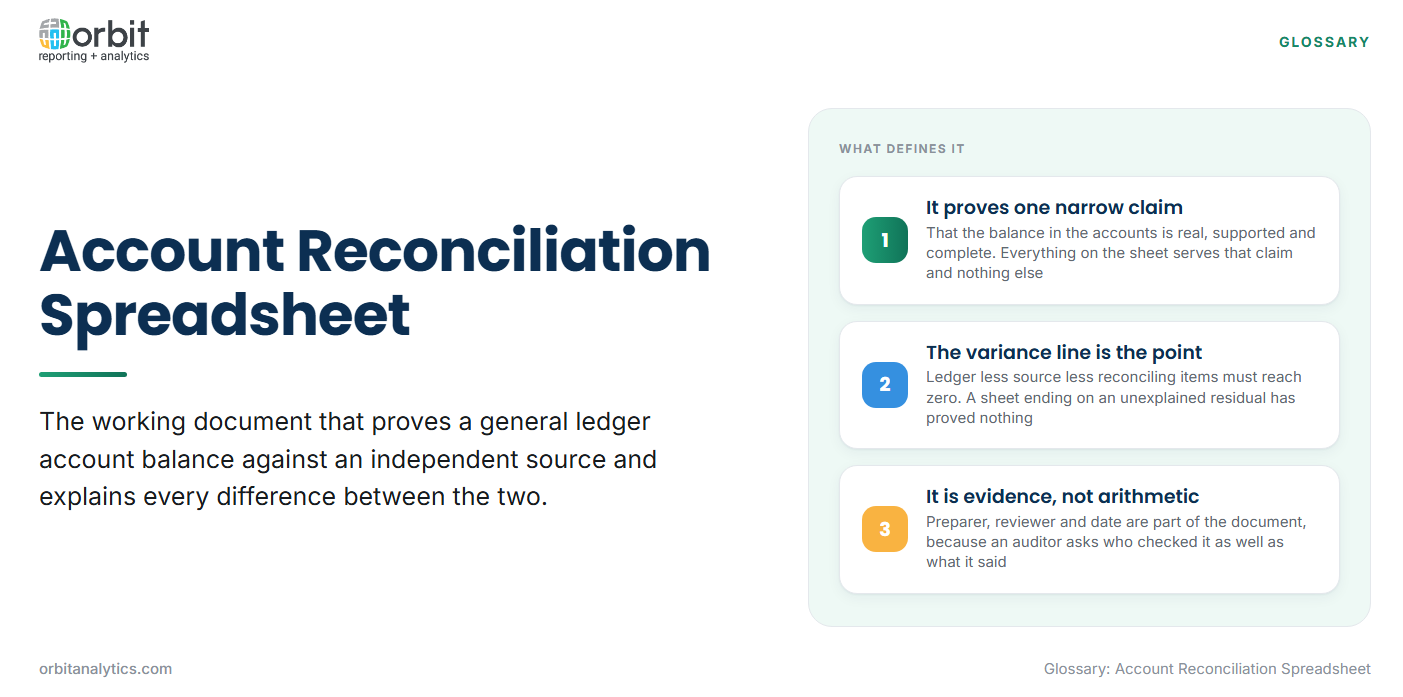
An account reconciliation spreadsheet is the working document that proves a general ledger account balance against an independent source and explains every difference between the two. The ledger says the bank account holds a given figure; the bank statement either agrees or it does not. The spreadsheet is where that comparison is written down, evidenced and signed.
What it proves is narrow: that the balance sitting in the accounts is real, supported and complete. Everything on the sheet serves that one claim, and a reconciliation ending in an unexplained difference has not proved it, whatever else the file contains.
The spreadsheet became the default tool because it is immediate and can be shaped to an account nobody anticipated. A preparer builds it, a reviewer checks it, and the file becomes the evidence an auditor later asks for.
What the Spreadsheet Actually Contains
The layout varies by account, but five elements are always present.
| Element | What it holds |
| Ledger balance | The closing balance from the general ledger for the account and period being proved |
| Source balance | The same balance per an independent source: a bank statement, a subledger total or a supplier confirmation |
| Reconciling items | Each difference between the two, with a date, an amount, a reason and a reference to its evidence |
| Variance | Ledger balance less source balance less reconciling items, which must be zero |
| Preparer, reviewer, date | Who built it, who checked it, and when each happened |
The variance line is the whole point. A sheet that reaches zero because every difference has been named and evidenced is a proof; one that ends on an unexplained residual is a note saying the balance might be wrong.
How the Reconciliation Process Works
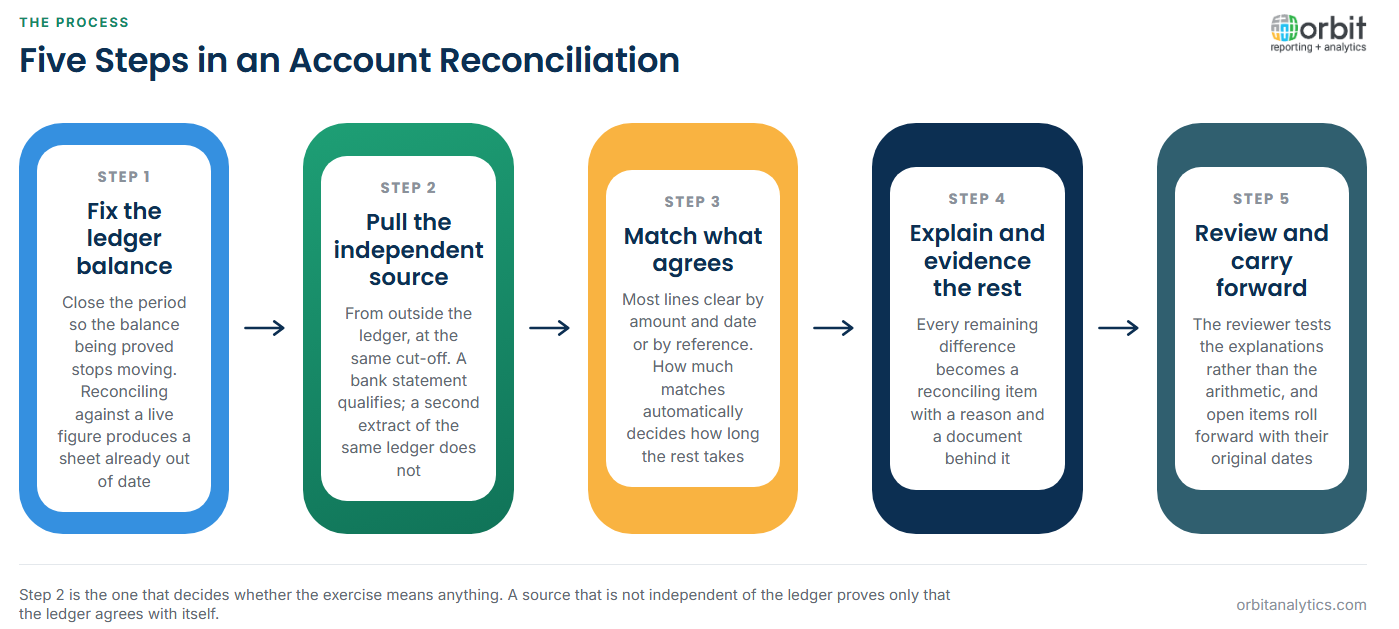
- Close the period and fix the ledger balance. The balance being proved has to stop moving, because reconciling against a live figure produces a sheet that is out of date by the time it is reviewed.
- Pull the independent source. It has to come from outside the ledger, at the same cut-off date. A bank statement qualifies; a second extract of the same ledger does not.
- Match what agrees. Most lines clear here, by amount and date or by reference, and how much matches automatically decides how long the rest takes.
- Explain and evidence what does not. Every remaining difference becomes a reconciling item with a reason and a document behind it.
- Review, sign off and carry items forward. The reviewer tests the explanations rather than the arithmetic, and open items roll forward with their original dates intact.
Reconciling items fall into four kinds:
- Timing differences: correct and recorded on both sides, but in different periods. A cheque issued and not yet presented is the classic example, and it clears itself.
- Errors and misposted entries: a wrong amount, a wrong account or a duplicate. These need a correcting journal, not a note.
- Items missing from one side: bank charges recorded by the bank but never posted to the ledger. They clear by being posted.
- Aged items that never clear: anything carried for several periods with the same explanation, which is where a real problem usually hides.
The Account Types Teams Reconcile
- Cash and bank accounts: reconciled monthly at minimum, often daily where volumes are high, because the source is genuinely independent.
- Subledger control accounts: receivables, payables and fixed assets, where the subledger total must agree with its control account in the ledger.
- Accruals, prepayments and provisions: proved against a supporting schedule rather than an external source, so the schedule carries the burden.
- Intercompany balances: proved against the counterparty entity’s matching balance, and the usual source of consolidation disputes.
- Suspense and clearing accounts: should sit near zero at period end. A growing balance means items are entering and never leaving.
How Reconciliation Fits the Period-End Close
Reconciliations sit after the subledgers close and before the financial statements are prepared, which makes them the step that decides whether the close runs to calendar.
Not every account deserves equal attention. Risk ranking sorts accounts by balance, volatility and what has gone wrong in them before, so high-risk accounts get a full reconciliation every period while low-value ones are reviewed on a lighter cycle. Materiality thresholds do the same inside a reconciliation: differences below a defined tolerance are monitored rather than investigated line by line.
Auditors ask for the completed sheet, the source document, the evidence behind each reconciling item, and proof that a reviewer who did not prepare it signed it off.
Where a Spreadsheet Stops Being Adequate
Spreadsheets are adequate for a handful of accounts in one entity. The failure modes appear as volume and reviewers are added.
- Version control and the emailed copy: once a file has gone for review, two versions exist, and the signed one is not always the one filed.
- Manual rekeying and broken formulas: balances typed rather than pulled go stale, and an inserted row outside a SUM range produces a sheet that ties without being right.
- No trail of who changed what: a workbook records its last saved state, not who changed a figure after review or what it said before.
- Volume, entities and currencies: the same reconciliation repeated across dozens of accounts and several entities becomes an assembly job. Orbit Analytics reports balances across every ledger and entity in one place, so the consolidation stops being a manual step.
- The balance that ties because someone forced it: a plug line carried forward until nobody remembers its origin.
Teams that want the familiar interface without the manual steps use Excel reporting that refreshes live ledger balances into the sheet instead of pasting an export into it.
What Changes When the Balances Come Straight From the Ledger
The reconciliation does not disappear when the data is connected. What changes is which parts are still done by hand.
The ledger balance is pulled rather than typed, so it matches what the accounts say without anyone checking. Any variance can be opened to the transactions behind it, which turns an investigation that used to mean requesting a detail report into a drill-down. Standing rules clear the routine matches, leaving the preparer with the exceptions, and the review trail lives with the reconciliation rather than in an inbox. Orbit Analytics provides general ledger reporting that reads Oracle Fusion Cloud and EBS balances directly, with drill-down from any balance to the journals behind it.
Reconciliation, the Trial Balance and the Close Compared
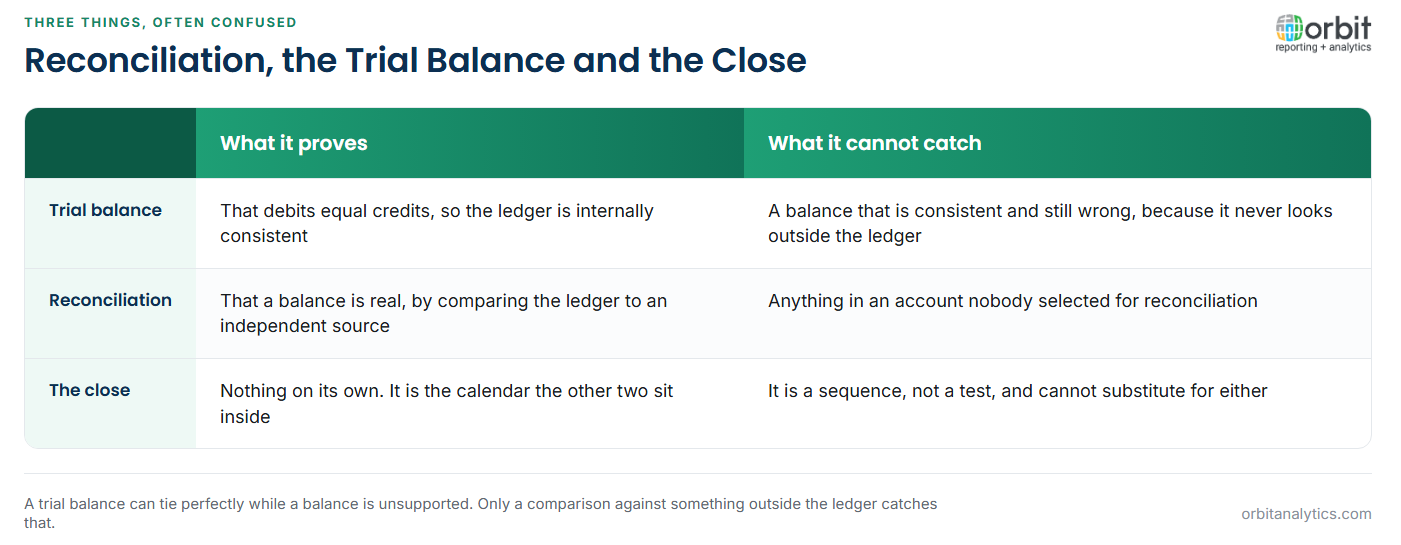
The trial balance shows that debits equal credits. It proves the ledger is internally consistent, which it can be while a balance is wrong.
Reconciliation shows that a balance is real. It compares the ledger to something outside it, the only way to catch a figure that is consistent and still unsupported.
The close is the calendar both sit inside. It is the sequence that turns a period’s transactions into reported numbers, and reconciliation is one step in it rather than a synonym for the whole thing.
Frequently Asked Questions
Q1. What is an account reconciliation spreadsheet?
It is a working document that compares a general ledger account balance with an independent source, evidences every difference, and shows the remaining variance as zero. It also records who prepared and reviewed it, and when.
Q2. What is a reconciling item?
It is a named difference between the ledger and the source: a timing difference, an error, an item posted on one side only, or an aged item that has not cleared. Each needs a reason and evidence, not just an amount.
Q3. What does it mean when a balance does not tie?
It means the difference between the ledger and the source is not fully explained by reconciling items. Either something is missing from the reconciliation or the ledger balance is wrong, and it is not complete until it is known which.
Q4. What is the difference between a reconciliation and a trial balance?
A trial balance checks that total debits equal total credits across the ledger. A reconciliation checks one account against a source outside the ledger, which is a different and stronger test.
Q5. Why do reconciliations fail an audit?
Usually because the evidence behind a reconciling item is missing, because an aged item has been carried for periods without resolution, or because the preparer and reviewer are the same person.
Reconciliation gets faster when balances arrive current and every variance can be questioned down to the transaction. Orbit Analytics reports live Oracle ledger data with that drill-down built in. Request a demo to see it against your own account set.
