
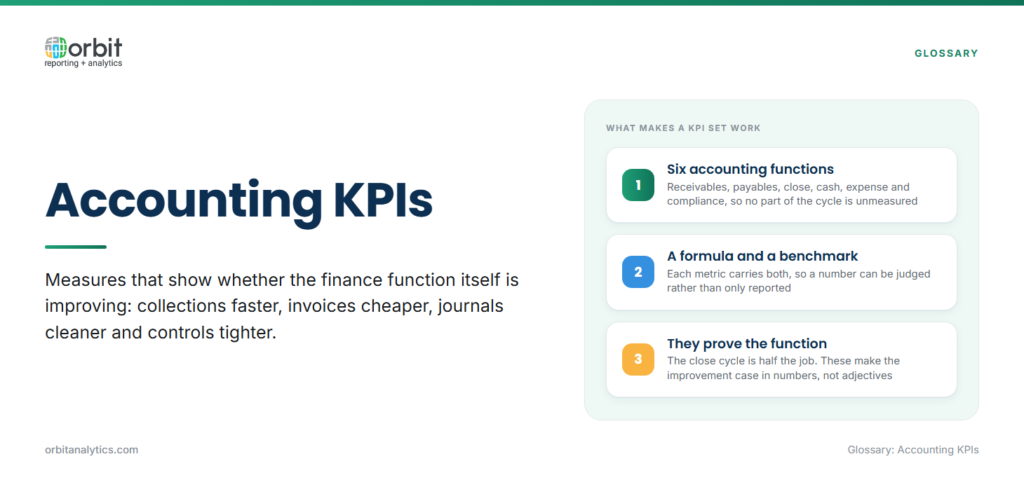
Finance leaders running an Oracle ERP shop know the close cycle is only half the job. The other half is proving the finance function itself is improving, collections faster, invoices cheaper, journals cleaner, controls tighter. The right accounting KPIs make that case in numbers, not adjectives.
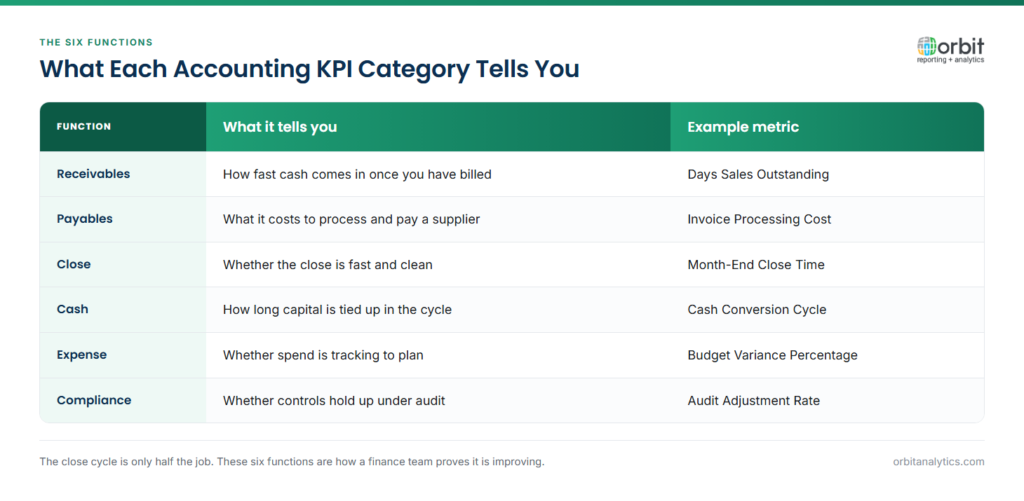
This guide lists 27 KPIs organized by accounting function: receivables, payables, close, cash, expense, and compliance. Each one comes with a formula, a working benchmark, and a single line on why it matters.
Why Do Accounting KPIs Matter?
Accounting KPIs measure how well finance operates, while financial KPIs measure how the business performs. A healthy P&L can still hide a 12-day close, $20 invoice processing cost, or 70% reconciliation completion rate. Tracking process KPIs alongside outcome KPIs exposes the inefficiencies that quietly tax every quarter, and funds the automation case.
Quick Reference: Top Accounting KPIs at a Glance
| Category | KPI | Formula or Definition | Benchmark |
| Receivables | Days Sales Outstanding (DSO) | (AR / Credit Sales) x Days | 30-45 days |
| Receivables | AR Turnover | Net Credit Sales / Avg AR | 8-12x annually |
| Payables | Days Payable Outstanding (DPO) | (AP / COGS) x Days | 30-45 days |
| Payables | Invoice Processing Cost | AP Cost / Invoices Processed | $5-15 per invoice |
| Close | Month-End Close Time | Days from period end to close | 5-7 days |
| Close | Journal Entry Error Rate | Errors / Total Entries | <1% |
| Cash | Cash Conversion Cycle | DSO + DIO – DPO | Lower is better |
| Cash | Working Capital Ratio | Current Assets / Current Liabilities | 1.2-2.0 |
| Expense | Operating Expense Ratio | OpEx / Revenue x 100 | Industry-specific |
| Compliance | Audit Adjustment Rate | Material adjustments per audit | Zero is target |
Accounts Receivable KPIs
- 1. Days Sales Outstanding (DSO): (Accounts Receivable / Total Credit Sales) x Number of Days. Benchmark: 30-45 days. Cash flow efficiency and collection effectiveness.
- 2. Accounts Receivable Turnover: Net Credit Sales / Average AR. Benchmark: 8-12x annually. How quickly receivables convert to cash.
- 3. Collection Effectiveness Index (CEI): ((Beginning AR + Monthly Credit Sales – Ending Total AR) / (Beginning AR + Monthly Credit Sales – Ending Current AR)) x 100. Benchmark: 80%+. Isolates collections quality from sales swings.
- 4. Bad Debt Ratio: (Bad Debt / Total AR) x 100. Benchmark: <1%. Credit risk and write-off exposure.
- 5. Average Days Delinquent (ADD): DSO minus Best Possible DSO. Benchmark: lower is better. Pure measure of collection lag.
Accounts Payable KPIs
- 6. Days Payable Outstanding (DPO): (Accounts Payable / COGS) x Number of Days. Benchmark: 30-45 days. Working capital management and supplier relationships.
- 7. Accounts Payable Turnover: Total Supplier Purchases / Average AP. Benchmark: 6-12x annually. How frequently payables are settled.
- 8. Invoice Processing Cost: Total AP Department Cost / Invoices Processed. Benchmark: $5-15 per invoice; under $5 is top decile. AP efficiency and automation ROI.
- 9. Invoice Processing Time: Average days from invoice receipt to payment. Benchmark: <5 days automated, <15 days manual. Process efficiency and discount capture window.
- 10. Early Payment Discount Capture Rate: (Discounts Taken / Discounts Available) x 100. Benchmark: 80%+. Cash savings from vendor terms.
General Ledger and Close KPIs
- 11. Month-End Close Time: Days from period end to close completion. Benchmark: 5-7 days standard, 3-4 days top quartile. Finance team efficiency and timely reporting.
- 12. Journal Entry Error Rate: (Entries Requiring Correction / Total Entries) x 100. Benchmark: <1%. Data accuracy and rework reduction.
- 13. Reconciliation Completion Rate: (Reconciliations On Time / Total Required) x 100. Benchmark: 100% by close deadline. Balance sheet accuracy and audit readiness.
- 14. Intercompany Reconciliation Time: Hours to reconcile intercompany transactions. Benchmark: <8 hours with automation. Multi-entity close efficiency.
- 15. Adjusting Entries per Close: Number of adjusting entries each cycle. Benchmark: lower indicates ongoing accuracy. Process quality and rework indicator.
Cash Management KPIs
- 16. Cash Conversion Cycle (CCC): DSO + Days Inventory Outstanding – DPO. Benchmark: lower is better; industry-specific. Working capital efficiency.
- 17. Working Capital Ratio: Current Assets / Current Liabilities. Benchmark: 1.2-2.0. Short-term financial health.
- 18. Operating Cash Flow Ratio: Operating Cash Flow / Current Liabilities. Benchmark: greater than 1.0. Cash-based liquidity measure.
- 19. Cash Forecast Accuracy: 1 minus (|Actual minus Forecast| / Actual). Benchmark: 90%+. Treasury planning and investment decisions.
Expense Management KPIs
- 20. Operating Expense Ratio: (Operating Expenses / Revenue) x 100. Benchmark: industry-specific; lower indicates efficiency. Cost control health.
- 21. Expense Report Processing Time: Average days from submission to reimbursement. Benchmark: <5 days with automation. Employee satisfaction and policy compliance.
- 22. Budget Variance Percentage: ((Actual – Budget) / Budget) x 100. Benchmark: +/- 5%. Planning accuracy and cost control.
- 23. Cost per Invoice Processed: Total Processing Cost / Invoices. Benchmark: $5-15 manual, under $3 automated. Process efficiency benchmark.
Compliance and Accuracy KPIs
- 24. Financial Statement Error Rate: (Material Errors Discovered / Statements Issued) x 100. Benchmark: 0%. Reporting accuracy and credibility.
- 25. Audit Adjustment Rate: Number of material audit adjustments. Benchmark: zero. Internal control effectiveness.
- 26. SOX Compliance Rate: (Controls Tested and Effective / Total Controls) x 100. Benchmark: 100%. Regulatory compliance and risk management.
- 27. Internal Control Effectiveness: (Controls Operating Effectively / Total Controls) x 100. Benchmark: 100%; above 95% acceptable. Risk mitigation and audit readiness.
How Do You Choose the Right Accounting KPIs?
Align with department goals first. A team chasing a faster close weights close time, reconciliation completion, and journal error rate. A team focused on working capital weights DSO, DPO, and cash conversion cycle. Balance process metrics (close time, invoice cost) with outcome metrics (bad debt ratio, audit adjustments). Orbit Analytics solves the data side with Oracle Fusion financial reporting and pre-modeled GL extracts that surface DSO, DPO, and close metrics without custom data work.
What Are Best Practices for Accounting KPI Tracking?
Automate data collection from the ERP first; manual workbook stitching is where every accounting KPI program goes to die. Set benchmarks by industry and company size, a $200M industrial doesn’t have the same DSO target as a SaaS scale-up. Review process KPIs weekly and outcome KPIs monthly, and tie every red metric to a named owner with a remediation date. Orbit Analytics supports this with GL Sense for financial reporting, which delivers drill-anywhere GL dashboards directly on top of Oracle Fusion and EBS data. Pair it with Excel reporting so analysts can pivot live ERP data inside the format they already use for variance commentary.
Frequently Asked Questions
Q1. What are accounting KPIs and how are they different from financial KPIs?
Accounting KPIs measure how well the finance function operates, close time, invoice cost, journal error rate. Financial KPIs measure how the business performs, revenue growth, gross margin, EBITDA. Accounting KPIs are process-focused; financial KPIs are outcome-focused. A high-performing finance team typically tracks both.
Q2. How do you calculate Days Sales Outstanding (DSO)?
DSO equals (Accounts Receivable divided by Total Credit Sales) multiplied by the number of days in the period. For a monthly view that is usually 30 days; for an annual view it is 365. Lower DSO means cash collects faster.
Q3. What is a good month-end close time?
Five to seven business days is the broad standard. Top-quartile finance teams running on automated ERP platforms close in three to four days. Anything above ten days usually signals manual reconciliations, intercompany lag, or chart-of-accounts complexity that needs attention.
Q4. How many accounting KPIs should a company track?
Five to seven core KPIs at the executive scorecard, with deeper functional metrics available on operational dashboards. Tracking too many top-line KPIs splits attention and dilutes accountability.
Q5. How often should accounting KPIs be reviewed?
Process KPIs like invoice processing time and reconciliation completion should be reviewed weekly during the close. Outcome KPIs like DSO, DPO, and audit adjustment rate fit a monthly cadence aligned with management reporting.
Q6. Can accounting KPIs be automated?
Yes. Modern ERP-connected BI tools pull AR, AP, GL, and cash data directly and refresh KPI dashboards without manual exports. The harder part is agreeing on definitions across entities so that a DSO from one business unit means the same as another.
Ready to track these accounting KPIs against live Oracle ERP data? Request a demo to see how Orbit Analytics delivers close-cycle and working-capital dashboards directly on Oracle Fusion Cloud and EBS.
