
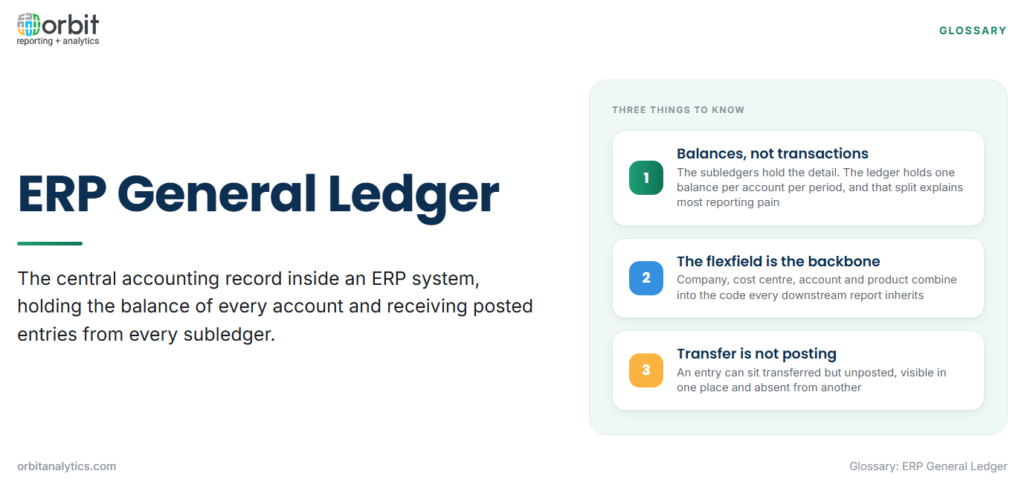
The ERP general ledger is the central accounting record inside an enterprise resource planning system, holding the balance of every account and receiving posted entries from every subledger. It is the point where operational activity becomes accounting: a purchase order is not accounting, but the invoice it generates eventually posts to the ledger as a debit and a credit.
The distinction that matters most is between the ledger and its subledgers. The subledgers hold transaction detail: individual invoices, receipts, payments, asset additions. The general ledger holds the summarized result, one balance per account per period. Almost every reporting frustration in an ERP traces back to that split, because the question being asked usually needs both.
The structure of a general ledger
- The chart of accounts is the list of accounts available for posting, and its design constrains everything reported afterwards. An account that does not exist cannot be reported on, and one created late will not exist in prior periods.
- Segments and the accounting flexfield extend a single natural account into a structured code combining company, cost centre, account, product and other dimensions. In Oracle this structure is the accounting flexfield, and it is the backbone of every management report the organization will ever run.
- Ledgers, ledger sets and legal entities determine what is reported together. A ledger carries one chart of accounts, one calendar, one currency and one accounting method, and entities sharing those four can be reported as a set.
- Calendars and open periods control when posting is allowed. A closed period cannot receive entries, which is what makes a reported figure stable.
How transactions reach the general ledger
- A subledger records the transaction. Payables records an invoice, receivables records a customer bill, assets records a depreciation run.
- Accounting rules assign the accounts. The subledger accounting engine decides which account combination each side of the entry hits, based on configured rules rather than manual judgement.
- The entry transfers to the ledger. Usually in batches, on a schedule, and this is where timing differences between subledger and ledger originate.
- The journal is posted. Transfer is not posting. An entry can sit transferred but unposted, visible in one place and absent from another.
- Balances update. Only after posting does the account balance change, and only then does it appear in reporting.
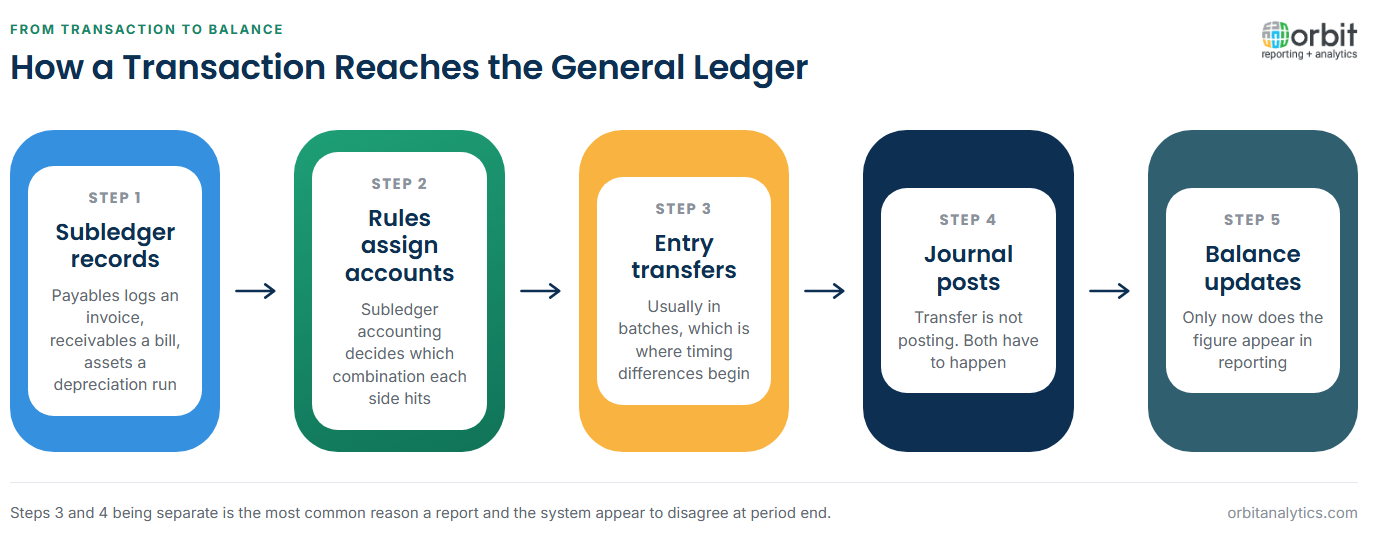
Step 3 and step 4 being separate is the single most common cause of “the report does not agree with the system” at period end.
What the general ledger produces
The trial balance is the first output, listing every account with its closing balance to confirm that debits equal credits. The statutory statements come next, built by grouping those balances into presentation categories. Management and segment reporting uses the same balances cut by the flexfield segments rather than by statutory category, which is why the segment design matters so much.
The fourth output is the audit trail. Every posted balance should resolve back through its journals to the source transaction, and an ERP that cannot demonstrate that chain has a control problem rather than a reporting one.
General ledger structures in Oracle EBS and Fusion Cloud
Oracle E-Business Suite organizes around a ledger with a chart of accounts, calendar, currency and accounting method, grouped into ledger sets for reporting across entities. Access to the underlying tables is direct, which makes reporting flexible and makes it easy to overload the transactional system.
Oracle Fusion Cloud keeps the same conceptual model but changes access fundamentally: there is no direct table access, and data reaches reporting through published interfaces. The accounting engine also moved forward, with subledger accounting rules configured more centrally.
Most organizations run both at once, often for years, because a phased transition is safer than a single cutover. That means group reporting crosses two systems with different structures, which is where the practical difficulty lives rather than in either system alone.
Multi-entity and multi-currency ledgers
A primary ledger carries the books of record. Secondary ledgers hold the same transactions under a different accounting method, typically for local statutory requirements that differ from group policy. Reporting currency ledgers hold the same balances restated into another currency.
Translation converts balances into a reporting currency at period end. Revaluation adjusts foreign-currency balances to current rates before translation. The two are often confused, and confusing them produces movements in the accounts that nobody can explain. Group reporting gets complicated here because a consolidated figure may combine entities on different primary ledgers, different currencies and occasionally different accounting methods. Orbit Analytics reports across those ledgers in a single view, so the group figure and each contributing entity are visible together rather than assembled by hand.
Common general ledger problems
A chart of accounts that has outgrown its design is the most consequential and the hardest to fix. Segments repurposed over time, values added without governance, and hierarchies that no longer roll up cleanly all show up as reports that need manual adjustment.
Unposted and unreconciled subledger transfers cause the ledger and the subledger to disagree in ways that look like errors and usually are not.
Manual journals with no supporting detail are an audit finding waiting to happen, and they are also the reason some balances cannot be explained months later.
Period close dependencies nobody documented turn the close into tribal knowledge. When the person who knows the order of operations is unavailable, the close slips.
Getting reporting out of the general ledger
Standard ERP reports handle the statutory cases well and run out of road quickly beyond them. They report balances, they report one ledger at a time, and they rarely join to anything outside finance. The moment a question needs headcount alongside cost, or needs the invoices behind a balance, the standard report is the wrong instrument.
Two capabilities matter more than any feature list. The first is drilling from a balance to the transactions behind it without leaving the report. The second is combining ledger data with operational data on a shared key. Orbit Analytics provides general ledger reporting that reads live Oracle balances across multiple ledgers and preserves that path from a summarized figure to the underlying detail.
General ledger vs. subledger vs. data warehouse
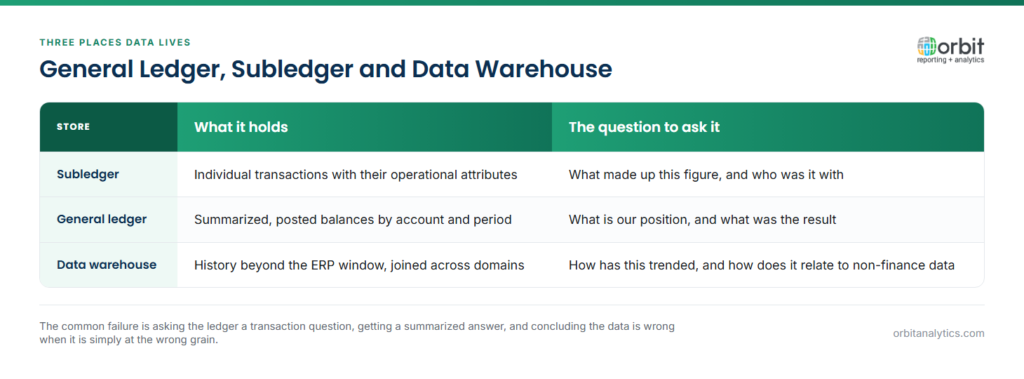
These three hold overlapping data at different grains, and choosing the wrong one wastes a great deal of time.
The subledger holds the detail. Individual invoices, receipts and payments, with the operational attributes that never reach the ledger. Ask it transaction-level questions.
The ledger holds the balances. Summarized, posted, period-bound and reconciled. Ask it questions about position and result.
The warehouse holds history and joins. It keeps periods beyond the ERP’s retention window and can join finance to operations on a common key. Ask it trend and cross-domain questions.
A well-run environment uses all three deliberately. The failure mode is asking the ledger a transaction question, getting a summarized answer, and concluding the data is wrong when it is simply at the wrong grain. Producing statements from these balances is the subject of financial reporting more broadly.
Frequently Asked Questions
Q1. What is an ERP general ledger?
It is the central accounting record inside an ERP system, holding the balance of every account and receiving posted entries from every subledger. It is where operational activity becomes accounting.
Q2. What is the difference between a general ledger and a subledger?
The subledger holds transaction detail such as individual invoices and payments. The general ledger holds the summarized result, one balance per account per period, after those transactions post.
Q3. What is an accounting flexfield in Oracle?
It is the structured account code combining segments such as company, cost centre, account and product into a single combination. It determines what can be reported on and how balances roll up.
Q4. How do transactions get from a subledger to the general ledger?
The subledger records the transaction, accounting rules assign the account combination, the entry transfers to the ledger in a batch, the journal is posted, and only then does the balance update.
Q5. What is a secondary ledger?
A secondary ledger holds the same transactions under a different accounting method or chart of accounts, usually to satisfy a local statutory requirement that differs from group accounting policy.
Q6. What is the difference between a general ledger and a data warehouse?
The ledger holds current, posted balances for accounting purposes. The warehouse holds longer history and can join finance data to operational data, which the ledger cannot do.
Most general ledger reporting problems are grain problems: the balance is right and the detail behind it is out of reach. Orbit Analytics reports live Oracle EBS and Fusion Cloud ledgers with drill-down to the source transactions. Request a demo to see it against your chart of accounts.
