
Enterprise performance management (EPM) is the set of processes, and the software behind them, that finance uses to set targets, plan and budget, consolidate and close the books, report results and revise the outlook. It connects what a business intends to do with what it actually did, period after period.
The same idea goes by other names. Corporate performance management (CPM) and business performance management (BPM) are used almost interchangeably with EPM, with the choice of term depending mostly on the analyst firm or software vendor using it. All three describe management processes that sit above day-to-day transaction recording.
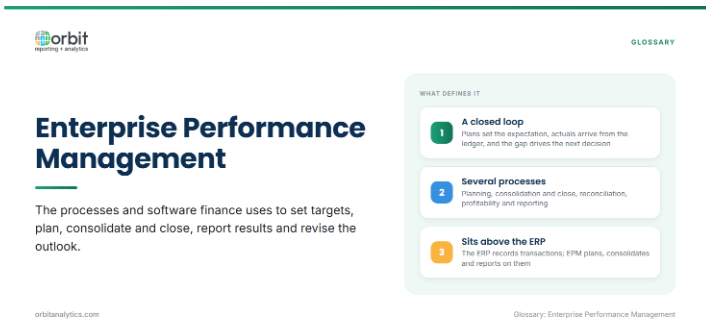
EPM is easiest to understand as a loop rather than a list of tools. Plans set the expectation, actuals arrive from the ledger, and the gap between them drives the next decision.
The EPM Cycle
Most organizations run EPM as a recurring cycle with five stages:
- Set strategy and targets: leadership sets financial and operational goals for the year, such as revenue growth, margin and cash targets.
- Plan and budget: finance and business units translate the targets into budgets and operating plans by department, product or region.
- Consolidate and close: each period, actuals from the ERP are closed, reconciled and consolidated across legal entities.
- Report and disclose: management, board and statutory reports are produced from the closed figures.
- Analyze and reforecast: results are compared against plan, variances are explained, and the forecast is updated for the rest of the year.
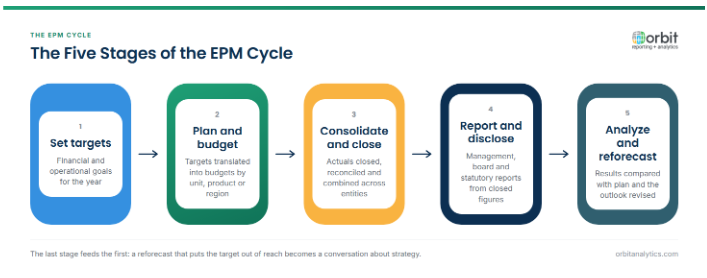
The last stage feeds the first. A reforecast that shows the year-end target is out of reach becomes a conversation about strategy, and the cycle starts again with revised targets.
Core EPM Processes
EPM is an umbrella for several distinct processes:
- Planning, budgeting and forecasting: building the annual budget and rolling forecasts, usually owned by financial planning and analysis teams.
- Financial consolidation and close: combining results from many entities, eliminating intercompany transactions and translating currencies, the work behind consolidated financial reporting.
- Account reconciliation: proving that balance sheet accounts are supported by independent evidence before the period is locked.
- Profitability and cost management: allocating shared costs to products, customers or channels to see where money is made and lost.
- Narrative and regulatory reporting: assembling annual reports, board packs and regulatory filings that combine figures with commentary.
Not every organization runs all five in dedicated software. Many start with planning and consolidation and add the rest as complexity grows.
Who Uses EPM
EPM serves several groups, each with a different question:
| Group | Main question | Typical EPM work |
|---|---|---|
| CFOs and finance leaders | Are we on track, and what should change? | Targets, forecast reviews, board reporting |
| FP&A teams | What will happen if current trends continue? | Budgets, forecasts, scenarios, variance analysis |
| Controllers and accounting teams | Are the numbers complete and correct? | Close, reconciliation, consolidation |
| Business unit leaders | How is my unit performing against plan? | Departmental budgets and performance reviews |
The groups depend on each other. FP&A cannot forecast credibly until the controller has closed the period, and business unit leaders only engage with a plan when they can see their own actuals against it.
Oracle EPM Cloud and Hyperion
In the Oracle world, EPM descends from Hyperion, which Oracle acquired in 2007. Hyperion Planning, Hyperion Financial Management and the Essbase multidimensional database were the standard on-premises EPM stack for many large finance teams.
Oracle EPM Cloud is the successor. Its main applications include Planning, Financial Consolidation and Close, Account Reconciliation, Narrative Reporting, Profitability and Cost Management, Tax Reporting and Enterprise Data Management. EPM Cloud is a separate product from Oracle Fusion Cloud ERP, connected to it through data integration rather than sharing one database.
That separation is where many reporting questions arise, because plans live in EPM and actuals live in the ledger. Orbit Analytics provides Oracle Fusion financial reporting on ledger actuals from Oracle Fusion Cloud and EBS. It also supports Oracle EPM planning, budgeting and consolidation data in the same reporting layer, so plan and actual figures sit side by side.
Benefits of EPM
When the cycle runs well, the benefits are practical:
- One version of the plan: budgets and forecasts sit in one governed model instead of dozens of departmental spreadsheets.
- Faster, more controlled close: standard consolidation rules, reconciliation workflows and approvals shorten the close and leave an audit record.
- Earlier warning when results drift: regular comparison of actuals against plan shows a problem while there is still time to respond.
- Consistent reporting: board, management and statutory reports draw on the same closed figures.
Common EPM Challenges
EPM projects tend to struggle at the edges, where EPM meets other systems:
- Spreadsheets between ERP and EPM: actuals are often exported from the ERP, adjusted in workbooks and loaded into EPM by hand, which adds delay and breaks traceability. Orbit Analytics reduces that manual step with 200+ pre-built connectors that read ERP data directly.
- Metadata that drifts from the ledger: account and entity hierarchies in EPM fall out of step with the chart of accounts in the ERP, so the same account rolls up differently in each system.
- Plans nobody compares to actuals: a budget built once a year and never revisited turns EPM into a filing exercise rather than a management process.
- Too much detail in the plan: planning at the lowest ledger level makes models slow and forecasts no more accurate.
EPM vs ERP vs Business Intelligence
The three are often confused because they all hold financial data:
| System | Records or produces | Main users | Time focus |
|---|---|---|---|
| ERP | Transactions: invoices, payments, journals | Operations and accounting | What happened today |
| EPM | Plans, forecasts, consolidated and closed results | Finance leadership, FP&A, controllers | The period and the year ahead |
| Business intelligence | Analysis and dashboards across both | Analysts and managers across the business | Any period, any question |
They work together. The ERP is the source of actuals, EPM turns actuals and plans into a managed financial cycle, and BI lets people explore the data in both without changing it.
Frequently Asked Questions
Q1. What is the difference between EPM and ERP?
An ERP records the business’s transactions, such as invoices, payments and journals. EPM uses the ERP’s actuals alongside plans and forecasts to manage performance across the planning, close and reporting cycle.
Q2. Is EPM the same as CPM?
In practice, yes. Corporate performance management and business performance management describe the same set of processes, and the term used mostly depends on the vendor or analyst firm.
Q3. Is FP&A part of EPM?
FP&A is the team and function that owns planning, budgeting and forecasting, which are core EPM processes. EPM also covers close, consolidation and reporting, which are usually owned by the controller.
Q4. What is Oracle EPM Cloud?
It is Oracle’s cloud suite for performance management, the successor to Hyperion. It includes Planning, Financial Consolidation and Close, Account Reconciliation, Narrative Reporting and other applications.
Q5. Where does EPM get its actuals?
From the general ledger in the ERP, usually loaded each period after the subledgers and ledger are closed. The quality of every EPM report depends on that feed being complete and consistent.
Q6. Does EPM replace spreadsheets?
It replaces spreadsheets as the system of record for budgets, forecasts and consolidation. Most finance teams still use Excel to analyze and present EPM data, which works well as long as the figures are read from the governed model rather than copied out of it.
EPM only works when plans can be compared with trustworthy actuals. Orbit Analytics reports on Oracle Fusion Cloud and EBS ledger data alongside EPM figures, without manual exports in between. Request a demo to see plan and actual side by side.
