
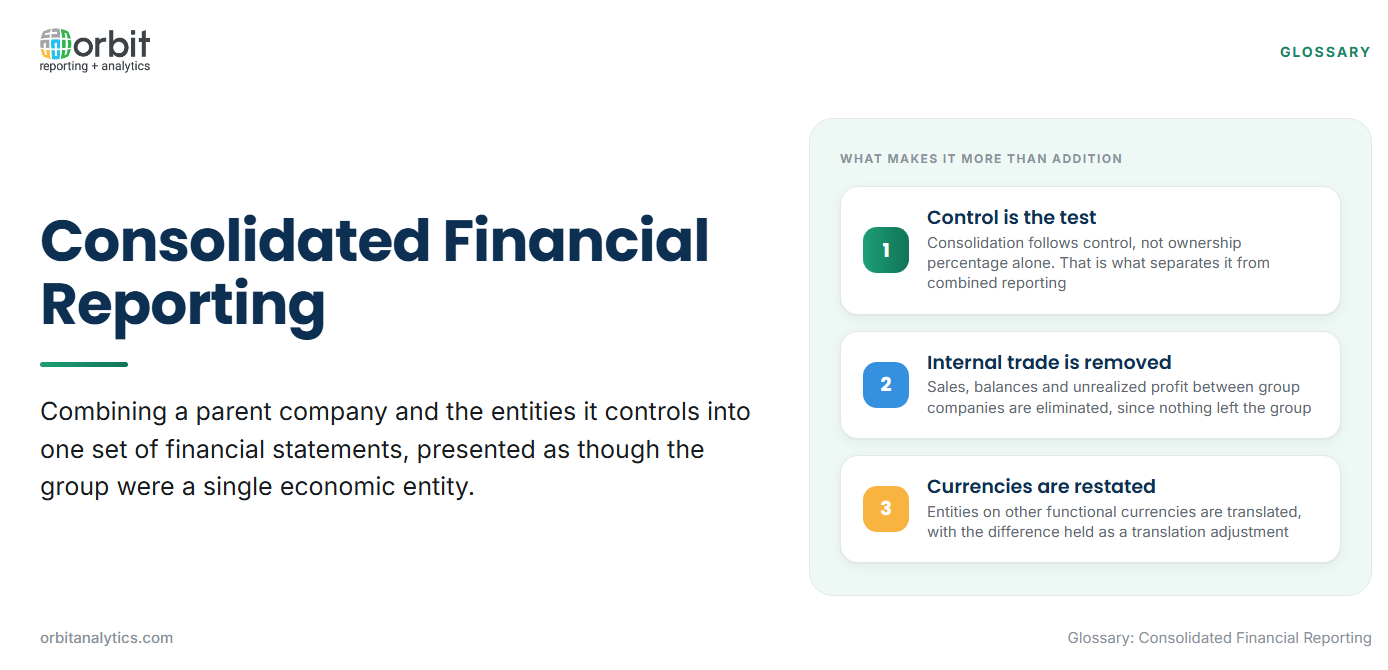
Consolidated financial reporting is the process of combining the results of a parent company and the entities it controls into a single set of financial statements, presented as though the group were one economic entity. The test is control, not ownership percentage alone, although a holding above fifty per cent of voting rights is the usual indicator.
The reason consolidation is more than addition is that groups trade with themselves. A sale from one subsidiary to another creates revenue in one set of books and cost in another, and neither represents anything the group did with the outside world. Consolidation removes those internal effects so the statements show only transactions with third parties.
What gets consolidated
- Balance sheet positions: assets and liabilities of every controlled entity are added line by line, then adjusted for intercompany balances and the elimination of the parent’s investment against subsidiary equity.
- Income statement results: revenue and expenses combine for the period the entity was controlled, which for an acquisition means from the acquisition date rather than the full year.
- Cash flows and equity movements: cash flows are consolidated on the same basis, with intercompany funding movements removed.
- Non-controlling interests: where the parent controls but does not wholly own a subsidiary, the share of net assets and profit belonging to other shareholders is presented separately rather than excluded.
The consolidation process step by step
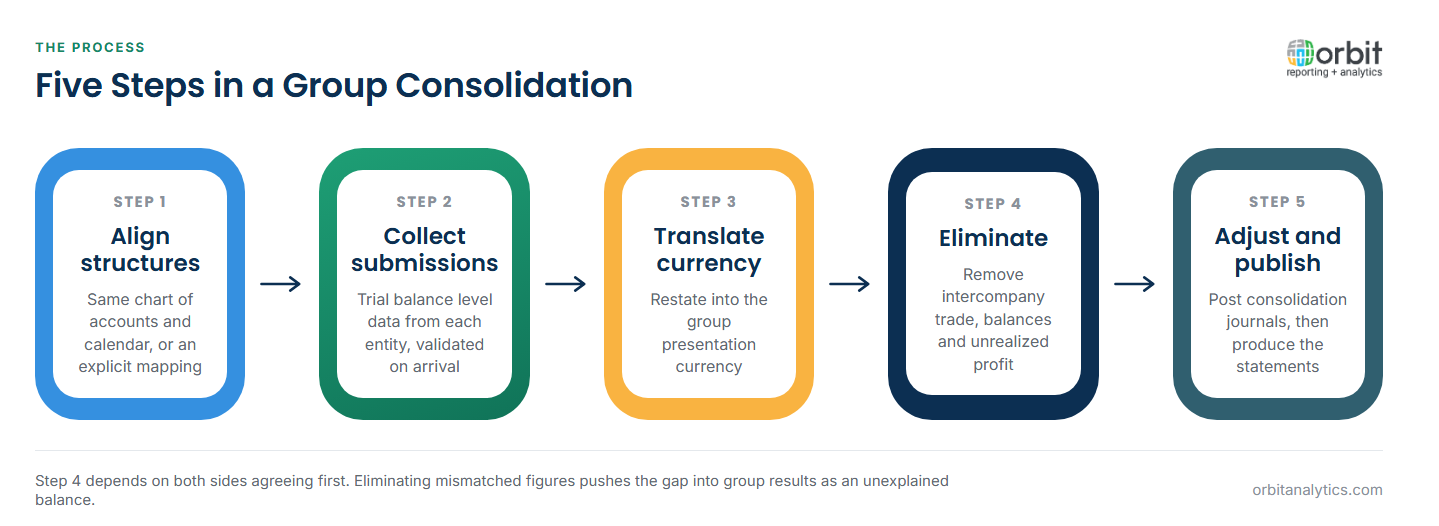
- Align charts of accounts and calendars. Every entity must report on the same account structure and the same period end, or the mapping must be defined explicitly before anything is added together.
- Collect and validate subsidiary submissions. Each entity submits a trial balance level set of figures, which is checked for completeness and internal consistency before it enters the consolidation.
- Translate foreign currency balances. Entities reporting in a different functional currency are restated into the group presentation currency.
- Eliminate intercompany transactions and balances. Internal sales, purchases, receivables, payables and unrealized profit are removed.
- Apply adjustments and produce the statements. Consolidation journals, fair value adjustments and goodwill treatment are posted, then the group statements are generated.
Intercompany eliminations explained
Elimination is conceptually simple and operationally difficult, because it depends on both sides of a transaction agreeing before anything can be removed.
Intercompany sales and purchases are removed in full from group revenue and cost of sales. If Subsidiary A sells 500,000 of goods to Subsidiary B, group revenue does not increase by 500,000, because nothing left the group.
Intercompany receivables and payables are netted off the group balance sheet for the same reason. A payable owed by one group company to another is not a liability of the group.
Unrealized profit in inventory is the subtler case. If Subsidiary A sold those goods at a margin and Subsidiary B still holds them at period end, the profit exists only inside the group and must be stripped out of both inventory and profit until the goods are sold externally.
The practical obstacle is agreement. Where Subsidiary A records a 500,000 sale and Subsidiary B records a 480,000 purchase, the 20,000 gap must be investigated and resolved before elimination, because eliminating mismatched figures pushes the difference into the group results as an unexplained balance.
Currency translation in consolidation
Translation is where most of the technical difficulty in consolidation actually sits. An entity’s functional currency is the currency of its primary economic environment. The presentation currency is the one the group reports in. When they differ, the entity’s figures must be restated, and different balances use different rates.
| Item | Rate applied |
| Assets and liabilities | Closing rate at the balance sheet date |
| Income and expenses | Average rate for the period, or transaction date rate |
| Share capital and pre-acquisition reserves | Historical rate at the date of the transaction |
| Resulting difference | Cumulative translation adjustment in other comprehensive income |
Because the balance sheet and income statement are translated at different rates, the two no longer tie. The gap is not an error: it is recognized as a cumulative translation adjustment within equity, and it accumulates over time rather than passing through profit.
Common obstacles in consolidated reporting
Subsidiaries on different ERP systems is the obstacle that causes the most work, because every submission arrives in a different structure and has to be mapped before it can be used. Charts of accounts that never fully aligned are the related problem: a group mapping table that has been patched for years quietly loses new accounts, which then fall outside the consolidation entirely.
Late and restated submissions compress an already tight timetable, and a restatement received after eliminations have been posted means redoing the work. The most serious obstacle is spreadsheet consolidation with no audit trail, where the group numbers exist only in a workbook whose formulas nobody can fully explain. Replacing that workbook with reporting that reads directly from the source ledgers is usually the single biggest improvement available, and Orbit Analytics does exactly that, making every group figure traceable back to the entity that produced it.
Consolidated financial reporting in Oracle environments
Oracle E-Business Suite and Fusion Cloud both support multiple ledgers and ledger sets, which handle a good part of the structural problem: entities sharing a chart of accounts and calendar can be reported together natively. The difficulty appears at the edges, where an acquired entity sits on a different instance, a different chart of accounts, or a different Oracle release.
The requirement that matters in practice is drill-down. A consolidated figure is only defensible if a reviewer can move from the group number to the contributing entity, then to that entity’s trial balance, then to the journals behind it. Orbit Analytics provides general ledger reporting across multiple Oracle ledgers that keeps that path intact, so a question about a group total does not become a week of investigation.
Consolidated vs. combined vs. standalone reporting
These three terms are used interchangeably in conversation and mean quite different things.
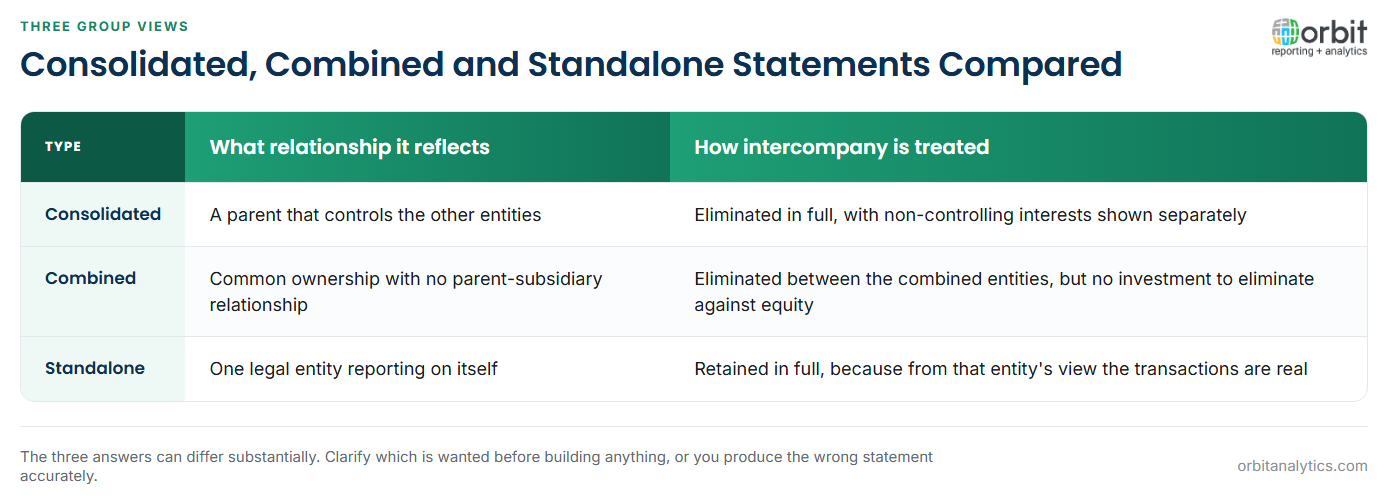
Consolidated statements reflect control. A parent consolidates the entities it controls, eliminating intercompany effects and presenting non-controlling interests separately.
Combined statements reflect common ownership without a parent. Where several entities share an owner but no single one controls the others, their results can be combined for presentation. There is no investment to eliminate against equity, because there is no parent holding.
Standalone statements reflect one legal entity. These are what a subsidiary files locally, and they include intercompany transactions in full, because from that entity’s own perspective those transactions are real.
The distinction matters when someone asks for group numbers, because the three answers can differ substantially. Clarifying which is wanted before building anything avoids producing the wrong statement accurately. Both consolidated and standalone views are ultimately products of the same underlying financial reporting cycle.
Frequently Asked Questions
Q1. What is consolidated financial reporting?
It is the process of combining a parent company and the entities it controls into one set of financial statements, presented as a single economic entity with all intercompany transactions removed.
Q2. What is the difference between consolidated and combined financial statements?
Consolidated statements are produced where a parent controls the other entities. Combined statements are produced where entities share common ownership but no parent-subsidiary relationship exists, so there is no investment to eliminate.
Q3. What are intercompany eliminations?
They are adjustments that remove transactions and balances between group companies, including internal sales and purchases, intercompany receivables and payables, and profit on goods still held within the group.
Q4. Why is currency translation needed in consolidation?
Because subsidiaries operating in different functional currencies must be restated into the group presentation currency. Different balances use different rates, and the resulting difference is recorded as a cumulative translation adjustment.
Q5. What is a non-controlling interest?
It is the portion of a subsidiary’s equity and results that belongs to shareholders other than the parent. The subsidiary is still consolidated in full, with that share presented separately.
Q6. What makes consolidation difficult across multiple ERP systems?
Each system produces a different account structure and calendar, so every submission needs mapping before it can be combined. Mapping tables drift as new accounts are created, and unmapped accounts silently fall out of the group figures.
Group reporting stops being a monthly ordeal when the consolidated figures read directly from the entity ledgers instead of a spreadsheet. Orbit Analytics delivers multi-ledger reporting across Oracle EBS and Fusion Cloud with drill-down from any group number to its source. Request a demo to see it on your own entity structure.
