
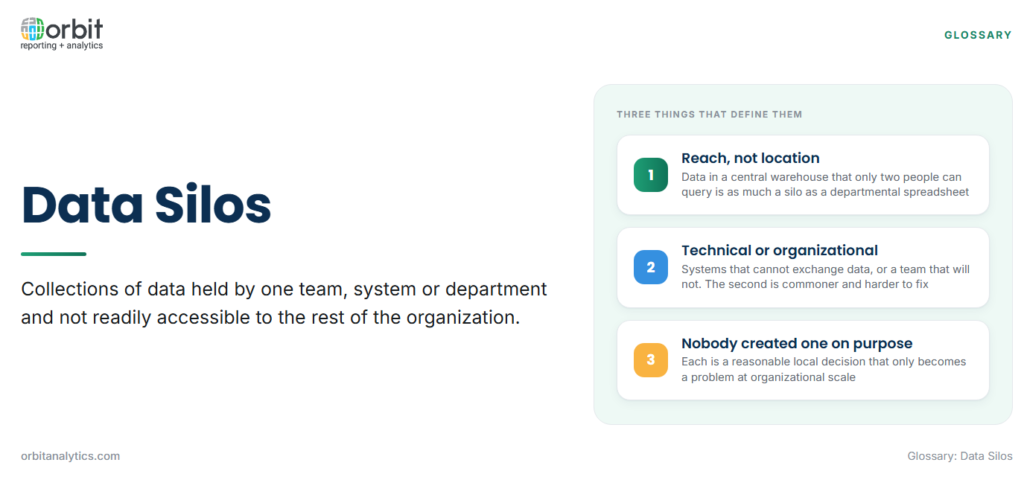
Data silos are collections of data held by one team, system or department and not readily accessible to the rest of the organization. The defining characteristic is reach rather than location: data sitting in a central warehouse that only two people can query is as much a silo as a spreadsheet on a departmental drive.
Silos come in two forms that need different responses. A technical silo exists because systems cannot exchange data, through incompatible formats, missing interfaces or no shared identifier. An organizational silo exists because a team will not share data, or because nobody has ever asked. The second is more common and considerably harder to fix, because no integration project resolves a governance question.
What causes data silos
Almost no silo is created deliberately. Each one is a reasonable local decision that becomes a problem at organizational scale.
- Departmental systems bought independently: marketing buys a platform, operations buys another, and each is a sensible purchase that arrives with its own database.
- Mergers and acquisitions: an acquired business brings a complete parallel stack, and integrating it is always scheduled for later.
- Legacy systems that outlive their owners: the person who understood the extract left, so the system stays running and unexamined.
- Access controls applied too broadly: a genuine restriction on sensitive fields gets implemented as a restriction on the entire dataset.
- Spreadsheet workarounds that become systems: a temporary file bridging a gap acquires users, then dependents, then a monthly deadline.
The real cost of data silos
The visible cost is duplicated storage and licence spend, and it is the least important one. The real damage shows up in decisions.
Conflicting numbers in the same meeting is the clearest symptom. When finance and operations quote different revenue figures, the meeting stops being about the business and becomes about whose number is right, which is time spent producing nothing.
Manual reconciliation effort is the recurring tax. Somebody spends days each period aligning figures that disagree because they come from different systems with different rules. That effort is invisible in any budget because it is absorbed inside existing roles.
Delayed decisions and stale reporting follow, because assembling a cross-functional view takes long enough that the answer arrives after the moment it was needed. Compliance and audit exposure is the quiet risk: when data about the same customer or transaction exists in several places with no authoritative version, satisfying an audit request or a data subject access request becomes an investigation.
Signs your organization has data silos
- Two teams report different revenue for the same period, and both can justify their figure.
- Reporting requests route through one person, because only they know which system holds what.
- Month-end depends on emailed extracts arriving from other departments before anything can be assembled.
- Nobody can say where a number came from. A figure appears in a board pack and tracing it back takes more than a few minutes.
Any one of these on its own is survivable. Two or more together means the organization is managing around its silos rather than through its data, and the workarounds have become the process.
How to break down data silos
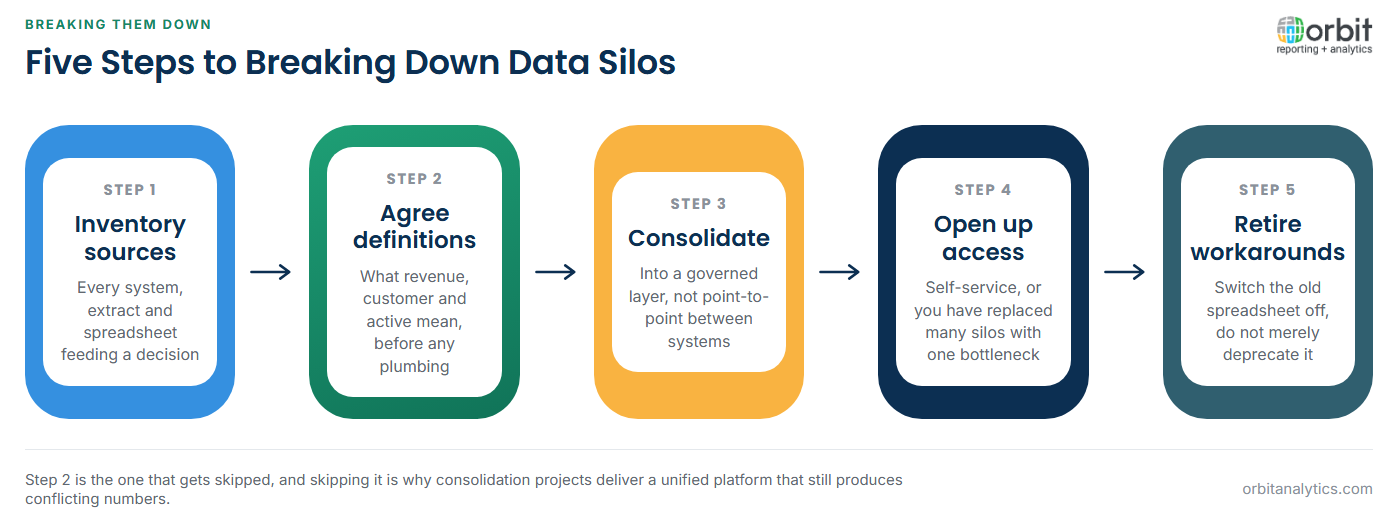
- Inventory the sources. List every system, extract and spreadsheet that feeds a decision, including the ones nobody officially owns. The list is usually longer than expected.
- Agree the definitions before the plumbing. Decide what revenue, customer and active mean across the organization. Skipping this step is the most common reason consolidation projects deliver a unified platform that still produces conflicting numbers.
- Consolidate into a governed layer. Bring the sources together where definitions, security and lineage are applied consistently, rather than point-to-point between every pair of systems.
- Give teams self-service access. Consolidation that ends in a central team fulfilling requests has replaced many silos with one bottleneck. Self-service reporting is what converts access into use, and Orbit Analytics delivers it on top of the governed layer rather than as a separate tool.
- Retire the workarounds. The old spreadsheet must be switched off, not merely deprecated, or it will continue to circulate alongside the new source.
Data silos in Oracle ERP landscapes
Oracle environments have a characteristic version of this problem. Many organizations run E-Business Suite and Fusion Cloud side by side, often for years, because a phased transition is safer than a single cutover. The two hold overlapping data on different structures, which makes every group-level question a reconciliation exercise.
Around them sit subledgers, industry bolt-ons and departmental extracts that were built when the core system could not answer a specific question. Each was justified at the time and each now holds data the rest of the organization cannot see. A full re-platform resolves this eventually, but the reporting problem is immediate and cannot wait for it. Orbit Analytics addresses that gap directly, reading live data from both EBS and Fusion Cloud alongside other sources so that a single enterprise reporting system view is possible without first completing the migration. Its data pipeline handles the consolidation into a governed layer rather than requiring a bespoke interface for each source.
Governance that keeps silos from returning
Consolidation is a project. Staying consolidated is a practice, and without it silos reform within a year or two.
Owned definitions and a shared dictionary are the foundation: every significant metric needs a named owner who can settle disputes about what it means. Access granted by role rather than by system is the second element, because it removes the incentive to take a private copy. When someone can reach what their job requires through a standard route, they stop building their own.
The third is monitoring for new shadow extracts. New silos announce themselves through new recurring exports, and noticing them early turns a conversation into a small fix rather than an entrenched dependency.
Data silos vs. data fragmentation vs. shadow systems
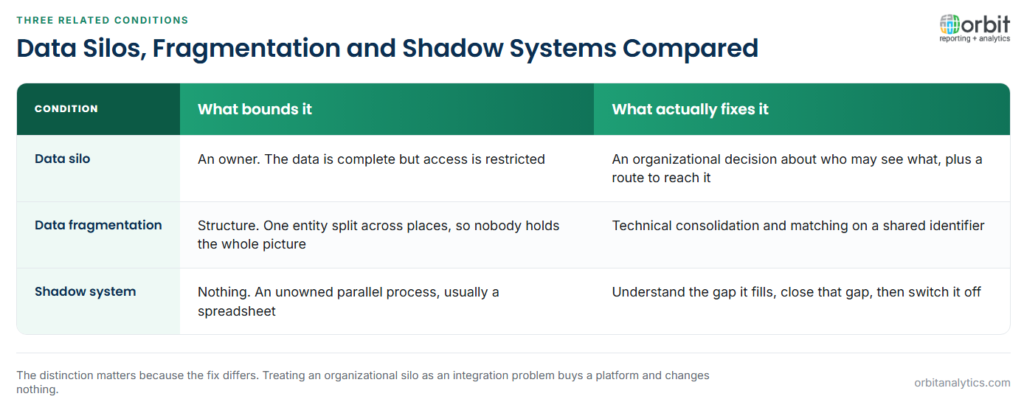
These three describe related conditions and are often used interchangeably, which matters because the fix differs.
A data silo is bounded by an owner. The data is complete and usable, but access is restricted to one team or system. The fix is organizational: agree who may see what and provide a route.
Data fragmentation is bounded by structure. The same entity is split across several places, so no single location holds the whole picture, even for the people who own it. The fix is technical: consolidate and match on a shared identifier.
A shadow system is an unowned substitute. Somebody built a parallel process, usually in a spreadsheet, because the official system could not do something. The fix is neither purely technical nor organizational: it requires understanding what gap the shadow system fills, then closing that gap before switching it off.
Frequently Asked Questions
Q1. What are data silos?
Data silos are datasets held by one team, system or department and not readily accessible to others. What defines a silo is who can reach the data, not where it is physically stored.
Q2. What causes data silos?
Independently purchased departmental systems, acquisitions that bring a parallel stack, legacy systems nobody owns, access controls applied too broadly, and spreadsheet workarounds that become permanent.
Q3. Why are data silos a problem?
They produce conflicting numbers, force manual reconciliation, delay decisions, and create audit exposure because no version of a record is authoritative. The reconciliation effort is usually invisible in any budget.
Q4. What is the difference between a data silo and a data warehouse?
A warehouse is a consolidated store designed for shared access. It becomes a silo only if access to it is restricted to a small group, which happens more often than people expect.
Q5. How do you break down data silos?
Inventory every source, agree shared definitions before building anything, consolidate into a governed layer, give teams self-service access, then switch off the workarounds rather than leaving them running.
Q6. What is the difference between data silos and data fragmentation?
A silo is bounded by an owner, so the data is whole but access is restricted. Fragmentation is bounded by structure, so the same entity is split across places and nobody holds the complete picture.
Breaking down silos is usually blocked by the reporting layer rather than the storage layer. Orbit Analytics reads live data across Oracle EBS, Fusion Cloud and other sources into one governed view, without waiting for a full re-platform. Request a demo to see it against your own systems.
