
An AI data analyst is software that takes a business question in plain language, finds the relevant data, runs the analysis and returns a number, a chart and a short explanation. It keeps the context of the conversation, so the next question can build on the last answer.
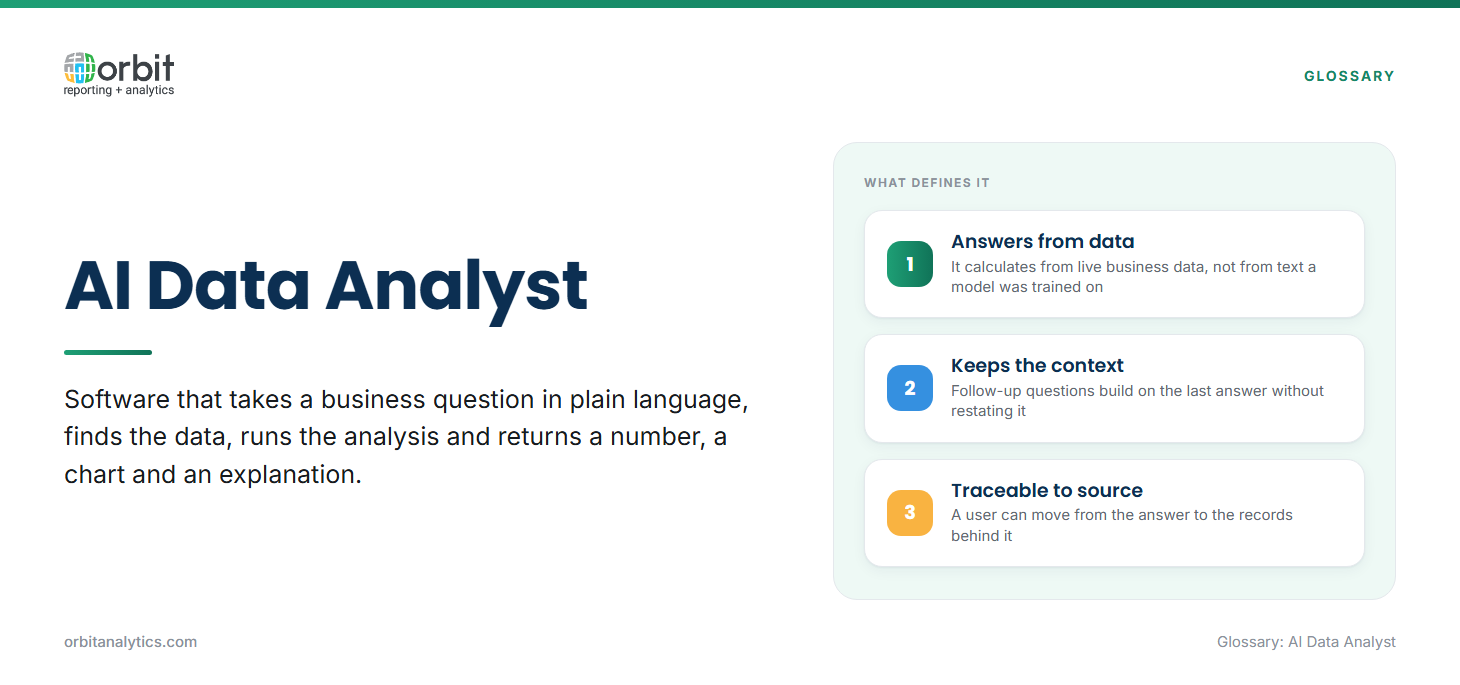
The term is often shortened to “AI analyst”, and the two names describe the same idea. Both sit on top of conversational analytics, the technology that lets people query data in everyday language. The analyst is the product shape built on that technology: something a finance manager can ask “Why did margin fall in March?” and get an answer from the actual figures.
What makes it an analyst rather than a search box is the work between question and answer. A search box finds documents that mention margin. An AI data analyst decides which measure, period and filters the question implies, calculates the result and explains what drove it.
How an AI Data Analyst Works
Every answer follows the same five steps:
- Read the question: identify the measure, the time period, the comparison and any filters, such as “operating expenses, this quarter, compared with last quarter, for the UK entity”.
- Map business words to data: translate “operating expenses” and “UK entity” into the tables, columns, accounts and hierarchies that hold them.
- Build and run the query under the user’s permissions: generate the query against the mapped data and execute it as the person asking. A user who cannot see a ledger in reports should not see it here either.
- Return the number, the chart and the explanation: present the result, pick a sensible visual and describe which items drove the change.
- Keep context for the follow-up: remember the measure, period and filters, so “break that down by cost center” needs no restating.
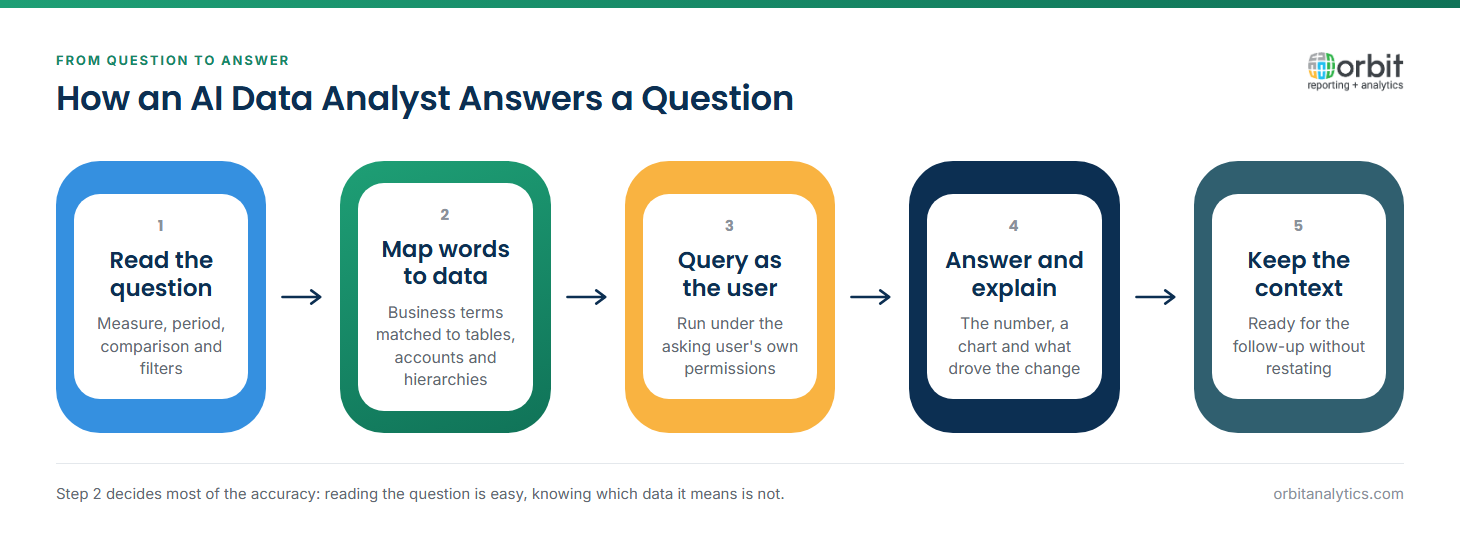
Step 2 is where most of the difficulty sits. The question is easy to read; knowing which of thousands of columns “operating expenses” means is the hard part.
What an AI Data Analyst Can Answer
The questions fall into four broad groups:
- Lookups and rankings: “What were total receivables at month end?” or “Who are our top ten suppliers by spend?”
- Period comparisons and trends: “How did revenue this quarter compare with the same quarter last year?”
- “Why did this change?” questions: the analyst breaks a movement into its contributors, such as the cost centers or accounts that explain most of a rise in expenses.
- Drill-downs to transactions: from a total to the invoices, journals or purchase orders behind it, which is how a user checks that the number is right.
AI Data Analyst vs AI Chatbot vs BI Copilot
Three kinds of AI tool get described as “analysts”, and they do different jobs:
| Tool | Answers from | Typical output |
|---|---|---|
| General AI chatbot | Text it was trained on, plus any documents supplied | Prose, summaries, drafts |
| BI copilot | The BI tool’s own report and dashboard designer | A report, chart or formula for a person to finish |
| AI data analyst | Live business data, through a governed model | A calculated answer with its explanation and drill path |
A chatbot can explain what operating expenses are. Only an AI data analyst can tell you what yours were last quarter.
Why the Data Foundation Decides Accuracy
The chat interface is rarely what makes an AI data analyst right or wrong. The data foundation is:
- Raw tables versus a semantic layer: pointing AI at raw ERP tables forces it to guess joins and meanings. A semantic layer gives it business objects with the relationships already defined.
- Shared metric definitions: “revenue” and “headcount” need one approved definition each, or the AI will give a different answer from the finance report.
- Hierarchies, calendars and currencies: cost center rollups, fiscal periods and currency conversion have to be modelled, because a question about “Q3” means the fiscal quarter, not the calendar one.
AI Data Analysts on Oracle ERP Data
ERP schemas are hard for AI. Thousands of tables, cryptic column names, flexfields and multi-level security sit between a plain question and a correct number.
An AI data analyst for Oracle Fusion has to understand ledgers, business units and subledger detail before it can answer a question such as “Why did operating expenses increase this quarter?” An AI data analyst for Oracle EBS faces thousands of tables and flexfields, and it has to respect each user’s EBS responsibilities.
Orbit Analytics offers ThinkBoxes as an AI data analyst for both Oracle Fusion and Oracle EBS, with one ThinkBox per business domain. The Financials ThinkBox, for example, covers General Ledger, Payables, Receivables, Cash Management and Fixed Assets. A conversation moves from the question to the answer, the explanation and then the underlying detail.
Limits and Risks
AI data analysts have known weaknesses:
- Plausible but wrong answers: a model can return a confident number built on the wrong table or filter, which is a form of AI hallucination.
- Ambiguous business terms: “sales” can mean bookings, invoiced revenue or shipments. A guess produces an answer to a question nobody asked.
- Permission leakage: if the AI runs with broader access than the user, it can expose figures the user cannot see in reports.
- Over-reliance on a single answer: a fast answer can discourage the checking an analyst would normally do before a number reaches a board pack.
Keeping AI Data Analyst Answers Trustworthy
Three habits make answers worth acting on:
- Trace every answer to its source rows: the user should be able to move from a total to the transactions that make it up.
- Inherit existing security: the AI should apply the same roles and data access rules as the source system, never its own.
- Ask back when a term is ambiguous: a clarifying question is better than a confident answer to the wrong question.
Orbit Analytics builds ThinkBoxes on its governed data models and a semantic layer, so users can move from an answer to the numbers behind it. For EBS, existing EBS responsibilities stay part of the security model.
AI Data Analyst: The Software vs the Job Title
Search for “AI data analyst” and most results describe a job, not software:
- The software meaning: an AI system that answers business questions from data, as described on this page.
- The career meaning: a human data analyst who uses AI tools, or who builds and tests AI models as part of the role. Job postings under this title usually ask for SQL, Python and machine learning skills.
- How the two work together: the software takes routine lookups and comparisons off the analyst’s desk. The human analyst defines the metrics, checks the answers and handles questions that need judgment.
Frequently Asked Questions
Q1. What is an AI data analyst in simple terms?
It is software you can ask a business question in plain language. It finds the data, calculates the answer and explains it, and it remembers the context for follow-up questions.
Q2. Is an AI analyst the same as an AI data analyst?
Yes. Both names describe AI software that answers questions from business data. “AI data analyst” is also used as a job title for people who work with AI tools.
Q3. How is an AI data analyst different from ChatGPT?
A general chatbot answers from the text it was trained on. An AI data analyst answers from your organization’s live data, under your permissions, and can show the records behind the number.
Q4. Can an AI data analyst give wrong answers?
Yes, especially when it queries raw tables or meets an ambiguous term. Governed data models, shared metric definitions and drill-down to source rows make errors much easier to catch.
Q5. Will an AI data analyst replace human data analysts?
Not in practice. It handles routine questions faster, while people still define metrics, check results and answer questions that need business judgment.
An AI data analyst is only as reliable as the data model it answers from. Orbit Analytics gives Oracle Fusion and EBS users governed, traceable answers to plain-language questions. Request a demo to see it on your own data.
