
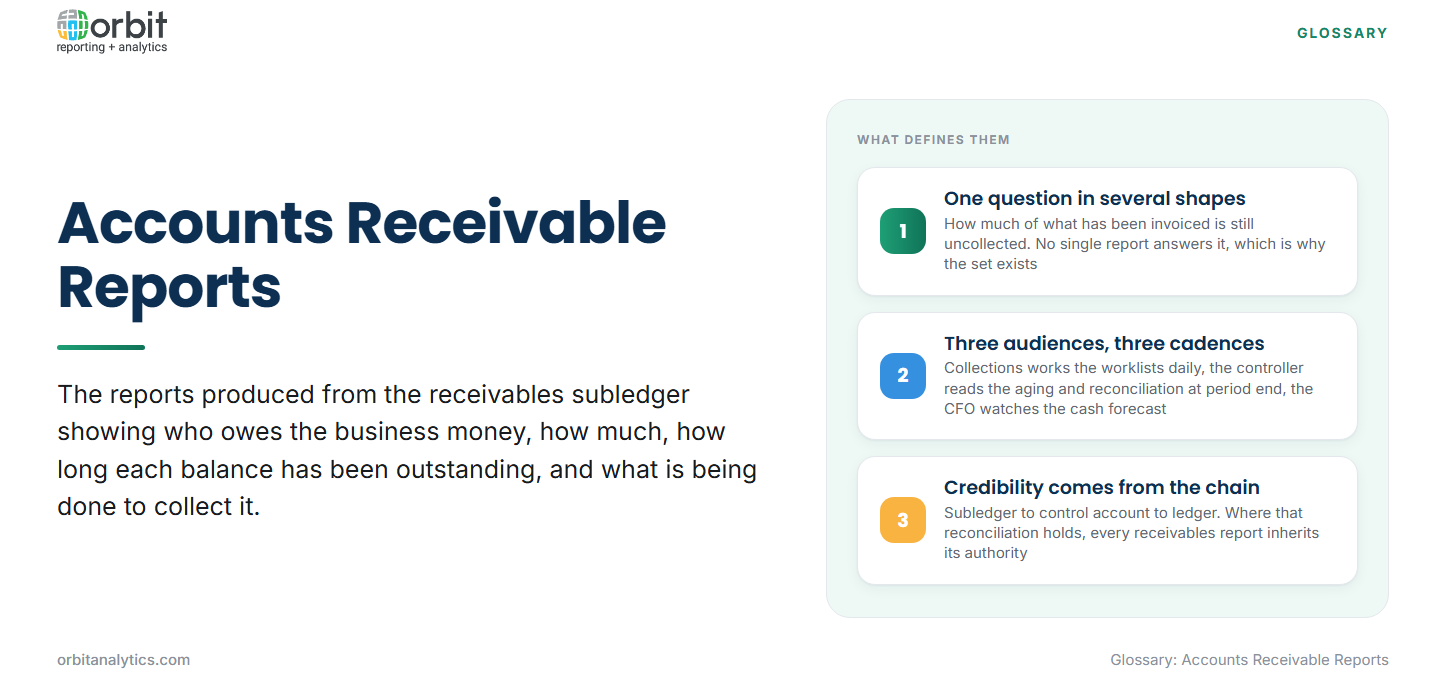
Accounts receivable reports are the reports produced from the receivables subledger showing who owes the business money, how much, how long each balance has been outstanding, and what is being done to collect it. Together they answer one question in several shapes: how much of what has been invoiced is still uncollected.
No single report covers the function. The aging report shows exposure by age, the cash receipts register shows what was collected, the collections worklist shows what is being chased this week, and the trial balance proves it all agrees with the general ledger. Reading one in isolation is how receivables surprises happen.
The audience splits by cadence: the collections work the operational reports daily, the controller reads the aging and the reconciliation at period end, and the CFO watches the cash forecast.
The Core Accounts Receivable Report Set
Five reports make up the standard set, and the names vary more than the content does.
- Aging report: buckets every open balance by how long it has been outstanding, typically current, 1-30, 31-60, 61-90 and over 90 days. It is what most people mean by receivables reporting.
- Open receivables and AR trial balance: lists every open item at a point in time and totals it. The trial balance version has to agree with the receivables control account in the ledger.
- Cash receipts and application register: shows money received in the period and the invoices it was applied against. Receipts that arrived without a match sit here as unapplied cash.
- Customer statement: the customer-facing view of one account over a period, listing invoices, credits and payments, and a collections instrument as much as a report.
- Credit memo and adjustment register: records every reduction to a receivable that was not a payment, which is what explains a balance falling without cash arriving.
Reports That Drive Collections
Collections has no equivalent on the payables side, and it runs on worklists and activity records rather than balances.
- Collections worklist: ranks accounts by what should be chased next, usually on balance, age and date of last contact.
- Promise-to-pay tracking: records what a customer committed to and flags it when the date passes without payment. A broken promise is a stronger risk signal than age alone.
- Dispute and deduction report: separates balances the customer is contesting from balances they are simply paying late. The two need different people and different fixes.
- Dunning and correspondence history: shows what has already been sent to each account, which stops two people chasing one invoice in the same week.
Reports That Measure Cash and Credit Risk
Where the collections reports ask what to chase today, these ask what the receivables book is worth. A cash forecast built from open receivables applies each customer’s payment history to their balances, which beats assuming everyone pays on terms. Credit exposure reporting compares open balances against the limit granted.
Four metrics come out of this group and carry most of the reporting conversation:
- Days sales outstanding (DSO): average days between invoicing and collection, calculated as closing receivables divided by credit sales for the period, multiplied by days in the period.
- Collections effectiveness index: the share of what was available to collect that was collected, which separates collections performance from sales growth in a way DSO does not.
- Percentage of receivables past due: the share of the open book beyond terms, which moves faster than DSO and works better as an early warning.
- Average days delinquent: average days past due across delinquent balances, isolating lateness from the payment terms themselves.
How the Reports Fit Together
Each report answers a different question.
| Question | Report to run |
| How much are we owed, and how old is it? | Aging report |
| Does the subledger agree with the ledger? | AR trial balance |
| What was collected this period? | Cash receipts register |
| Who should be chased today? | Collections worklist |
| Why did a balance fall without a payment? | Adjustment register |
The reconciliation chain is what makes the set trustworthy, and it runs in three steps:
- The open items on the AR trial balance total to the receivables subledger balance.
- That subledger balance agrees with the receivables control account in the general ledger.
- Any remaining difference is explained by a named item, usually a journal posted straight to the control account or a period closed in one system and not the other.
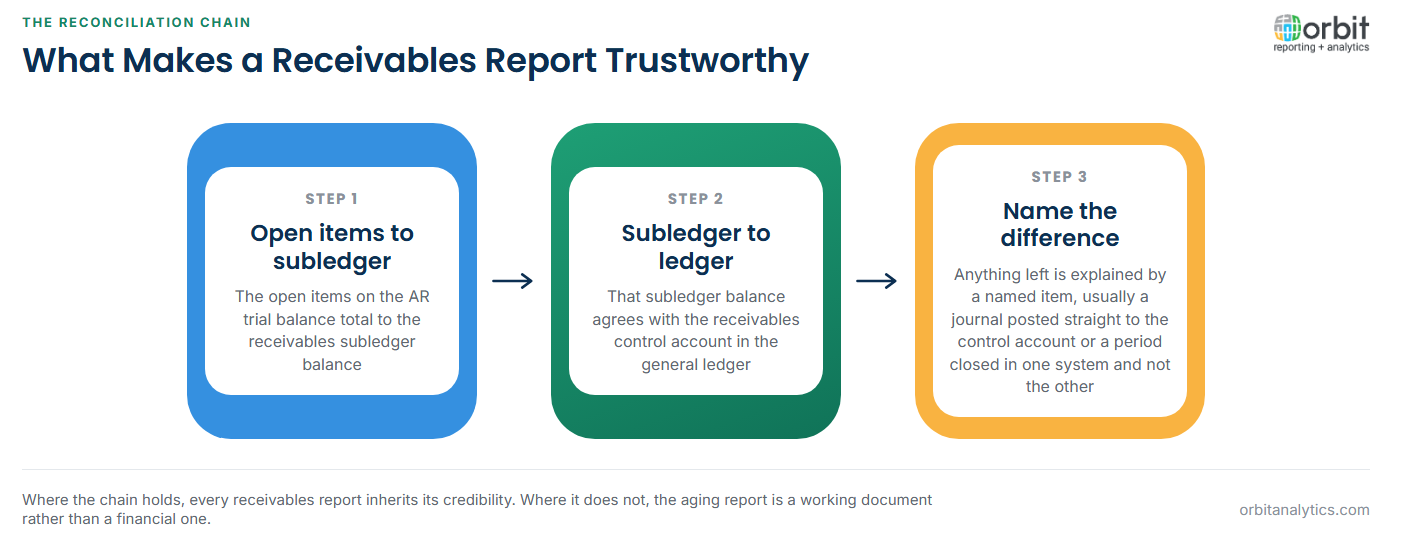
Where the chain holds, every receivables report inherits its credibility. Where it does not, the aging report is a working document rather than a financial one, and two reports can differ with nobody able to say why. A reconciliation assembled by hand rarely stays current, and general ledger reporting that holds subledger detail and the ledger balance together turns step three into a drill-down instead of an investigation.
Accounts Receivable Reporting in Oracle
In Oracle EBS and Oracle Fusion Cloud the standard receivables reports live in the Receivables module and are dependable for a single ledger. The difficulty starts when the business is not a single ledger.
Groups operating several legal entities run several ledgers in several currencies, and the standard reports are scoped to one at a time, so a consolidated aging means running the same report repeatedly and assembling the results elsewhere. Orbit Analytics reads Fusion Cloud and EBS receivables data directly and reports across ledgers, entities and currencies in one pass, with drill-down from a consolidated total to the invoice that created the balance.
Common Problems With AR Reporting
- Unapplied and unidentified cash: money has arrived but is not matched to an invoice, so the customer still shows as owing it and the aging overstates exposure.
- Aging buckets that hide a single balance: a heavy 90+ bucket reads as a systemic problem, but is often one disputed invoice from one customer. Summaries conceal concentration.
- Period-end timing differences: invoices raised after the cut-off, receipts applied in the next period and reports run on different as-of dates produce differences that are real rather than errors.
- Manual consolidation across entities: exporting each entity’s aging to a spreadsheet and combining it adds delay and a version problem. With Orbit Analytics, that consolidation runs as a report rather than a monthly assembly job.
Receivables Reports vs. Payables Reports vs. the Ledger
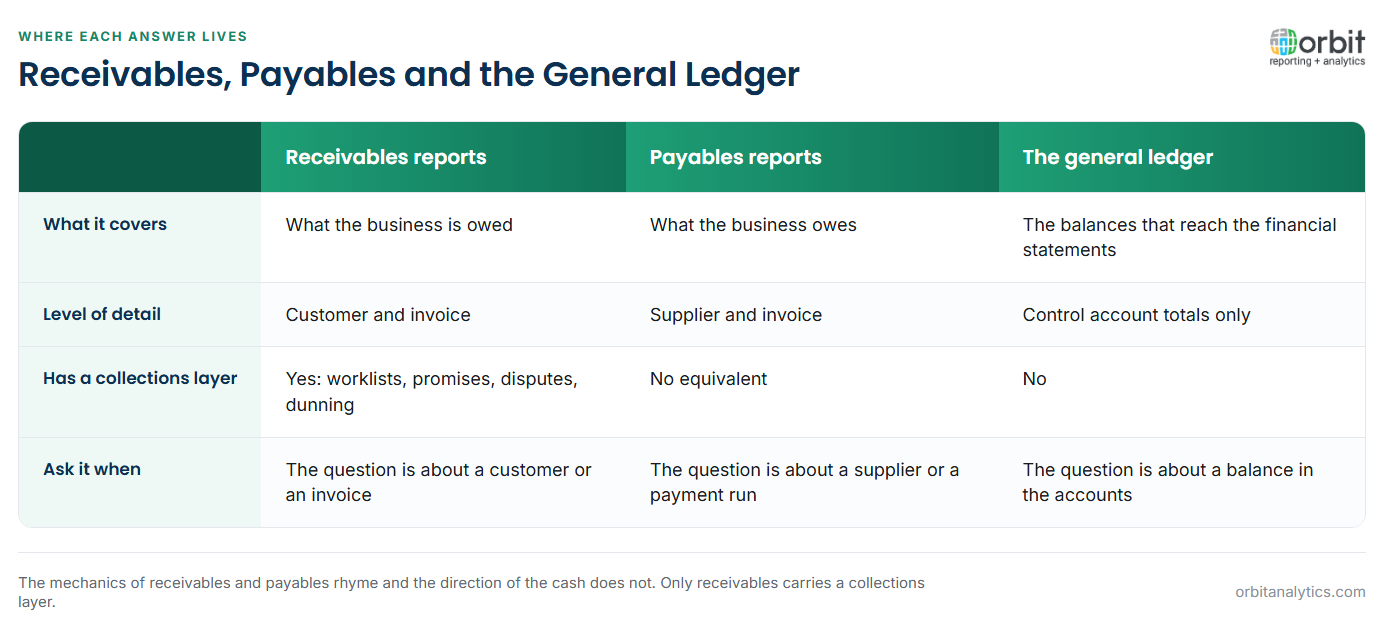
Receivables reports cover what the business is owed. Their mirror image is the accounts payable reports set, covering what the business owes: open invoices, payment runs, supplier statements and the equivalent accounts payable aging report. The mechanics rhyme, the direction of the cash does not, and only receivables carries a collections layer.
The general ledger proves both. Receivables and payables hold the detail, while their control accounts hold the totals that reach the financial statements. Reach for a subledger report when the question is about a customer or an invoice, and the ledger when it is about a balance in the accounts.
Frequently Asked Questions
Q1. What are accounts receivable reports?
They show who owes the business money, how much, how overdue each balance is and what is being done to collect it. The core set is the aging report, the AR trial balance, the cash receipts register, customer statements and the adjustment register.
Q2. What is an accounts receivable aging report?
It groups every open customer balance by how long it has been outstanding, usually in 30-day buckets. It sizes overdue exposure and prioritises collections work, and it is the most frequently run report in the set.
Q3. What is days sales outstanding?
DSO is the average number of days between raising an invoice and collecting it: closing receivables divided by credit sales for the period, multiplied by the days in that period. A rising DSO means cash is arriving more slowly.
Q4. Why must receivables reports reconcile to the general ledger?
The receivables figure in the financial statements comes from the ledger control account, while the detail sits in the subledger. If the two disagree, either the statements are wrong or the detail is, and nobody can say which until the difference is named.
Q5. What causes unapplied cash on a receivables report?
A payment arrives without enough information to match it to an invoice: a missing remittance advice, a lump sum covering several invoices, or a short payment against a disputed amount. Until it is applied, the invoices still show as open.
Receivables reporting is only as useful as the speed at which the numbers arrive and the depth to which they can be questioned. Orbit Analytics reports live Oracle receivables data across every ledger and entity, with drill-down from any aging bucket to the invoice behind it. Request a demo to see it against your own book.
