
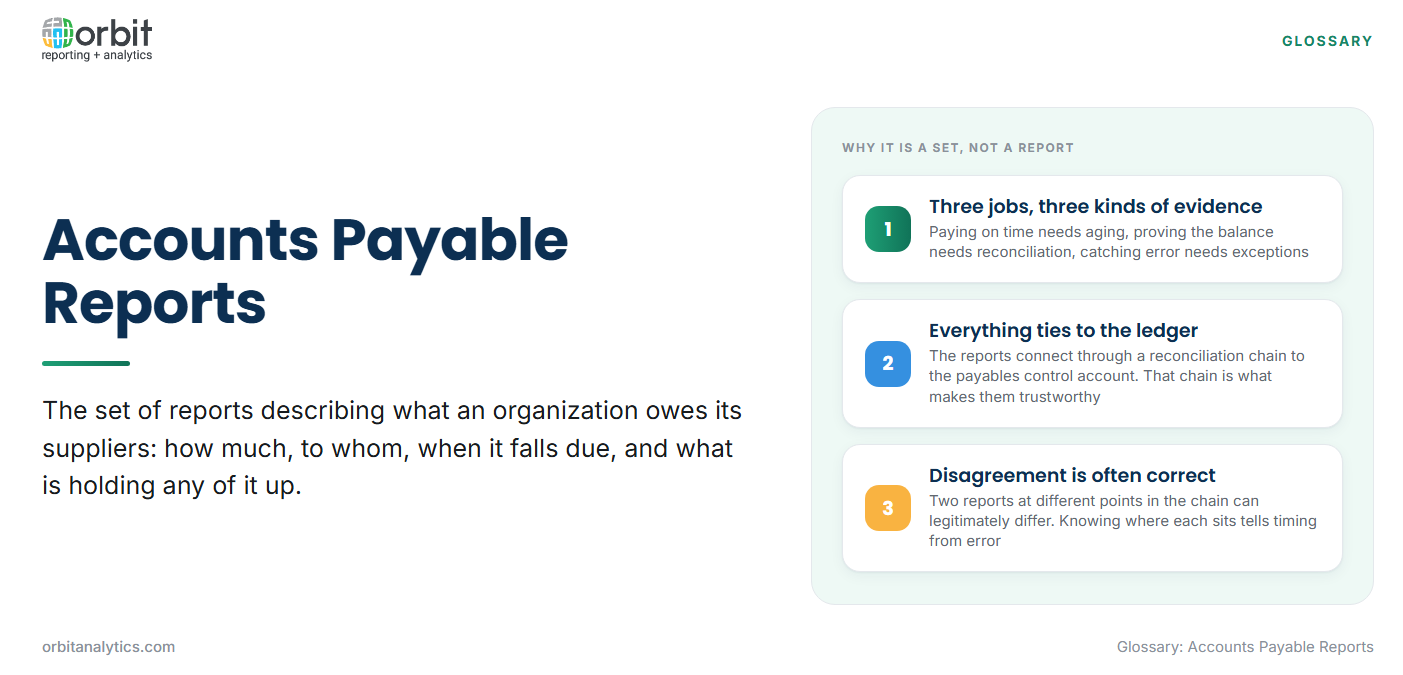
Accounts payable reports are the set of reports that describe what an organization owes its suppliers: how much, to whom, when it falls due, and what is holding any of it up. No single report answers all of that, which is why payables teams work from a set rather than a report.
The set exists because the payables function has three distinct jobs, and each needs different evidence. Paying the right amount on time needs aging and cash forecasting. Proving the balance is correct needs reconciliation to the ledger. Catching error and fraud needs exception reporting. A report that serves one of those serves the others badly.
The core accounts payable report set
| Report | What it answers |
| Aging report | How much is outstanding, and how overdue |
| Open payables / AP trial balance | Does the subledger agree with the control account |
| Payment register | What was actually paid, when and by what method |
| Invoice register | What entered the system in the period |
| Invoice hold report | What cannot be paid yet, and why |
| Supplier balance | What one supplier is owed across all their invoices |
The accounts payable aging report is the one most people mean when they say “the AP report”, and it is covered separately in depth. Within this set its job is narrow: it groups outstanding invoices by how overdue they are, and it drives the payment run.
Reports that support cash and working capital
The cash requirement forecast projects what must be paid over a coming window based on due dates and terms, which is what treasury needs to position funds. It is distinct from aging: aging looks backward at lateness, forecasting looks forward at obligation.
The discount opportunity report identifies invoices where early settlement terms are still available and quantifies what is being left behind. Discounts expire quietly, and without a report nobody notices.
Days payable outstanding tracking measures how long the organization actually takes to pay. Read alongside the discount report it exposes a real tension: stretching payment improves cash but forfeits discounts, and the two reports together let that be a decision rather than a drift.
Reports that support control and audit
- Duplicate invoice detection flags invoices matching on supplier, amount, date or invoice number. Duplicates are common, rarely malicious, and expensive when paid.
- Invoices on hold and why separates a system hold from a business dispute. A hold sitting for ninety days is either an unresolved query or a forgotten one.
- Approval and exception reporting shows what bypassed the normal path: manual payments, overridden matches, invoices approved outside limits.
- Supplier master change log records changes to bank details and supplier records. This is the single highest-value control report in payables, because payment redirection fraud works by changing bank details rather than by creating invoices.
How the reports fit together
The reports connect through a reconciliation chain, and understanding it is what lets a payables team explain a difference instead of guessing at it.
- An invoice is entered and appears on the invoice register for that period.
- It validates or goes on hold, appearing on the hold report if something fails.
- It sits open, counted in the aging report and the AP trial balance.
- It transfers and posts to the ledger, updating the payables control account.
- It is paid, leaving the aging report and appearing on the payment register.
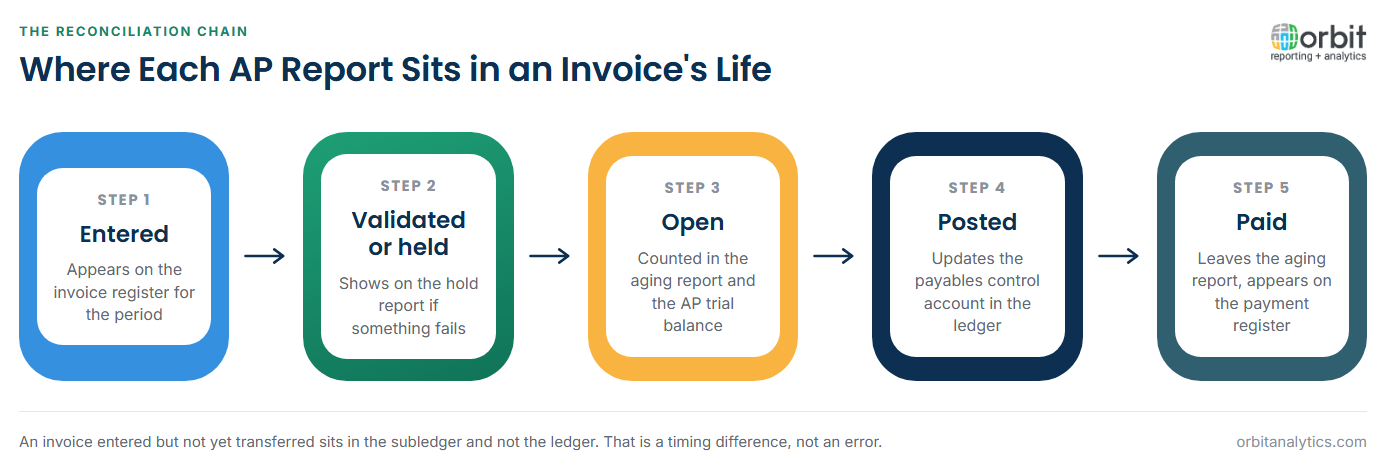
Two reports can legitimately disagree at any point in that chain. An invoice entered but not yet transferred appears in the subledger and not the ledger. That is a timing difference, not an error, and knowing where in the chain a report sits is what tells the two apart.
Accounts payable reporting in Oracle
In Oracle E-Business Suite and Fusion Cloud the standard payables reports cover the core set adequately for a single ledger in a single currency. Complexity arrives with scale: a group running several ledgers, operating units or currencies has to run each report repeatedly and combine the output by hand.
The requirement that matters is drill-down. A total on an aging bucket is only actionable if the reviewer can move from it to the invoices behind it, and from an invoice to its holds and approvals. Orbit Analytics provides operational reporting that produces one payables view across ledgers from live ERP data and keeps that path from a total to the underlying document.
The metrics these reports feed
- Days payable outstanding measures average payment time. Rising DPO improves cash and strains supplier relationships.
- Invoice processing cost and cycle time measure the efficiency of the function itself, and are what automation business cases are built on.
- First-time match rate measures how many invoices clear three-way match without intervention. A low rate points upstream to purchasing data quality rather than to payables.
- Discount capture rate measures available early-settlement discounts actually taken.
First-time match rate is the most diagnostic of the four, because payables usually inherits its problems from procurement rather than creating them.
Common problems with AP reporting
Reports that do not tie to the control account are the most serious, because every downstream figure inherits the discrepancy. The usual cause is a report reading a different data set than the ledger, or reading it as at a different moment.
Unapplied prepayments and credit memos distort supplier balances, since a credit sitting unmatched makes the supplier appear owed more than the net position.
Period-end timing differences account for most apparent errors and are usually correct behaviour being misread.
Manual consolidation across entities is where accuracy is actually lost. Each report may be right and the combined spreadsheet still wrong, because consolidation by hand has no audit trail and no reconciliation step. Orbit Analytics removes that step by reporting across ledgers directly rather than combining exports.
Payables reports vs. receivables reports vs. the ledger
The three answer questions that sound similar and are not interchangeable.
Payables reporting looks at what you owe. It drives payment timing, supplier relationships and cash outflow, and it belongs to the payables and treasury teams.
Receivables reporting looks at what you are owed. Same bucket logic, opposite direction, and it drives collections activity rather than payment runs.
The ledger proves both. The trial balance confirms that the payables and receivables subledgers agree with their control accounts. It carries no aging dimension and says nothing about lateness, which is why it is a control view rather than a management one.
Reach for payables reporting to decide what to pay, receivables to decide what to chase, and the ledger to prove that either figure is right.
Frequently Asked Questions
Q1. What are accounts payable reports?
They are the set of reports describing what an organization owes suppliers: how much, to whom, when due, and what is blocking payment. The set covers payment decisions, ledger reconciliation and exception control.
Q2. What are the most important AP reports?
The aging report for payment decisions, the AP trial balance for reconciliation, the payment register for what was actually paid, the hold report for blockages, and the supplier master change log as the key control report.
Q3. Why must AP reports reconcile to the general ledger?
Because the payables subledger and the ledger control account should hold the same balance. If they do not, either the reports are reading incomplete data or transactions exist in one place and not the other.
Q4. What is days payable outstanding?
It measures how long on average the organization takes to pay its suppliers. Rising DPO improves cash position but strains supplier relationships and usually forfeits early settlement discounts.
Q5. How are duplicate invoices detected?
By matching candidate invoices on combinations of supplier, amount, invoice date and invoice number, then reviewing the matches. Duplicates are common and rarely deliberate.
Q6. Why do two AP reports show different totals?
Usually because they sit at different points in the reconciliation chain. An invoice entered but not yet transferred to the ledger appears in the subledger and not in the control account, which is a timing difference rather than an error.
The payables reports are only as useful as the ability to move from a total to the invoice behind it. Orbit Analytics delivers that across Oracle EBS and Fusion Cloud ledgers without a manual consolidation step. Request a demo to see it on your own payables data.
