
Zero-based budgeting is a budgeting method in which every line starts at zero each cycle and has to be justified from scratch, rather than being derived from last year’s figure. Nothing is inherited. A department that spent 4 million last year does not begin the process with 4 million on the table; it begins with nothing and builds a case for each activity it wants funded.
The contrast that defines it is with incremental budgeting, where last year’s spend becomes this year’s starting point and the conversation is only about the change. Incremental budgeting is fast and it protects continuity, but it also protects spending nobody has examined in a decade. Zero-based budgeting exists to make that spending visible.
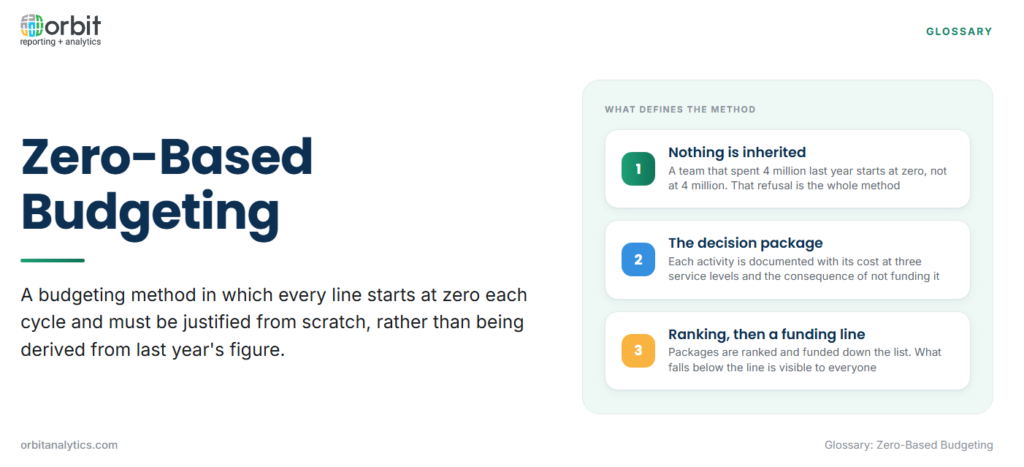
Zero-based budgeting vs. traditional incremental budgeting
Incremental budgeting assumes the existing base is broadly correct and asks what should change at the margin. It is quick and politically comfortable. Its weakness is that legacy commitments accumulate: a subscription, a contractor arrangement or a regional office survives for years because no process ever asks whether it should.
Zero-based budgeting refuses that assumption. Every activity competes on its current merits, which surfaces both the spending that has outlived its purpose and the underfunded activity incremental logic never lets catch up. The cost of that visibility is effort, and it is substantial.
The two also surface different things. Incremental budgeting controls the rate of change; zero-based budgeting reallocates between activities, which is why it is adopted when an organization needs to fund something new without growing the total.
The zero-based budgeting process
- Define the decision units. Break the organization into units small enough to have a real owner and a describable purpose, usually a function, a team or a programme rather than a whole division.
- Build the decision packages. Each unit documents its activities as discrete, fundable packages, described below.
- Rank the packages. Managers rank within a unit, then leadership ranks across units. This is the step where the method actually bites.
- Allocate against the funding line. Work down the ranked list until the available funding is exhausted. What falls below the line is not funded, and everyone can see what it was.
- Monitor and re-justify next cycle. Funding granted this year confers no claim on next year.
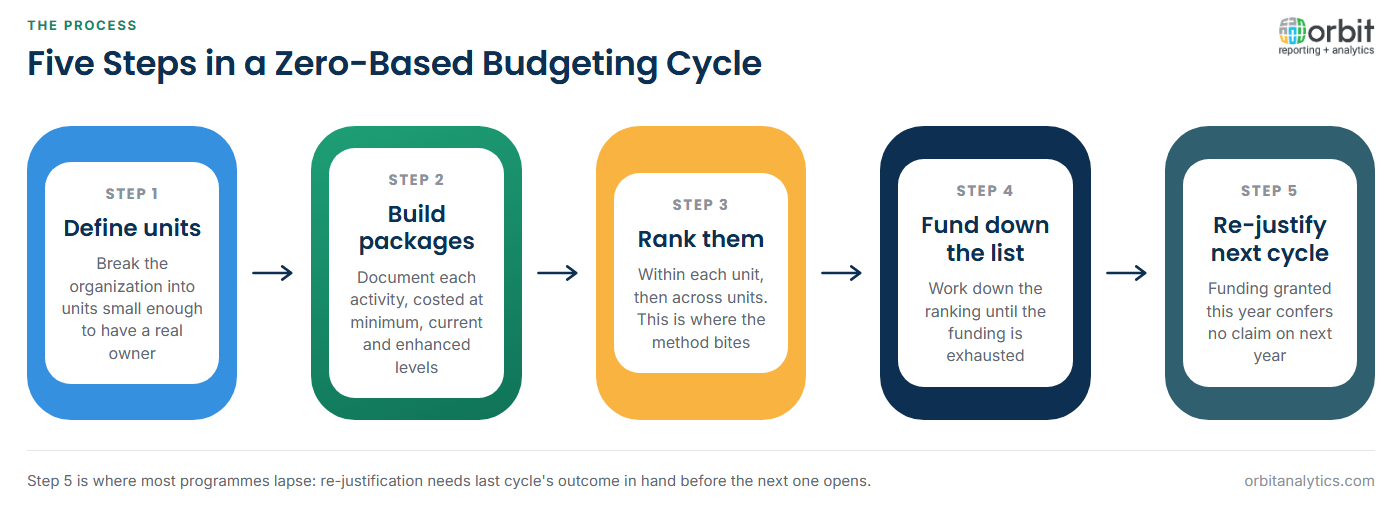
Step 5 is where most programmes quietly lapse, because re-justification needs last cycle’s outcome in hand before the next one opens. Orbit Analytics reports actuals against each funded package on a schedule, which keeps that loop closed.
What a decision package contains
The decision package is the working unit of the method, and it is the part most descriptions skip. Without it, the exercise collapses into a spreadsheet argument.
| Element | What it records |
| Activity and purpose | What is done and which objective it serves |
| Cost at service levels | What it costs at minimum, current and enhanced levels |
| Consequence of not funding | What specifically stops, and who notices |
| Alternatives considered | Other ways the same outcome could be reached |
| Owner | The named manager accountable for the package |
Costing at more than one service level is what makes ranking possible. A package offered only at its current cost is a yes-or-no decision; described at three levels, it lets leadership fund the core of many activities rather than all of a few.
The benefits organizations report
- Legacy spend becomes visible. Activities that have run on inertia have to be described and defended, and some do not survive that.
- Resources move toward priorities. Because packages compete across units, funding can shift between departments without a reorganization.
- Managers understand their own cost base. Building packages forces a level of familiarity with cost drivers that reviewing a variance report never produces.
- Padding is harder to hide. A line with no base to inherit has nowhere to conceal a contingency.
Common objections and where it fails
The effort is the first and most legitimate objection. A full cycle across an entire organization consumes weeks of management time, and repeated annually at that scale, fatigue sets in and the second cycle becomes a copy of the first.
The second is short-termism. Packages with measurable near-term output rank above research, training or maintenance, so a naive ranking defunds the things that only hurt later. Organizations running the method well protect certain categories from open ranking.
The third is gaming. Once managers understand the ranking, packages get written to rank rather than to describe, usually by overstating the consequence of not funding.
Where zero-based budgeting fits best
It works best on discretionary overheads and support functions, where activities are separable and the counterfactual is knowable. It works badly on committed costs and regulated activity, because building a decision package for something that cannot be cut is theatre.
The strongest practical pattern is a rolling subset: a third of the cost base each year on a three-year cycle, rather than everything annually. That keeps the scrutiny real while avoiding the fatigue that kills most programmes after their second attempt. It also suits the aftermath of a merger, when the inherited base genuinely is unexamined.
The data zero-based budgeting depends on
The method fails on data more often than on method. Three things have to be in place before packages can be written honestly.
Cost visibility at activity level is the first. If the finance system can report cost by department but not by activity, managers cannot build packages without estimating, and estimated packages cannot be ranked against each other meaningfully. Orbit Analytics provides general ledger reporting that resolves cost to the transactions behind it, so a package is built on what was actually spent rather than an allocation.
Consistent definitions across decision units is the second. If two units count contractor cost differently, their packages are not comparable and the ranking is meaningless.
Actuals that arrive fast enough to act on is the third. Re-justification only works if the previous period’s outcome is known before the next cycle starts. Where the close takes three weeks and the budget cycle starts immediately after, the loop never closes. This is the same discipline that underpins driver-based forecasting, where the model is only as good as the frequency of the actuals feeding it.
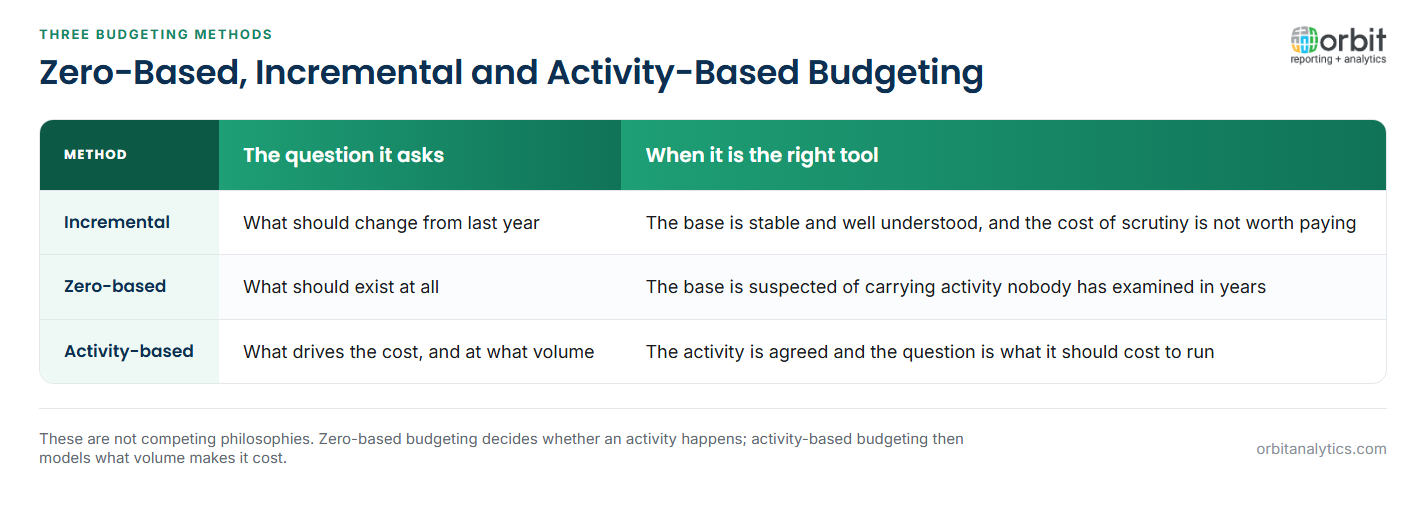
Zero-based, incremental and activity-based budgeting compared
The three are often presented as competing philosophies. They answer different questions and can coexist in one organization.
Incremental budgeting adjusts the prior year. It asks what should change. It is cheap to run and appropriate where the base is stable and well understood.
Zero-based budgeting rebuilds from nothing. It asks what should exist at all. It is expensive to run and appropriate where the base is suspected of carrying activity nobody has examined.
Activity-based budgeting traces cost to drivers. It asks what drives the cost, then budgets the driver rather than the cost. Where zero-based budgeting questions whether an activity should happen, activity-based budgeting assumes it should and models what volume will make it cost. The two combine well: package the activity, then let the driver set the number.
Frequently Asked Questions
Q1. What is zero-based budgeting?
It is a method in which every budget line starts at zero each cycle and must be justified from scratch, rather than being derived from the previous year’s figure. Nothing is inherited.
Q2. How is zero-based budgeting different from traditional budgeting?
Traditional incremental budgeting takes last year’s spend as the base and debates the change. Zero-based budgeting discards the base entirely, so every activity competes for funding on its current merits.
Q3. What is a decision package?
It is the document describing one fundable activity: its purpose, what it costs at minimum, current and enhanced service levels, what happens if it is not funded, the alternatives considered, and its named owner.
Q4. What are the drawbacks of zero-based budgeting?
It consumes substantial management time, it can systematically defund activities whose payoff is long term, and once managers learn the ranking they tend to write packages to score well rather than to describe accurately.
Q5. Does zero-based budgeting have to be applied to everything?
No, and it usually should not be. The common pattern is a rolling subset, typically a third of the cost base each year, concentrated on discretionary overheads rather than committed or regulated spend.
Q6. What data does zero-based budgeting require?
Cost visibility at activity level, definitions applied consistently across every decision unit, and actuals that close fast enough for the previous cycle’s outcome to inform the next one.
Zero-based budgeting stands or falls on whether managers can see their own cost base at activity level. Orbit Analytics reports live Oracle ledger data with drill-down from any figure to its transactions, which is what makes a decision package defensible. Request a demo to see it against your own cost structure.
