
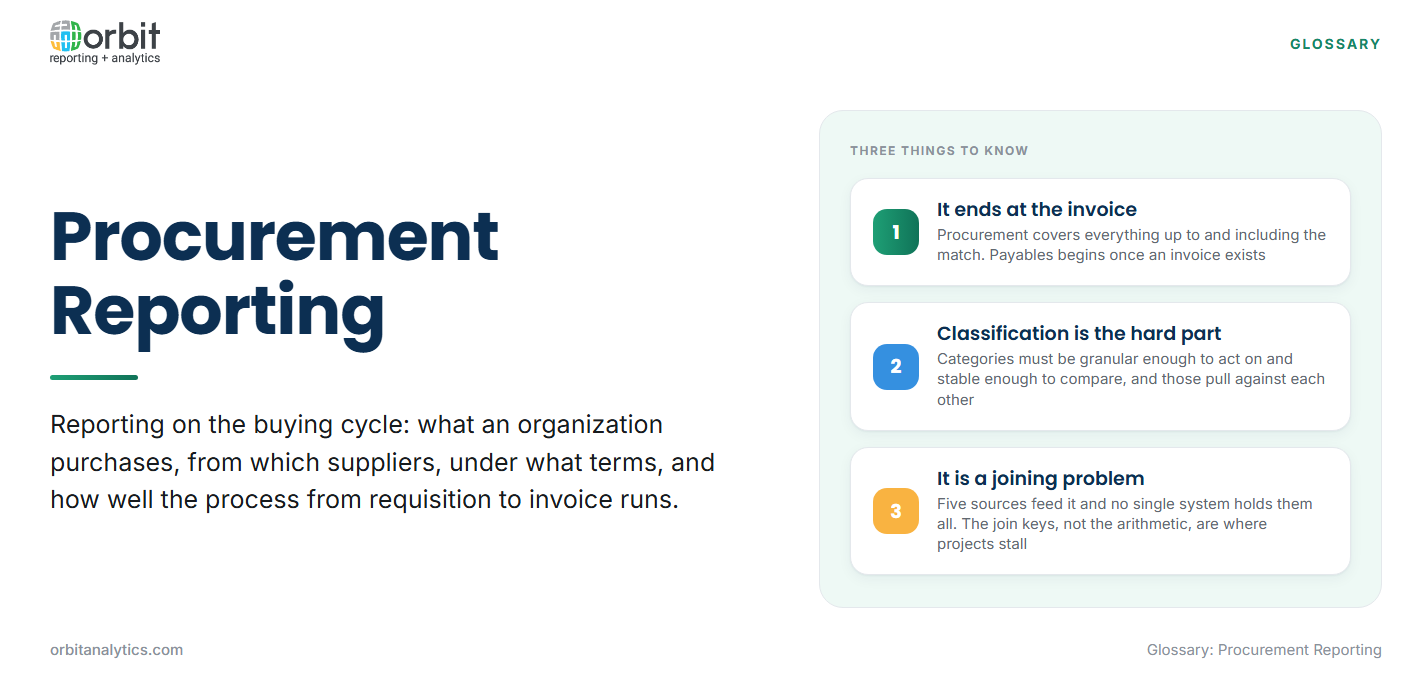
Procurement reporting is the reporting discipline covering the buying cycle: what an organization purchases, from which suppliers, under what terms, and how well the process from requisition to invoice actually runs. It spans spend, supplier performance and cycle efficiency, and it draws on data that sits across several systems rather than in one.
The boundary with payables is worth stating early because the two overlap in most people’s minds. Procurement reporting covers everything up to and including the invoice match. Payables reporting starts once an invoice exists and concerns itself with paying it. A question about supplier delivery performance is procurement; a question about how overdue an invoice is belongs to the accounts payable aging report.
The core procurement report types
- Spend analysis aggregates purchasing by category, supplier, business unit and time. It is the report most people mean by procurement reporting, and it depends entirely on classification quality.
- Supplier performance tracks delivery, quality and responsiveness per supplier, usually against agreed service levels.
- Purchase order status and cycle time shows where orders sit in the process and how long each stage takes.
- Contract compliance measures how much spend went through negotiated agreements versus outside them.
- Savings realization tracks whether negotiated savings actually appeared in what was paid.
The metrics that matter
| Metric | What it measures | Why it matters |
| Spend under management | Share of spend actively controlled by procurement | The scope of procurement’s influence |
| Maverick spend rate | Purchases made outside agreed channels | Leakage from negotiated terms |
| Requisition to order cycle time | Days from request to issued PO | Internal responsiveness |
| On-time in-full delivery | Orders delivered complete and on schedule | Supplier reliability |
| Purchase price variance | Actual price against standard or contracted | Where negotiated terms are not holding |
Spend under management is the most quoted and the most gamed, because the definition of “managed” is set internally. Stating the definition on the report is what keeps it honest.
Where the data comes from
Procurement reporting is a joining problem more than a calculation problem. Five sources feed it, and no single system holds them all.
Requisitions and purchase orders provide the demand and commitment picture. Receipts and goods received notes confirm what actually arrived and when, which is what makes delivery performance measurable. Invoices and payment terms come from payables and complete the three-way match. The supplier master supplies identity, category and parent relationships. Contracts and catalogues define what should have been paid, which is what compliance and savings are measured against.
The join keys between these are frequently imperfect, and that, rather than the arithmetic, is where procurement reporting projects run into difficulty.
Spend classification, and why it is the hard part
Every spend analysis depends on a category taxonomy, and building one is unglamorous work that determines whether the output is usable. Categories need to be granular enough to act on and stable enough to compare year on year, and those two pull against each other.
Supplier normalization is the second half of the problem. The same supplier appears as several records across entities, spelling variants and acquisitions, so spend that should aggregate under one parent scatters across five children. Until suppliers are normalized and rolled up to parents, every concentration figure understates reality.
Unclassified spend is worth treating as a metric rather than a nuisance. A rising unclassified percentage is an early signal that new categories are appearing or that requisition discipline is slipping, and it is often more informative than the classified figures.
Procurement reporting in Oracle environments
In Oracle E-Business Suite procurement data sits across purchasing, inventory and payables schemas, joined on order and receipt identifiers. In Fusion Cloud the same information is reached through the procurement pillar’s subject areas and published interfaces rather than by querying tables.
Two practical difficulties recur. The first is joining procurement to finance: matching a purchase order to the ledger entry it eventually produced crosses a pillar boundary the delivered reporting does not span cleanly. The second is multiple operating units, where the same supplier and the same category exist separately in each, so any group view requires normalization before aggregation.
Orbit Analytics reads procurement and financial data from both EBS and Fusion Cloud into one model, so spend can be reported across operating units with the supplier and category rollups applied once rather than per report. Its operational reporting keeps the drill path from a category total back to the individual purchase orders behind it.
Three-way match reporting
The three-way match compares the purchase order, the goods receipt and the supplier invoice. When all three agree within tolerance, the invoice can be paid without intervention. When they do not, it becomes an exception.
Match exceptions are diagnostic. A price mismatch points at contract data or an out-of-date catalogue. A quantity mismatch points at receiving practice or partial delivery. A missing receipt usually points at a process gap rather than a supplier problem.
The useful framing is exceptions as a process measure rather than a blame list. A rising exception rate in one category is information about how that category is bought, and first-time match rate is the single best summary of procurement data quality reaching payables.
Common procurement reporting problems
Duplicate suppliers splitting spend is the most common defect, and it makes concentration and bargaining power look smaller than they are. Orbit Analytics applies parent rollups once in the model, so every report counts a supplier group as one.
Free-text requisitions with no category push spend into the unclassified bucket at the point of entry, where it is cheapest to fix and rarely is.
Savings claimed but never traced to the ledger is the credibility problem of the discipline. A negotiated rate that never shows up in what was actually paid is not a saving, and reconciling claimed savings against ledger spend is what separates a defensible number from an aspirational one.
Reports that stop at the purchase order miss what was received and invoiced, so they describe intent rather than outcome.
Procurement reporting vs. spend analysis vs. payables reporting
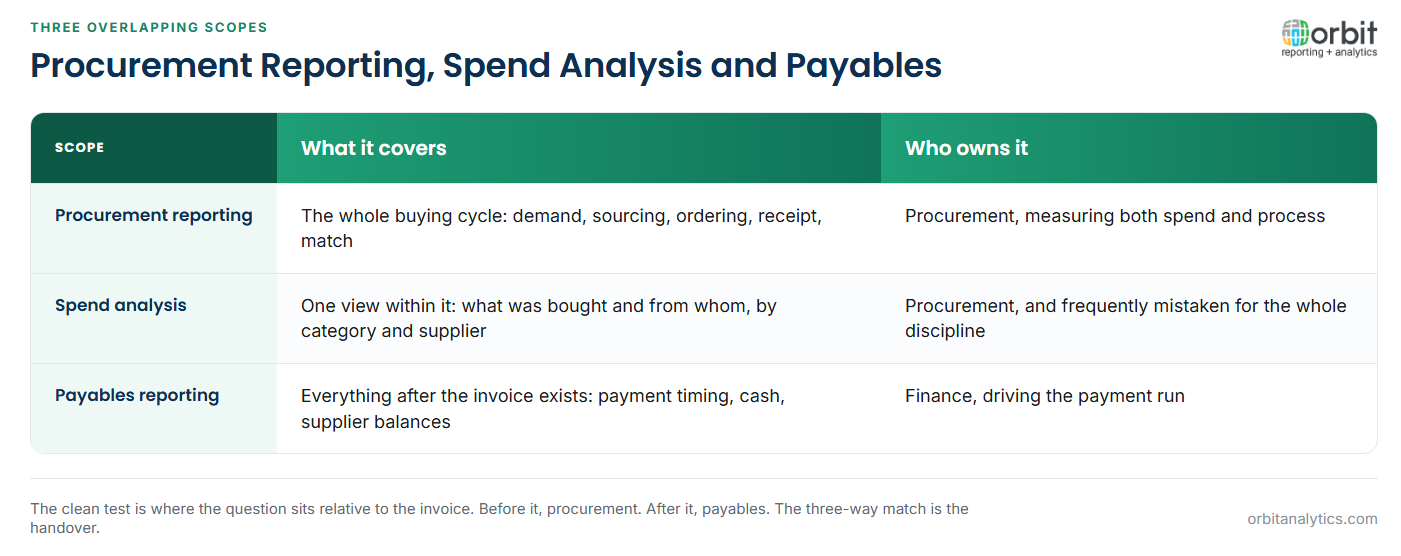
These three are used interchangeably and describe different scopes.
Procurement reporting covers the buying cycle end to end: demand, sourcing, ordering, receipt, match. It is owned by procurement and measures both spend and process.
Spend analysis is one view within it. It answers what was bought and from whom, aggregated by category and supplier. It is the most visible part of procurement reporting and frequently mistaken for the whole of it.
Payables reporting starts once an invoice exists. It concerns payment timing, cash and supplier balances, and it belongs to finance rather than procurement.
The clean test is where the question sits relative to the invoice. Before it, procurement. After it, payables. The three-way match is the handover point, which is why it appears in both sets of reporting.
Frequently Asked Questions
Q1. What is procurement reporting?
It is reporting on the buying cycle: what is purchased, from which suppliers, under what terms, and how efficiently the process runs from requisition through to invoice match.
Q2. What is spend under management?
The share of total spend actively controlled by procurement through agreed channels and negotiated terms. The definition is set internally, so it should be stated on the report.
Q3. What is maverick spend?
Purchasing made outside agreed channels or contracts, which forfeits negotiated pricing and reduces the visibility procurement has over commitments.
Q4. What is three-way match reporting?
It reports on the comparison between purchase order, goods receipt and supplier invoice. Exceptions arise where the three disagree beyond tolerance, and the exception type indicates where the process broke.
Q5. Why is spend classification difficult?
Because categories must be granular enough to act on yet stable enough to compare over time, and because the same supplier appears as multiple records that must be normalized and rolled up before spend aggregates correctly.
Q6. What is the difference between procurement reporting and payables reporting?
Procurement covers everything up to and including the invoice match. Payables begins once an invoice exists and covers payment timing, cash requirements and supplier balances.
Procurement reporting fails on joins rather than on arithmetic, and the joins cross systems. Orbit Analytics reads procurement and finance data from Oracle EBS and Fusion Cloud into one model with supplier and category rollups applied once. Request a demo to see it on your own spend.
