
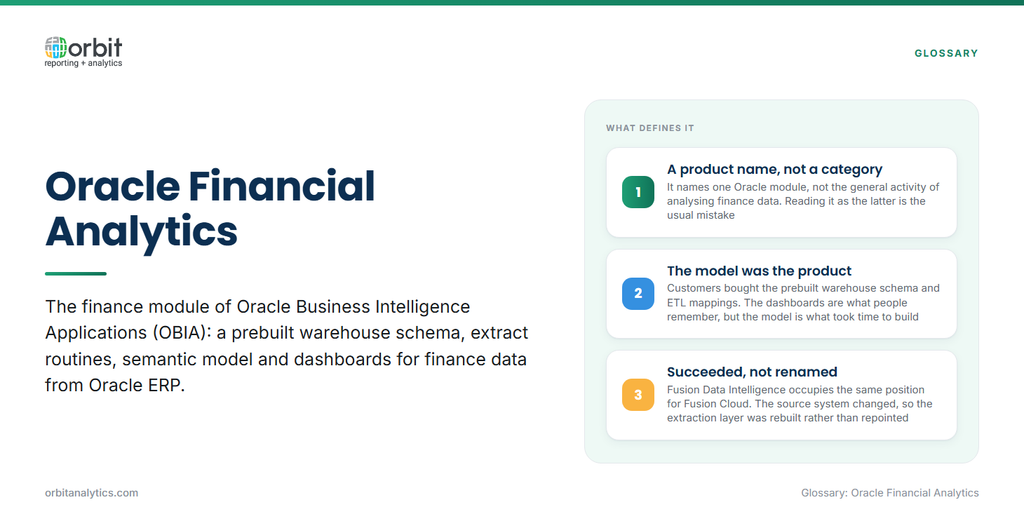
Oracle Financial Analytics is the finance module of Oracle Business Intelligence Applications (OBIA), Oracle’s family of prebuilt analytics applications. It is a product name, not a general term for analysing finance data, and reading it as the latter is the most common mistake made about it.
What Oracle shipped under that name was a package: a prebuilt data warehouse schema for finance, prebuilt extract and load routines from Oracle’s own ERP systems, a semantic model over the result, and a set of dashboards and reports on top. A customer bought the module rather than building the warehouse.
Where Oracle Financial Analytics Came From
OBIA arrived with Oracle’s acquisition of Siebel, whose analytics applications were built on the same idea: rather than sell a BI tool and leave the customer to model their own data, sell the model.
That reasoning explains the packaging. Analytics was sold by business function, so finance, procurement, supply chain and HR each had a module, and each module carried its own subject areas and its own ETL mappings for the source systems Oracle supported. A customer running Oracle ERP could, in principle, buy the finance module and have a working warehouse in weeks rather than quarters.
The promise was never quite that clean in practice, for a reason worth naming: the prebuilt mappings assumed a standard implementation, and few ERP estates are standard.
What the Module Actually Contained
The dashboards are what people remember. The valuable parts were underneath.
- The prebuilt warehouse schema: A dimensional model for finance, with conformed dimensions shared across OBIA modules so finance and procurement data could sit in one warehouse.
- The prebuilt ETL mappings: Source-specific routines that read Oracle ERP tables and populated that schema, which is the component that took the longest to build from scratch.
- The semantic model: The layer that turned warehouse tables into business terms, so a user asked for revenue rather than for a join.
- The prebuilt dashboards and reports: The visible layer, and the one most heavily customised in practice.
The Subject Areas It Shipped With
Subject areas mattered more than dashboards, because a subject area is what a report can be built from. The finance module covered the ledger and profitability, payables and receivables, fixed assets, and cash flow, each modelled against shared dimensions for time, organization and account.
A team that understood the subject areas could build what it needed. A team that only knew the dashboards was stuck the moment a question fell outside them, which is why OBIA projects so often divided into those two experiences of the same product.
How It Sourced Data From Oracle ERP
The module’s supported sources were Oracle’s own transactional systems of the era, principally E-Business Suite and PeopleSoft, and the path from source to report ran in three stages.
- Extract and load. Prebuilt routines read the source tables on a schedule and populated the warehouse staging layer.
- Transform. Data was conformed into the dimensional model, resolving the source system’s structures into shared dimensions.
- Present. The semantic model exposed the result, and dashboards queried that rather than the ERP.
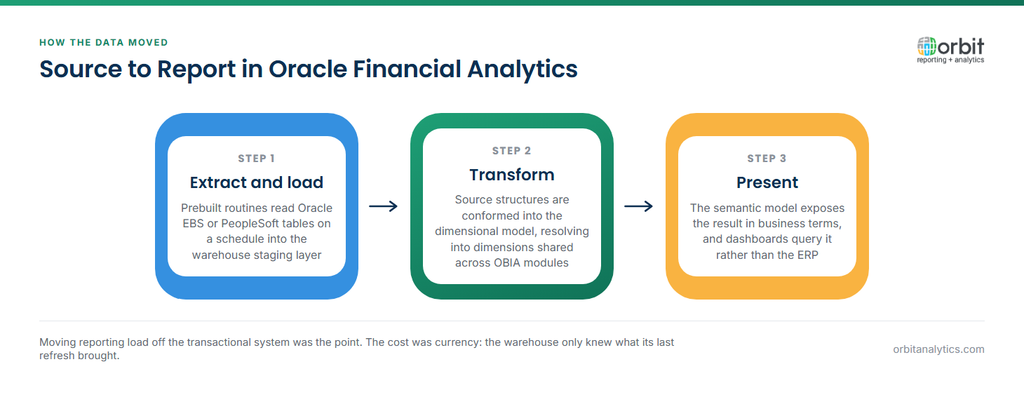
Two consequences followed from the schedule. Reporting load moved off the transactional system, which was the point. But the warehouse was only as current as its last refresh, so the module answered yesterday’s questions well and today’s not at all, and the gap between the two is where most customisation went.
What Replaced It in the Fusion Era
Oracle’s current prebuilt analytics application for Fusion Cloud Applications is Fusion Data Intelligence, previously named Fusion Analytics Warehouse. It occupies the same position in the product line: a prebuilt model and prebuilt content, sold rather than built.
It is a successor rather than a rename, and the distinction matters. The source system changed from an on-premises database the customer controlled to a SaaS application that does not expose one, so the extraction layer had to be rebuilt rather than repointed. Prebuilt content carried the idea forward; almost none of the implementation came with it. Organizations running both eras at once find that the two do not share a model, which is the practical problem Orbit Analytics addresses by reporting across Oracle Fusion analytics and legacy estates from one place.
Why the Name Still Appears in Oracle Estates
The term turns up constantly in Oracle environments that have long since moved on, for four ordinary reasons.
- Long-running installations: On-premises OBIA deployments that still work and have no forcing reason to change.
- Reports built on its schema: Years of custom reporting written against the warehouse model, which outlives interest in the product that created it.
- Hybrid estates: Organizations part-way through a cloud move, running the old warehouse alongside the new applications.
- Documentation and skills: A large body of material and a generation of practitioners who learned finance analytics through this product.
The Data Problems It Was Built to Solve
Stripped of the product, the module addressed three problems that have not gone anywhere.
Finance data spread across modules. A question about days sales outstanding needs receivables, the ledger and often order data. No single ERP module answers it, so something has to bring them together.
Reporting load on the transactional system. Running analytical queries against a live ERP degrades the system people are trying to work in. Separating the two is why warehouses exist.
History that outlives the source. Ledger history matters for years, while source systems get replaced, upgraded and migrated. A reporting layer that only knows the current system loses the comparison the moment the system changes, which is why Orbit Analytics holds history across both eras rather than starting again at each cutover.
Oracle Financial Analytics, Oracle BI Applications and Fusion Data Intelligence Compared
The three names are used interchangeably and are not interchangeable.
| Name | What it refers to | Era | Sources |
| Oracle BI Applications (OBIA) | The whole family of prebuilt analytics modules | On-premises | Oracle EBS, PeopleSoft, Siebel and others |
| Oracle Financial Analytics | The finance module within that family | On-premises | The same, scoped to finance subject areas |
| Fusion Data Intelligence | The prebuilt analytics application for Fusion | Cloud | Oracle Fusion Cloud Applications |
The quickest way to tell which one an estate is running is to look at what feeds it. If the answer is a database the organization controls, it is the older line. If the answer is a SaaS application, it is the newer one.
Frequently Asked Questions
Q1. What is Oracle Financial Analytics?
It is the finance module of Oracle Business Intelligence Applications, a prebuilt analytics package containing a warehouse schema, extract routines, a semantic model and dashboards for finance data from Oracle ERP systems.
Q2. Is Oracle Financial Analytics the same as Oracle BI Applications?
No. Oracle BI Applications is the whole family of prebuilt modules across finance, procurement, supply chain and HR. Oracle Financial Analytics is the finance module inside it.
Q3. Which source systems did it support?
Principally Oracle’s own transactional systems of that era, including E-Business Suite and PeopleSoft, through source-specific prebuilt extract and load routines.
Q4. What replaced Oracle Financial Analytics?
Fusion Data Intelligence, previously called Fusion Analytics Warehouse, occupies the same position for Oracle Fusion Cloud Applications. It is a successor rather than a rename, because the change of source system required the extraction layer to be rebuilt.
Q5. How is it different from Oracle Financials Cloud?
Oracle Financials Cloud is the ERP where finance transactions are recorded. Oracle Financial Analytics was a reporting layer built on top of transactional data, not a system of record.
Q6. Why do Oracle estates still reference it?
Because working installations, custom reports built on its schema, hybrid estates and a large body of documentation all keep the name in circulation long after the product stopped being the current answer.
The problems Oracle Financial Analytics was built for outlast any one product, and the hardest of them is reporting across eras when a business runs cloud and legacy systems side by side. Orbit Analytics reports live across Oracle Fusion and EBS data with drill-down from any figure to the transactions behind it. Request a demo to see it against your own ledger.
