
Oracle publishes analytics under four names that read like competing products on one shortlist. Anyone comparing OBIEE vs OAC is usually trying to settle a narrower question: does one replace the other, is a third name simply a rebrand, and where does the fourth fit at all.
Three of the four are the same product line in different operating models. The fourth is a different kind of thing entirely, and mistaking it for a platform is the single error that makes Oracle’s analytics documentation hardest to follow.
This page is definitional rather than evaluative. All four are Oracle’s own, and two or three of them commonly sit in one estate at once. The expansions: Oracle Business Intelligence Enterprise Edition (OBIEE), Oracle Analytics Server (OAS), Oracle Analytics Cloud (OAC) and Fusion Data Intelligence (FDI).
Why Oracle Has Four Analytics Names
The names accumulated rather than replaced one another. Read them as two groups, a platform line of three plus one application on top of it, and three habits explain why that is not obvious.
- Renaming without retiring: A renamed product stays in service under its old name. Teams, job titles and internal documents keep using whichever name was current when the system was installed.
- Two deployment models, one lineage: The same capability is sold both as software an organisation installs and as a service Oracle runs, so one feature appears under two names.
- A prebuilt application shelved next to platforms: FDI is sold alongside the platforms and described in similar language, which invites readers to treat it as a fourth platform.
What OBIEE Is
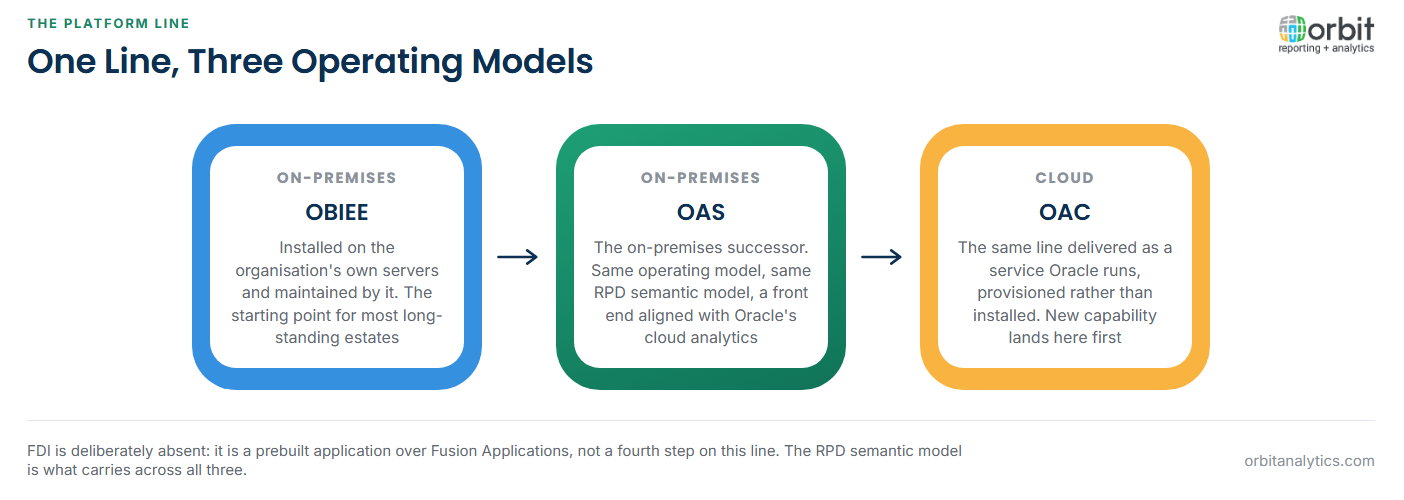
OBIEE, Oracle Business Intelligence Enterprise Edition, is the on-premises analytics platform that a large share of long-standing Oracle estates still run. It is software an organisation installs on its own servers and maintains itself.
The components readers meet by name are the semantic layer, the dashboard interface, and the publishing engine used for pixel-precise documents. The piece that matters most is the RPD, the repository holding the semantic model: what a fact and a dimension are, which tables join to which, and what a term such as net revenue resolves to.
An OBIEE estate today is typically a working system with years of dashboards, a large RPD, and few people who understand it. That inertia, not the interface, decides how long it stays.
What OAS Is
OAS, Oracle Analytics Server, is the on-premises successor to OBIEE. It remains software the organisation installs and patches, so the operating model is unchanged.
What carries forward is the substance: the RPD semantic model, the reporting objects built on it, and the publishing capability. What changes is the front end, broadly aligned with Oracle’s cloud analytics service, including its data visualisation and self-service authoring.
An estate sits on OAS to get that current experience without moving the workload off its own infrastructure, usually for residency, network or contractual reasons.
What OAC Is
OAC, Oracle Analytics Cloud, is the same analytics line delivered as a service Oracle runs. The organisation provisions it rather than installing it, and Oracle handles the infrastructure, patching and upgrades underneath.
Beyond the on-premises line it adds managed elasticity, native connectivity to Oracle’s cloud data services, and the machine-assisted features Oracle ships to its cloud products first. Connectivity to Oracle Fusion Applications is a first-class path rather than something an estate engineers. New capability lands in the cloud service first and reaches the on-premises product later, and that direction is the durable point about cadence.
What FDI Is
FDI, Fusion Data Intelligence, is the name that breaks the pattern, because it is a prebuilt analytics application rather than a platform. It ships with its own data pipelines, a warehouse structure, a semantic model, and a library of subject areas and dashboards for Oracle Fusion Applications.
It was previously called Fusion Analytics Warehouse, or FAW, and that older name remains in circulation, so a reader meets two names for one product.
Prebuilt means the modelling decisions are already made. That is its value and its boundary: it assumes the source is Oracle Fusion Applications configured in recognisable ways, so questions outside its model, or needing data it does not carry, are not a configuration change. Orbit Analytics is used alongside it in exactly those cases, reporting across Oracle Fusion analytics data without depending on a prebuilt model’s assumptions about how the estate is set up.
How the Four Relate to Each Other
The relationship holds as a line with one thing beside it.
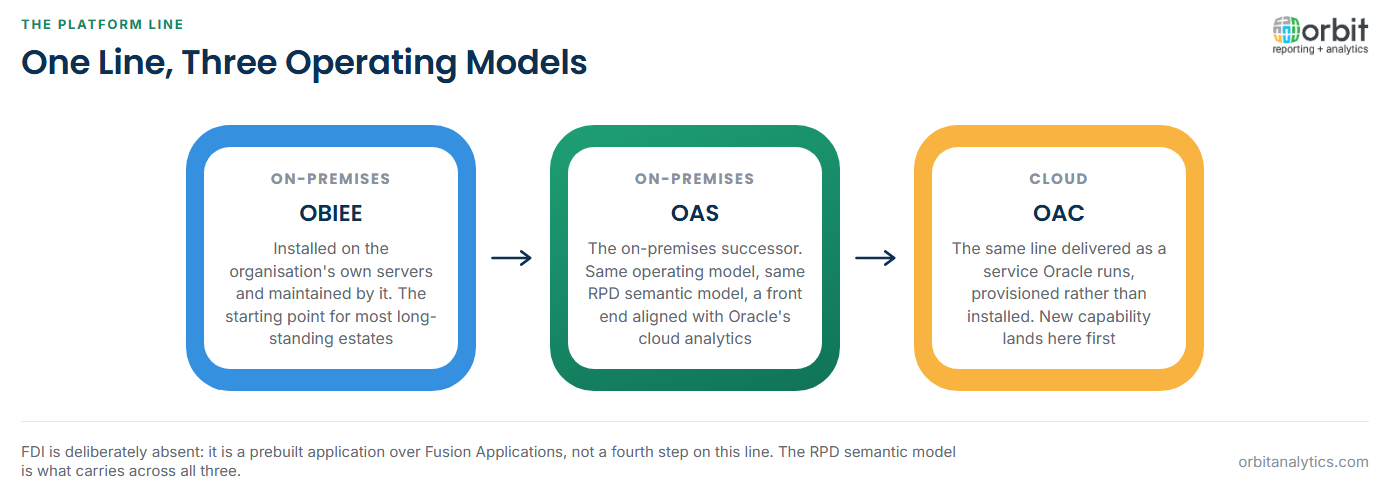
- OBIEE to OAS to OAC is one line. One lineage in three operating models: installed and self-maintained, installed and modernised, or provisioned and Oracle-maintained.
- FDI sits beside the line, not on it. It delivers answers out of the box, whereas the other three are platforms an organisation builds answers on.
- The semantic model is the thread. The RPD carries across the OBIEE, OAS and OAC line, which is why migration conversations are dominated by the model rather than by dashboards.
More than one coexisting in a single organisation is normal, not a sign of a stalled migration. A finance function can run a decade of OBIEE dashboards, a newer cloud deployment, and a prebuilt application over its Fusion modules at once. Orbit Analytics reports across both eras together, bringing Oracle Fusion Cloud reporting and on-premises EBS data into one view, which keeps a mixed estate answerable while its analytics platforms are still being consolidated.
What Each One Was Built For and Who Maintains It
Purpose and maintenance model track each other.
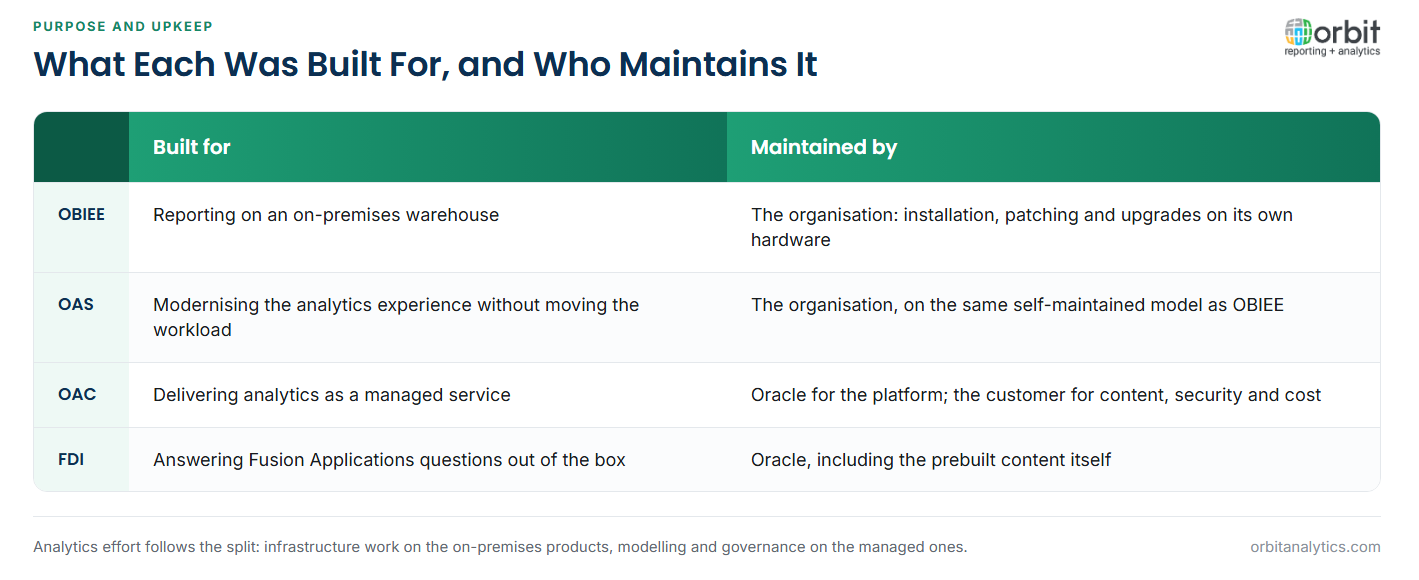
- OBIEE: Built to report on an on-premises warehouse, with the organisation owning installation, patching and upgrades on its own hardware.
- OAS: Built to modernise the analytics experience without moving the workload, on the same self-maintained model as OBIEE.
- OAC: Built to deliver analytics as a managed service, with Oracle responsible for the platform and the customer for content, security and cost.
- FDI: Built to answer Fusion Applications questions out of the box, with the prebuilt content itself maintained by Oracle.
Analytics effort follows that split: infrastructure work on the on-premises products, modelling and governance on the managed ones.
The Four Platforms Compared
| Name | What it refers to | Era | Where it runs | What it sources from |
| OBIEE | Oracle Business Intelligence Enterprise Edition, a platform | Earlier on-premises | Customer infrastructure | Sources modelled in the RPD |
| OAS | Oracle Analytics Server, a platform | Current on-premises | Customer infrastructure | The same RPD-modelled sources |
| OAC | Oracle Analytics Cloud, a platform | Current cloud | Oracle-managed cloud | Cloud and on-premises sources, including Fusion |
| FDI | Fusion Data Intelligence, a prebuilt application | Current cloud | Oracle-managed cloud | Fusion Applications, via its own pipelines |
To tell which one you are looking at, ask what is being maintained. Patching a server means OBIEE or OAS. Ready-made subject areas over Fusion modules mean FDI. A provisioned service nobody installed means OAC. The same test settles an Oracle Cloud ERP modules discussion, where analytics and module names get mixed.
Frequently Asked Questions
Q1. What is the difference between OBIEE and OAC?
OBIEE is the on-premises analytics platform an organisation installs and maintains itself. OAC is Oracle Analytics Cloud, the same lineage delivered as a service Oracle runs. The difference is the operating model, not a different category of product.
Q2. Is OAS the same as OAC?
No, though they are close relatives. OAS is Oracle Analytics Server, installed on customer infrastructure, and is broadly feature-aligned with the cloud service. OAC is the Oracle-managed cloud service, and it receives new capability first.
Q3. What is FDI in Oracle analytics?
FDI is Fusion Data Intelligence, a prebuilt analytics application for Oracle Fusion Applications. It supplies pipelines, a warehouse, a semantic model and ready-made content, rather than being a platform on which an organisation builds its own model.
Q4. What is an RPD?
The RPD is the repository that holds the semantic model in the OBIEE, OAS and OAC line. It defines facts, dimensions, joins and the business meaning of terms used in reports, which is why it is the asset that carries across the line.
Q5. Can an estate run more than one of them at once?
Yes, and many do. Legacy OBIEE dashboards, a newer cloud deployment and a prebuilt application over Fusion modules can all run at once, which is why naming precision matters.
Naming settles a definitional question, not a reporting one, and a mixed estate still has to produce one set of numbers while consolidation runs. Orbit Analytics reports live across Fusion Cloud and EBS data with drill-down from any figure to the transactions behind it. Request a demo to see it against your own estate.
