
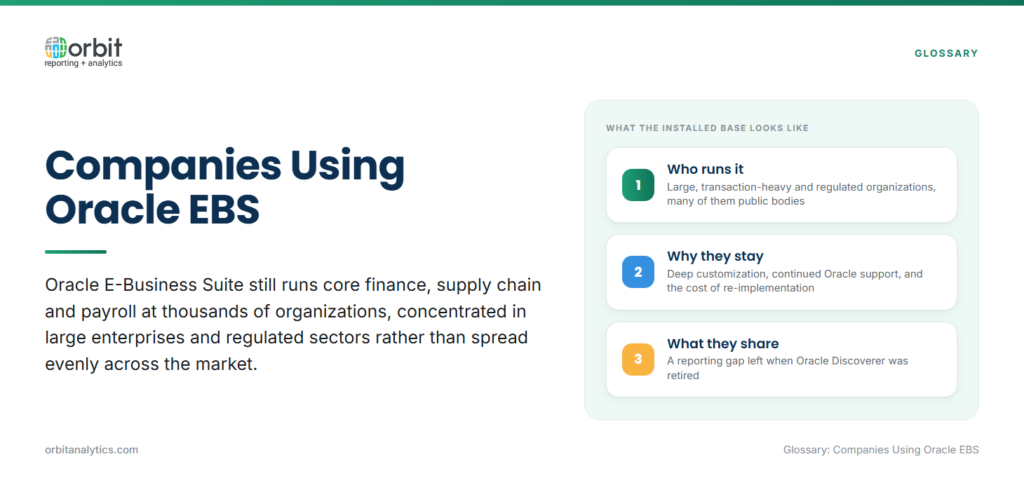
Anyone compiling a list of companies using Oracle EBS discovers the same thing quickly: the installed base is large, concentrated, and quieter than the cloud migration narrative suggests. Oracle E-Business Suite still runs core finance, supply chain, and payroll at thousands of organizations, most of them large and many of them household names.
The useful version of this list is organized by sector rather than alphabetically, because sector is what predicts which modules a company runs and which reporting problems it has. A discrete manufacturer and a public university both run EBS Financials, but almost nothing else about their estates looks alike.
Two caveats are worth stating before the list. Any named list dates quickly, because organizations migrate to Oracle Fusion Cloud on their own timetables and rarely announce it. And a great many EBS users are private or public-sector bodies that never appear in a vendor case study at all.
What does not date is the pattern: who runs EBS, which modules they lean on, why they stay, and the reporting problem they all hit.
What Is Oracle E-Business Suite (EBS)?
Oracle E-Business Suite is Oracle’s integrated, on-premise ERP suite: a set of business applications covering finance, supply chain, procurement, HR, projects, and manufacturing, all sharing one Oracle database.
It descends from the older Oracle Applications line, and the releases still in service are 11i, 12.1, and 12.2. EBS sits alongside Oracle Fusion Cloud rather than beneath it: Fusion Cloud is the SaaS ERP Oracle sells to new customers, while EBS is the self-managed estate many enterprises still run, often for years after evaluating a move.
The reason “who still uses Oracle EBS” is a live question is that Oracle continues to support and develop EBS under Applications Unlimited, so there is no forced migration deadline pushing companies off it.
Quick Reference: Companies Using Oracle EBS at a Glance
| Industry | Profile of the typical EBS user | Common EBS modules |
| Manufacturing and industrials | Diversified manufacturers, industrial equipment makers, automotive suppliers | Discrete and Process Manufacturing, Inventory, Cost Management, Financials |
| Retail and consumer goods | National retailers, CPG and food-and-beverage brands, distributors | Order Management, Supply Chain, Financials, Procurement |
| Telecom and technology | Carriers, hardware OEMs, IT services firms | Financials, Projects, Service Contracts, Order Management |
| Financial services and insurance | Banks, insurers, asset managers | Financials, Procurement, HRMS, Fixed Assets |
| Healthcare, pharma, life sciences | Hospital systems, medical-device and pharmaceutical companies | Financials, Procurement, Projects, Inventory |
| Public sector, education, utilities | Government agencies, universities, energy and water utilities | Financials, Procurement, Projects, HRMS |
How Many Companies Still Use Oracle EBS?
The installed base runs to thousands of organizations worldwide, and technographic databases such as Enlyft, HG Insights, AppsRunTheWorld, and 6sense each publish their own count. The figures differ because each vendor detects deployments differently, so treat any single number as an estimate rather than a census.
Two patterns are consistent across all of them. The base skews heavily toward large enterprises, because EBS was licensed, implemented, and customized at a scale that suited organizations with thousands of employees. And it skews toward regulated and asset-heavy sectors, where on-premise control over financial and payroll data is a deliberate choice rather than an accident of history.
The adoption split matters more than the total. Many organizations counted as Fusion Cloud customers still run EBS alongside it, module by module, which means reporting has to span both estates for years.
Companies Using Oracle EBS in Manufacturing and Industrials
Manufacturers standardized on EBS because it handled the full chain from bill of materials to general ledger in one database, and because plant-level processes were customized heavily enough that replacing them is a multi-year programme.
These estates typically run Discrete or Process Manufacturing alongside Inventory, Cost Management, and Financials. The reporting they need is cost roll-ups, inventory valuation, and plant-level operational analysis, most of which used to be served by Oracle Discoverer.
Companies Using Oracle EBS in Retail, Consumer Goods, and Telecom
High-volume, high-transaction businesses stay on EBS because Order Management and the supply chain modules were tuned to their throughput over many years, and because peak-season stability outweighs the appeal of a new platform.
Order Management, Supply Chain, Financials, and Service Contracts carry the load. Transaction volume is precisely what strains native reporting, so these are the estates where BI Publisher jobs and export limits cause the most friction.
Companies Using Oracle EBS in Financial Services, Healthcare, and Public Sector
Regulated organizations keep EBS on-premise for reasons that have not changed: data residency, audit control, and certified processes that would need requalifying on a new platform.
Financials, Procurement, Projects, HRMS, and Fixed Assets are the common set. The reporting requirement here is audit-ready and controlled: every reported figure has to trace to a transaction, which rules out spreadsheet assembly as a long-term answer.
Why Do Companies Still Run Oracle EBS in 2026?
- Customization as sunk cost. Years of extensions, interfaces, and bespoke reports encode business rules that exist nowhere else, and re-implementing them carries real risk.
- A support runway with no cliff. Oracle’s Applications Unlimited commitment removes the forced-migration deadline that drives most re-platforming decisions.
- Re-implementation cost and disruption. A full ERP replacement occupies the finance and IT organization for years, and the business case rarely closes on reporting benefits alone.
- Core finance and payroll work. When the general ledger closes on time and payroll runs correctly, the pressure to change is low.
The Reporting Gap Every Oracle EBS Company Hits
The ERP is rarely the complaint. Getting information out of it is.
- Discoverer’s retirement left a hole. It was the self-service tool business users actually used, and nothing native replaced it like for like.
- BI Publisher and custom SQL are IT-dependent. Each new question becomes a ticket, and the queue sets the pace of decision-making.
- Generic BI tools do not understand EBS schemas. Pointing Tableau or Power BI at EBS means modelling hundreds of normalized tables, multi-org structures, and flexfields first.
- What users actually want is narrow. Self-service access, current data, and an Excel-native path for finance.
Orbit Analytics fills that gap without touching the ERP: an Oracle-native reporting layer that reads the EBS schema directly, with 1,000+ pre-built reports and 200+ pre-built connectors, so business users query enterprise reporting content themselves instead of raising a ticket.
How to Get Modern Reporting and Analytics on Oracle EBS
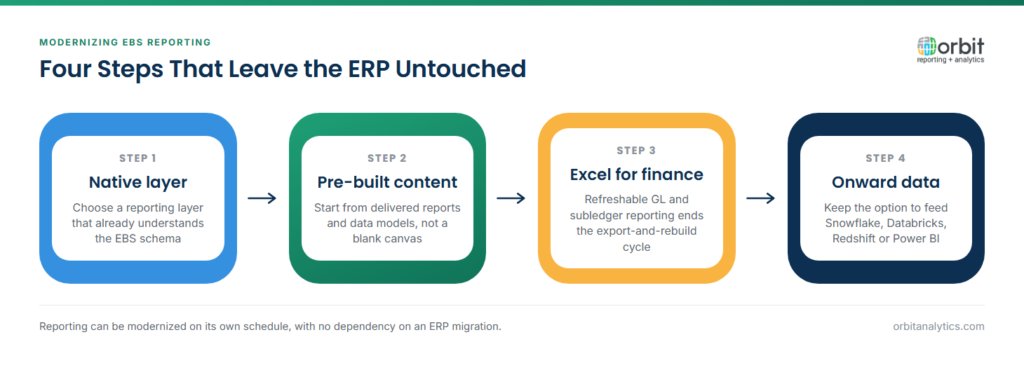
Four steps take an EBS estate from ticket-driven reporting to self-service, and none of them touch the ERP itself.
- Choose an Oracle-native layer over generic BI. Native schema understanding removes most of the semantic modelling that otherwise front-loads the project.
- Start from pre-built reports and data models. Beginning from delivered EBS content is faster than a blank canvas and encodes the module relationships correctly.
- Give finance an Excel-native path. GL and subledger reporting that refreshes in Excel ends the export-and-rebuild cycle.
- Keep the option to feed modern platforms. EBS data should be able to reach Snowflake, Databricks, Redshift, or Power BI when the analytics roadmap calls for it.
Orbit Analytics is an Oracle Gold Partner serving 150,000+ users, purpose-built for Oracle EBS reporting and analytics as well as Fusion Cloud, which matters for the many organizations running both during a phased migration.
Frequently Asked Questions
Q1. How many companies still use Oracle EBS?
Thousands worldwide, concentrated in large enterprises. Technographic providers publish differing estimates because they detect deployments differently, so any single figure is an estimate. The base skews toward manufacturing, retail, telecom, financial services, healthcare, and the public sector.
Q2. What types of companies use Oracle EBS?
Predominantly large, transaction-heavy, and regulated organizations: manufacturers, national retailers and CPG brands, telecom carriers, banks and insurers, hospital systems and pharmaceutical companies, and government, education, and utility bodies.
Q3. Is Oracle EBS still supported in 2026?
Yes. Oracle continues to support and develop E-Business Suite under its Applications Unlimited commitment, which is why there is no forced migration deadline. Specific dates depend on release and support tier, so confirm against Oracle’s current lifecycle policy.
Q4. Why do companies still use Oracle EBS instead of moving to Oracle Fusion Cloud?
Because heavy customization, deep integrations, and a stable finance and payroll core make re-implementation expensive and risky, while continued support removes any deadline. Many organizations run both, migrating one pillar at a time.
Q5. What are the biggest reporting challenges for Oracle EBS users?
Oracle Discoverer’s retirement removed the self-service option, leaving BI Publisher and custom SQL that depend on IT. The EBS schema is highly normalized with multi-org structures and flexfields, so generic BI tools need extensive modelling before producing a usable report.
Q6. How do companies report on EBS data now that Oracle Discoverer is retired?
Most use some combination of BI Publisher, hand-written SQL, and spreadsheets, and a growing number add an Oracle-native reporting layer that reads the EBS schema directly and restores self-service access without replacing the ERP.
Staying on Oracle EBS does not mean living with the reporting that came with it. Request a demo to see how Orbit Analytics delivers self-service, Excel-native reporting on live EBS data, and across Fusion Cloud in the same view.
