
Embedded conversational AI is a chat assistant built into the application a person already works in, so it knows who the user is and what they are looking at when they ask a question. It answers in plain language and can carry a conversation over several turns.
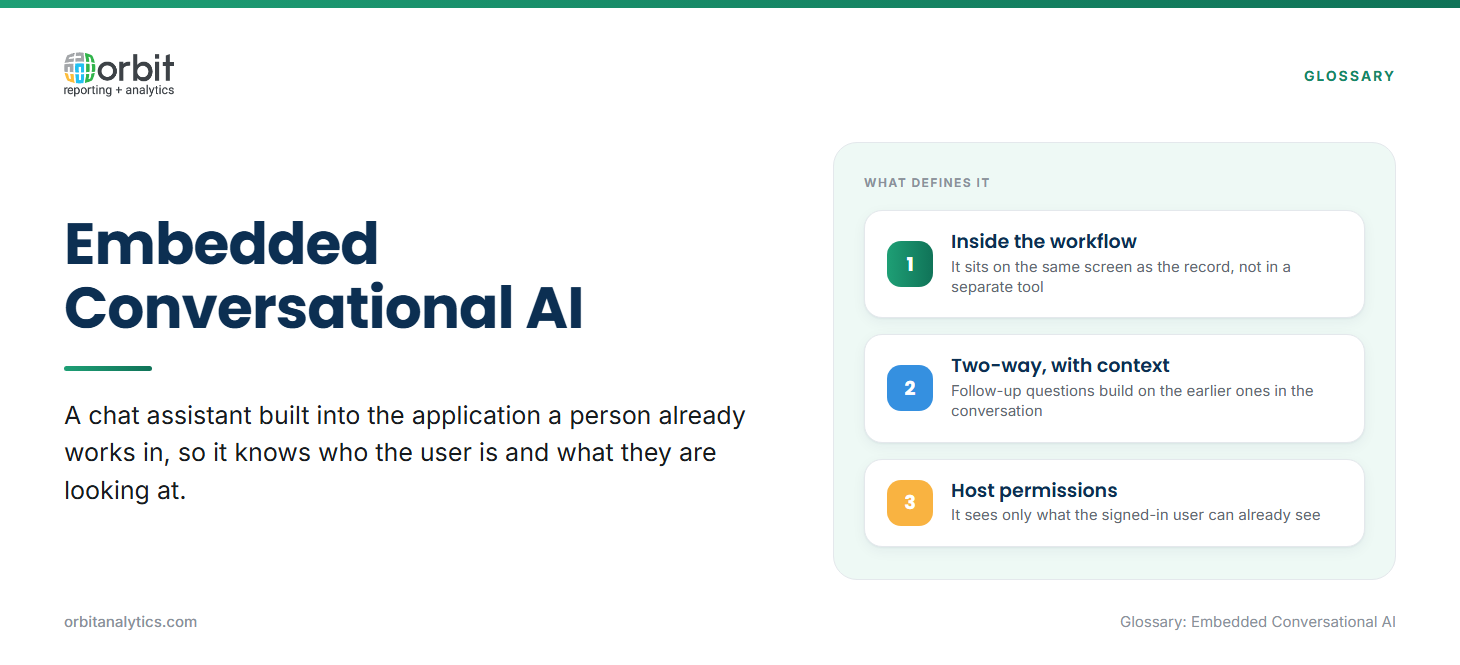
Both words in the name do real work. “Embedded” means the assistant lives inside the workflow, on the same screen as the invoice, the order or the report, rather than in a separate tool. “Conversational” means a two-way exchange that keeps context, so a follow-up such as “and for last month?” makes sense without restating the question.
Embedded vs Standalone Conversational AI
The difference is where the assistant sits and what it knows when a question arrives:
| Standalone assistant | Embedded assistant | |
|---|---|---|
| Where it runs | A separate chat window or app | Inside the business application |
| What it knows about the user | Only what the user types | Identity, role and the record on screen |
| Typical question | “What is our refund policy?” | “Why is this invoice on hold?” |
| Follow-on step | Copy the answer somewhere else | Act on the same screen |
Context changes the answer. The question “What is overdue?” means one customer’s invoices on a customer record, and every supplier’s payments on a payables dashboard. A standalone window cannot tell the difference unless the user explains it.
How Embedded Conversational AI Works
Most embedded assistants handle a question in four steps:
- Sign in with the host application’s identity: the assistant uses the same login as the application, so it knows who is asking without a second account.
- Pass page and record context: the application sends the current screen, record or filter along with the question.
- Retrieve data or documents: the assistant fetches the records, figures or policy text the question needs, within the user’s access.
- Answer, or hand off an action: it replies in plain language, or prepares an action such as a draft approval for the user to confirm.
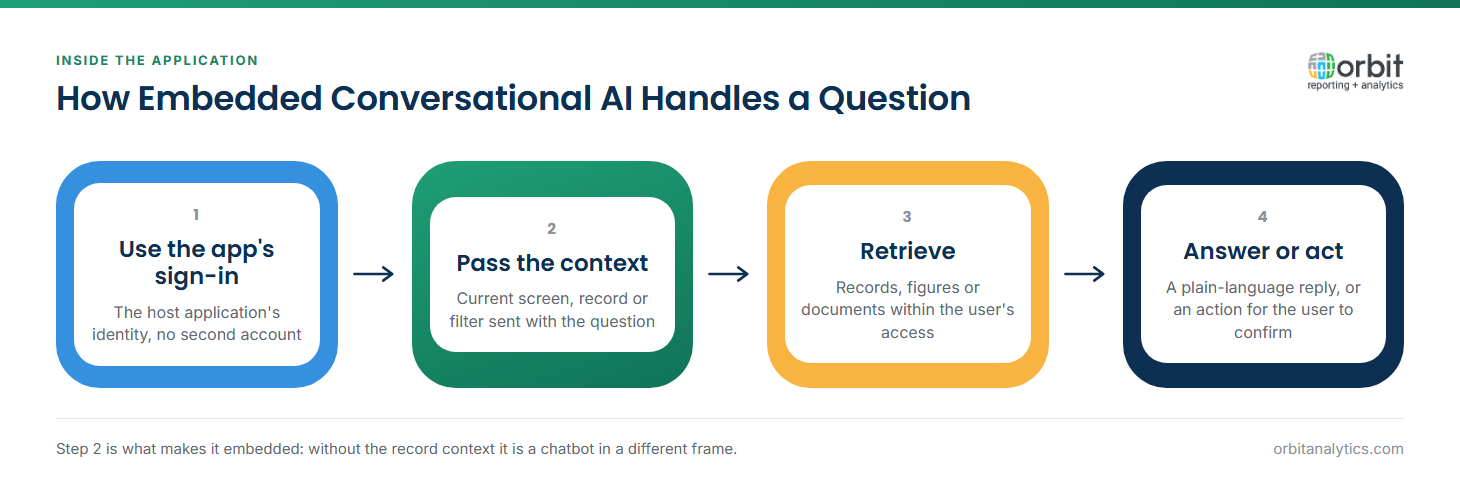
Step 2 is what separates an embedded assistant from a chatbot placed on a page. Without the record context, it is a standalone assistant in a different frame.
Where Embedded Conversational AI Appears
The pattern shows up in four kinds of software:
- Inside business applications: ERP, CRM and HR systems, where users ask about the transaction or record in front of them.
- Customer and partner portals: self-service sites where customers ask about orders, invoices or cases.
- Analytics and reporting tools: an assistant beside a dashboard that answers questions about the figures on it.
- Collaboration tools: chat platforms where an assistant answers questions without the user opening the source application.
Embedded AI and Embedded Conversational AI
“Embedded AI” on its own usually means something else:
- Embedded AI on devices and hardware: machine learning models running on chips inside cameras, vehicles, sensors and appliances, often with no network connection.
- Embedded AI in software: AI features built into business applications, such as forecasting inside a planning tool or anomaly flags in a finance system.
- Where the two meanings overlap: in name only. Embedded conversational AI belongs to the software meaning, and it is the chat-shaped part of it.
Embedded Conversational AI in ERP and Analytics
In ERP and analytics, an assistant answers two different kinds of question, and they need different foundations:
- Questions about transactions: “Why is this purchase order not approved?” These need the live record and its workflow, and often end in an action.
- Questions about data: “Why did expenses rise this quarter?” These need governed data across many records, with consistent metric definitions and a drill path to the detail.
The first kind can work from the transaction tables behind the screen. The second cannot, because a total across thousands of records has to be calculated the same way the finance team calculates it.
Conversational AI for Oracle Fusion is a good example of the “questions about data” pattern: a finance user asks why expenses rose this quarter and drills into the invoices behind the change. Conversational AI for Oracle EBS has to do the same over decades of E-Business Suite history, while keeping each user’s EBS responsibilities in place.
Orbit Analytics offers ThinkBoxes as conversational AI on Oracle Fusion and Oracle EBS data, answering from governed data models so that figures match the reports finance already trusts.
Security and Context Boundaries
An assistant inside an application is a new route to its data, so three rules apply:
- Inherit the host application’s permissions: the assistant should see exactly what the user can see in the application, and nothing more.
- Keep out what the assistant should never see: credentials, other users’ records and fields the user’s role excludes should never reach the assistant’s context.
- Log and review: recording questions, answers and actions lets administrators check how the assistant is used and correct it.
The safest design treats the assistant as one more user session rather than a privileged service. If it can only reach what the signed-in user can reach, a cleverly worded question cannot widen that access.
Common Challenges
Three problems come up repeatedly in practice:
- Generic answers without business context: an assistant that knows the screen but not the business definitions gives answers that sound right and do not match the reports.
- Latency inside a live screen: users tolerate a pause in a chat window more than in a form they are working through, so slow retrieval is felt quickly.
- Keeping answers consistent with reports: if the assistant calculates “overdue” differently from the aging report, users stop trusting both.
Embedded Conversational AI vs Embedded Analytics
Embedded analytics applications put charts, tables and dashboards on the screen. A conversation adds the ability to ask about what is there: why a figure moved, what sits behind it and how it compares with last period.
The two work together. A dashboard shows the state of the business at a glance, and an assistant answers the next question it raises. Orbit Analytics provides embedded reporting that places reports and dashboards inside websites, portals and other applications, which is the visual half of that pairing.
Frequently Asked Questions
Q1. What is embedded conversational AI in simple terms?
It is an AI chat assistant built into the software you already use. Because it sits inside the application, it knows who you are and what you are looking at.
Q2. What is the difference between embedded AI and embedded conversational AI?
Embedded AI usually means AI running on devices and hardware. Embedded conversational AI is a chat assistant inside a software application.
Q3. How does embedded conversational AI handle user permissions?
A well-designed assistant inherits the host application’s permissions. It retrieves only the records and figures the user could already see on screen.
Q4. Does embedded conversational AI take actions or only answer questions?
Both patterns exist. Many assistants answer questions only, while others prepare actions such as approvals or updates for the user to confirm.
Q5. What is the difference between embedded analytics and embedded conversational AI?
Embedded analytics puts charts and dashboards inside an application. Embedded conversational AI lets users ask questions about the data in plain language and get answers back.
Q6. What data does an embedded assistant need access to?
It needs the record the user is looking at, plus whatever data or documents its questions require. For questions about business figures, that means governed data with agreed metric definitions, accessed under the user’s own permissions.
Conversational AI on business data is only as reliable as the data model behind it. Orbit Analytics answers plain-language questions on Oracle Fusion and EBS data from governed data models. Request a demo to see it on your own data.
