
Data democratization is the practice of making data available to people across an organization who are not data specialists, so they can answer their own questions without routing every request through a technical team. It covers access, but it also covers the tools, definitions and literacy that make access useful.
The distinction between access and ability is the one most often missed. Granting three hundred people permission to query a warehouse is not democratization if none of them knows which table holds the authoritative revenue figure. Access without shared understanding produces confident wrong answers, which is a worse outcome than the bottleneck it replaced.
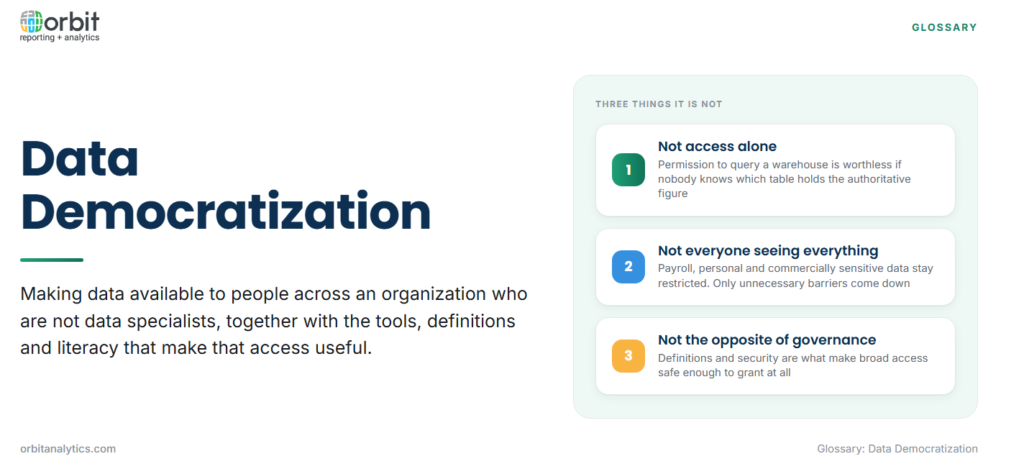
Equally, it does not mean everyone sees everything. Payroll records, personal data and commercially sensitive information stay restricted. Democratization is about removing the unnecessary barriers, not all of them.
The principles behind data democratization
- Access by role, not by request. People receive the data their job requires as a standing entitlement, rather than raising a ticket each time. Request-based access is the bottleneck being removed.
- Shared definitions everyone trusts. One agreed meaning for each significant metric, held centrally, so two teams computing revenue arrive at the same figure.
- Tools matched to skill level. An analyst wants a query interface. A regional manager wants a filtered view with three controls. Handing both the same tool fails one of them.
- Governance that enables rather than blocks. Controls exist to make broad access safe, not to preserve the gatekeeping the initiative set out to remove.
The benefits of data democratization
Faster decisions at the edge is the main one. When the person closest to a problem can check a figure themselves, the decision happens in the meeting rather than three days later. That speed compounds across hundreds of small decisions that never reach a reporting queue at all.
Reducing load on central reporting teams is the second, and it changes what those teams do. A group spending most of its time producing routine extracts is not building anything; freed from that, it can work on data quality, modelling and the harder questions. The third benefit is better questions, because people who understand the operational context ask things a central analyst would not think to ask. The fourth is fewer shadow spreadsheets, since private copies mostly exist because the official route was too slow.
The risks and how they are managed
The risks are real and each has a standard mitigation.
- Conflicting numbers from uncontrolled definitions. If everyone computes their own metrics, the organization gets more numbers and less agreement. Managed with a governed semantic layer where definitions live once.
- Sensitive data exposure. Broad access increases the surface area for a mistake. Managed with row and column level security applied at the data layer, not in each report.
- Report sprawl. Thousands of one-off reports accumulate until nobody can find the right one. Managed by certifying a small set as authoritative and letting the rest expire.
- Misreading data without context. A user sees a drop and escalates, not knowing a reclassification occurred. Managed with annotations, definitions surfaced in the tool, and a clear route to ask.
What has to be in place first
Democratization is not a switch. Four things need to exist before broad access helps rather than harms.
A governed semantic layer comes first: business-friendly names, agreed calculations and relationships defined once, so users work with concepts rather than raw tables. Row and column level security comes with it, applied centrally so a user’s entitlements follow them into every report rather than being reimplemented each time.
Data literacy support is the element most often skipped and most often responsible for failure. It does not need to be a formal programme, but people need to know what the main measures mean and when a figure is provisional. Finally, a clear escalation path to experts matters, because self-service should handle the routine and route the unusual to someone who can help. Orbit Analytics supports this pattern with self-service reporting built on a governed layer, so entitlements and definitions are enforced centrally while users work independently.
How data democratization works in practice
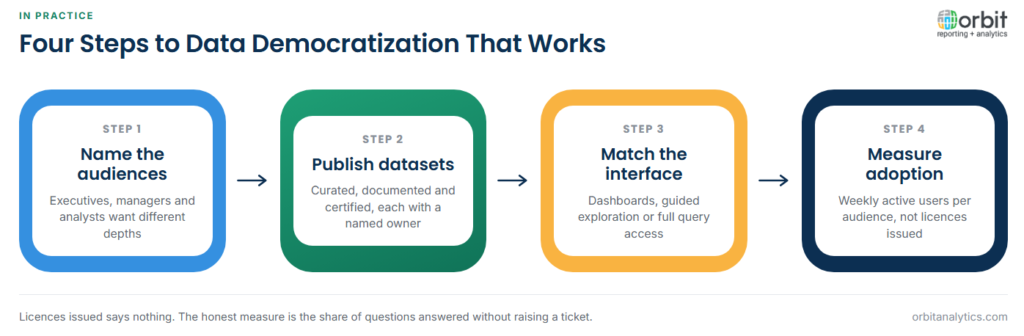
- Define the audiences and their questions. Executives, functional managers and analysts want different things at different depths. Naming the audiences prevents building one interface that suits nobody.
- Publish governed datasets. Curated, documented and certified, with an owner named on each.
- Give each audience the right interface. Dashboards for monitoring, guided exploration for managers, full query access for analysts.
- Measure adoption, not licence count. Licences issued says nothing. Weekly active users per audience, and the proportion of questions answered without a ticket, say a great deal.
Orbit Analytics serves these audiences from the same governed data, so a dashboard figure and an analyst’s ad hoc reporting query resolve to the same definition rather than diverging.
Data democratization in Oracle ERP organizations
ERP data is harder to open up than most, for reasons that are structural rather than cultural. The underlying schemas are large and normalized, designed for transaction processing rather than for a finance manager to query directly. Table and column names rarely resemble the business terms people use.
Security is the second complication. Oracle applications enforce access at the application layer through responsibilities, roles and data access sets. A reporting layer that ignores this and grants blanket table access has quietly undone the security model the organization relies on, so entitlements need to be inherited rather than reinvented.
The third is audience divergence. Finance needs ledger-level accuracy and period discipline. Operations needs near real-time figures and cares less about the accounting calendar. Executives need a small number of trusted measures. One report serving all three serves none of them properly, which is why matching the interface to the audience matters more here than the tooling choice.
Data democratization vs. self-service analytics vs. data governance
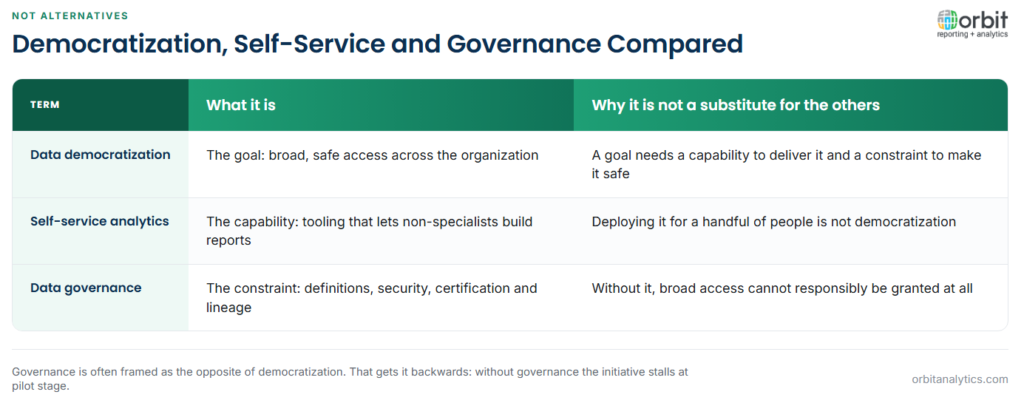
These three are frequently presented as competing approaches. They are not alternatives at all: they are a goal, a capability and a constraint.
Democratization is the goal. It describes the intended state, where people across the organization can answer their own questions safely.
Self-service analytics is the capability that delivers it. It is the tooling and modelling that lets a non-specialist build a report without writing SQL. An organization can deploy self-service tools and still not be democratized, if only a handful of people have access.
Governance is the constraint that makes it safe. Definitions, security, certification and lineage are what stop broad access producing chaos. Governance is often framed as the opposite of democratization, which gets it exactly backwards: without it, broad access cannot be granted responsibly, so the initiative stalls at pilot stage.
Frequently Asked Questions
Q1. What is data democratization?
It is making data accessible to non-specialists across an organization, together with the tools, definitions and literacy support needed to use it correctly, so people can answer their own questions.
Q2. Does data democratization mean everyone sees everything?
No. Sensitive data stays restricted. It means removing unnecessary barriers so people can reach the data their role requires, rather than removing all controls.
Q3. What is the difference between data democratization and self-service analytics?
Democratization is the organizational goal of broad, safe access. Self-service analytics is the capability that delivers it. Deploying self-service tools for a small group is not democratization.
Q4. What are the risks of data democratization?
Conflicting numbers from uncontrolled definitions, exposure of sensitive data, report sprawl, and users misreading figures without context. Each has an established mitigation in the governance layer.
Q5. What is needed before data can be democratized?
A governed semantic layer with agreed definitions, row and column level security applied centrally, data literacy support, and a clear route to escalate unusual questions to specialists.
Q6. How is data democratization measured?
By adoption rather than licences: weekly active users within each audience, and the share of questions answered without raising a request to the central team.
Opening up ERP data without losing control of definitions or security is the practical obstacle for most Oracle organizations. Orbit Analytics delivers governed self-service over live EBS and Fusion Cloud data with source entitlements preserved. Request a demo to see how it fits your access model.
