
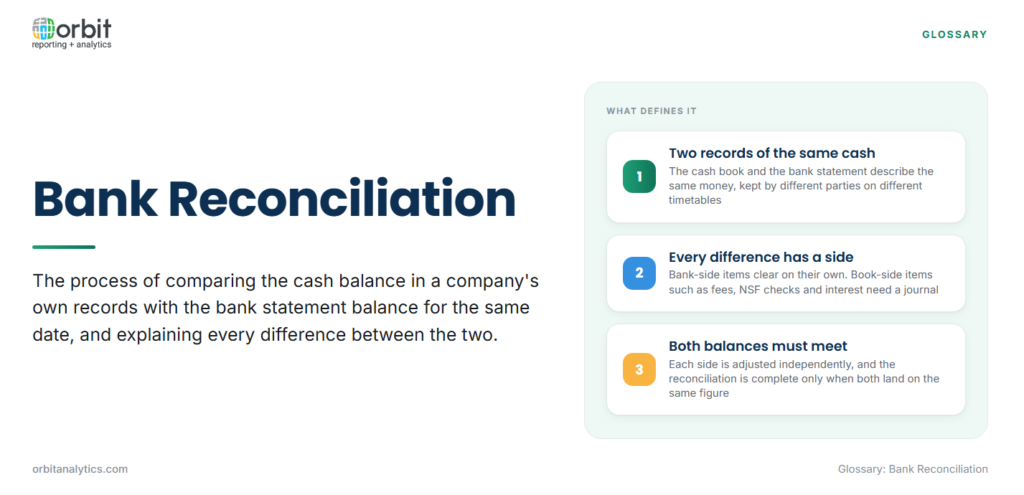
Bank reconciliation is the process of comparing the cash balance in a company’s own records (the cash book, or the cash account in the general ledger) with the balance on the bank statement for the same date, and explaining every difference between the two. When it is complete, both balances have been adjusted to the same figure and every adjustment has a reason.
The two records describe the same money but are kept by different parties on different timetables. The company records a check the day it is written; the bank records it the day it is presented. So the balances rarely agree on their own, and the reconciliation is where the gap is accounted for.
Why Bank Reconciliation Matters
Cash is where errors and fraud surface fastest, and this is the control that surfaces them:
- Catching errors before they reach the statements: a transposed amount, a duplicated receipt or a payment posted to the wrong bank account shows up as a difference nobody can explain.
- Detecting fraud and unauthorised payments: a withdrawal on the statement with no matching entry in the books is exactly what an unauthorised payment looks like.
- Knowing the cash actually available: the book balance ignores checks not yet presented and the bank balance ignores deposits not yet credited. Only the reconciled figure tells treasury what can really be spent.
The Reconciling Items That Explain the Difference
Every difference belongs to one of a small set of items. The useful question is which side needs adjusting, because that decides whether a journal entry is required.
| Reconciling item | What it is | Side adjusted | Journal needed? |
|---|---|---|---|
| Deposit in transit | Cash recorded in the books but not yet credited by the bank | Bank | No |
| Outstanding check | A check issued and recorded but not yet presented for payment | Bank | No |
| Bank fees and service charges | Charges deducted by the bank and not yet recorded in the books | Book | Yes |
| NSF check | A customer check returned for non-sufficient funds | Book | Yes |
| Interest earned | Interest credited by the bank and not yet recorded | Book | Yes |
| Bank error | A mistake made by the bank | Bank | No (the bank corrects it) |
| Book error | A mistake in the company’s own records | Book | Yes |
Bank-side items clear themselves as the bank catches up. Book-side items stay open until someone posts them.
The Adjusted-Balance Method
The standard layout adjusts each balance independently rather than working from one to the other. The bank balance is adjusted for what the bank does not yet know: add deposits in transit, subtract outstanding checks, and correct any bank error. The book balance is adjusted for what the books do not yet know: subtract fees and NSF checks, add interest, and correct any book error.
If every item has been found and classified correctly, the two adjusted balances are identical. That figure is the true cash balance. A remaining difference means an item has been missed or put on the wrong side, and the reconciliation is not finished.
How to Perform a Bank Reconciliation
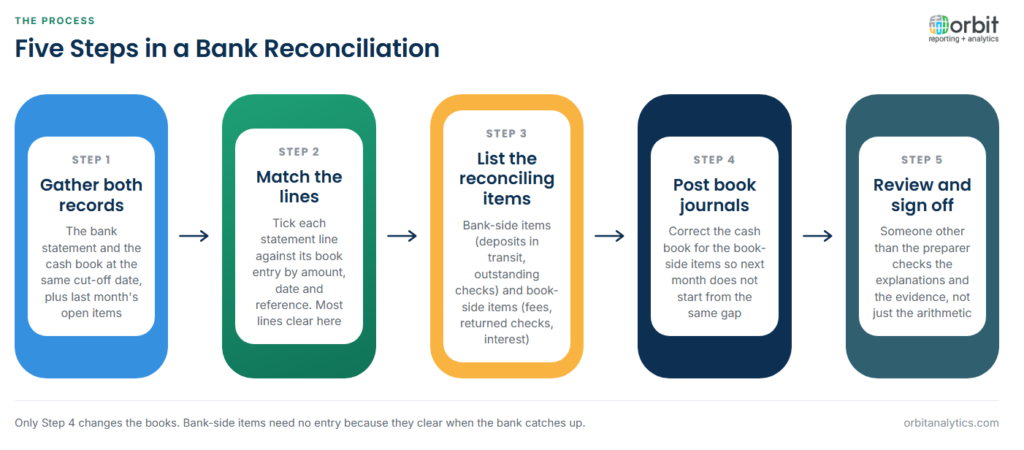
- Gather the statement and the cash book. Use the same cut-off date for both, plus the previous reconciliation so its open items can be checked off.
- Match deposits and withdrawals. Tick each statement line against its book entry by amount, date and reference. Most lines clear here.
- List the reconciling items on both sides. Unmatched book deposits become deposits in transit and unmatched checks become outstanding checks (bank-side items); unmatched statement lines such as fees, returned checks and interest become book adjustments (book-side items).
- Post journals for the book-side items. The cash book is corrected, so next month does not start from the same gap.
- Review and sign off. Someone other than the preparer checks the explanations and the evidence, not just the arithmetic.
A Worked Bank Reconciliation Example
Suppose the statement shows 48,200 at month end and the cash book shows 46,885. Matching finds a deposit of 5,600 not yet credited, outstanding checks totalling 7,350, a bank fee of 45, a returned customer check of 600 and interest of 210.
| Bank side | Amount | Book side | Amount |
|---|---|---|---|
| Balance per bank statement | 48,200 | Balance per cash book | 46,885 |
| Add: deposit in transit | 5,600 | Less: bank fee | (45) |
| Less: outstanding checks | (7,350) | Less: NSF check | (600) |
| Add: interest earned | 210 | ||
| Adjusted bank balance | 46,450 | Adjusted book balance | 46,450 |
Both sides land on 46,450, so the reconciliation is complete. Three journals follow on the book side (the fee, the NSF check and the interest); nothing is posted for the bank-side items, which clear when the bank processes them.
Bank Reconciliation in an Oracle ERP Environment
In Oracle Fusion Cloud and Oracle EBS, Cash Management imports bank statements electronically and applies matching rules that clear routine lines automatically. That removes most of Step 2, but not the judgement: unmatched items still need a person to decide whether each one is timing, a missing entry or an error.
What finance teams then need is visibility. Controllers want to see unreconciled items by account and by age, and compare the reconciled cash figure with the ledger balance at period end. Orbit Analytics provides general ledger reporting that reads cash and GL balances directly from Oracle Fusion Cloud and EBS, with drill-down from any balance to the journals behind it.
Common Bank Reconciliation Problems
- Stale outstanding checks: a check that has sat on the list for months was probably lost, voided or never sent. It needs investigating, not rolling forward indefinitely.
- Unrecorded bank charges: small fees that nobody posts make the book balance drift a little every month until the difference is too tangled to trace.
- Cut-off errors at period end: a deposit recorded on the last day that the bank credits on the first day of the next month is legitimate, but one recorded early to flatter the balance is not.
- Many accounts, entities and currencies: a group with dozens of bank accounts repeats the exercise dozens of times, then has to assemble the results. Orbit Analytics reports cash balances across every entity and currency in one place, so that assembly is no longer manual.
Teams that prefer to keep the familiar workbook can use Excel reporting that refreshes live ledger balances into the sheet instead of pasting an export into it.
Bank Reconciliation vs Account Reconciliation
Bank reconciliation is one case of a wider control. Account reconciliation proves any balance sheet account against an independent source: a subledger, a supporting schedule or a counterparty confirmation. The general method, and the workbook that records it, is covered in the account reconciliation spreadsheet entry.
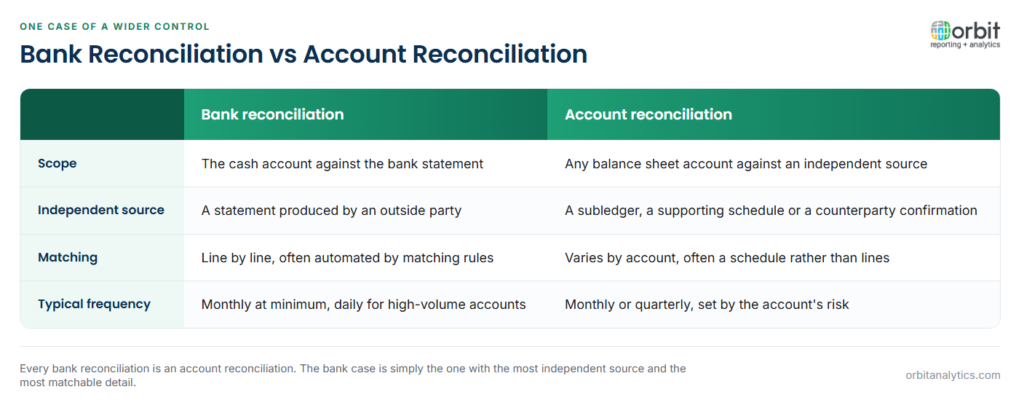
What makes the bank case different is the source. A bank statement is produced by an outside party, arrives on a fixed cycle and can be matched line by line, which is why bank reconciliation is usually the most frequent and most automated reconciliation a finance team performs.
Frequently Asked Questions
Q1. What is a bank reconciliation?
It is the comparison of a company’s cash book balance with its bank statement balance at the same date, with every difference explained. Both balances are adjusted until they agree, and the agreed figure is the true cash position.
Q2. What are deposits in transit?
They are receipts the company has recorded but the bank has not yet credited, usually because they were deposited near the statement date. They are added to the bank balance and need no journal entry.
Q3. Which items need a journal entry after a bank reconciliation?
Only book-side items: bank fees, NSF checks, interest earned and errors in the company’s own records. Bank-side items clear on their own when the bank processes them.
Q4. How often should a bank reconciliation be done?
At least monthly, when the statement arrives. High-volume accounts are often reconciled weekly or daily, because a small gap is far easier to trace than a month of them.
Q5. What happens if a bank reconciliation does not balance?
It means an item has been missed, classified on the wrong side or entered at the wrong amount. The reconciliation is not complete until the difference is explained, and it should never be closed with an unexplained plug.
Bank reconciliation is quicker when balances arrive current and every unreconciled item can be traced to its source transaction. Orbit Analytics brings live Oracle cash and ledger data into one reporting layer for exactly that. Request a demo to see it against your own bank accounts.
