
Agentic analytics is analysis carried out by AI agents that take a goal, plan the steps needed to reach it, run those steps against data and report what they found. Instead of answering one question at a time, the agent decides which questions to ask next.
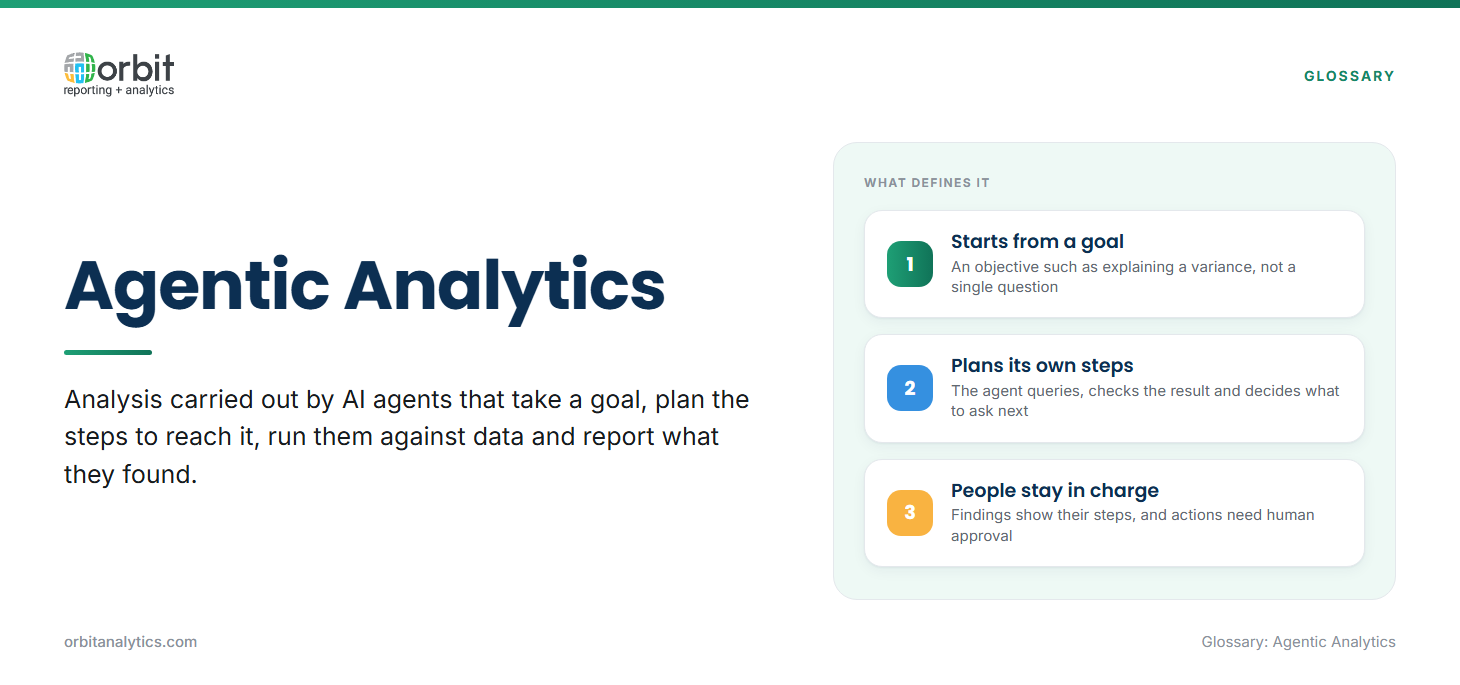
“Agentic” is the part that changes the picture. A conventional AI assistant waits for each question. An agent works toward an objective, such as “find out why gross margin fell in March”, by choosing queries, checking results, trying another angle when a result is unclear and stopping when it has an explanation.
The term borrows from agentic AI, the broader idea of AI systems that plan steps and use tools toward a goal, which became widely discussed in 2024 and 2025. Analytics vendors then applied it to data analysis, so definitions vary from one vendor to the next.
How Agentic Analytics Works
An agentic analysis usually follows five steps:
- Take a goal, not a question: the starting point is an objective, such as explaining a variance or monitoring a set of KPIs.
- Plan the analysis: the agent breaks the goal into smaller questions, such as which regions, products or cost centers moved most.
- Query, check and re-query: it runs queries, checks whether each result answers its sub-question and refines the next query based on what it learned.
- Report the finding: it summarizes the explanation, with the figures and the steps it took to reach them.
- Hand off or act within limits: it passes the finding to a person, or takes a pre-approved action such as raising an alert.
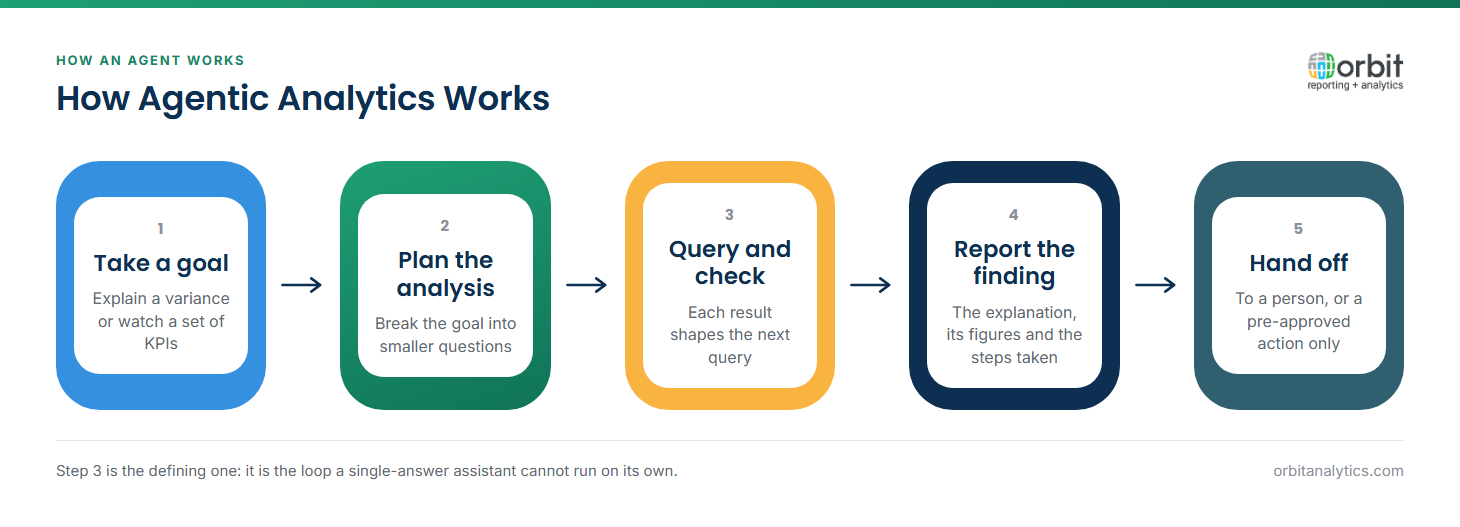
Step 3 is the defining one. The loop of querying, checking and re-querying is what a human analyst does, and it is what a single-answer assistant cannot do on its own.
Agentic Analytics vs Conversational Analytics vs an AI Analyst
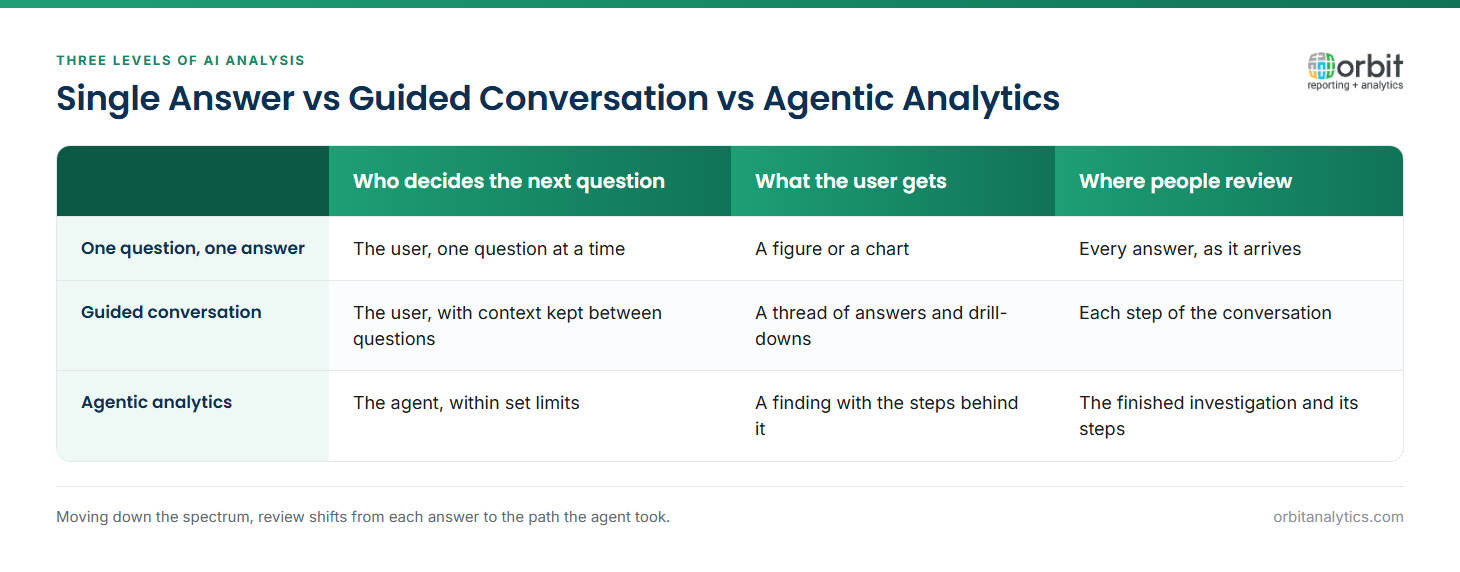
AI for analysis sits on a spectrum, from one answer to a full investigation:
- One question, one answer: the user asks, the system returns a figure or chart. Natural language query tools work this way.
- A guided conversation: the user leads a series of questions and the system keeps context between them. This is conversational analytics, and it is how an AI data analyst works. An Oracle Fusion AI analyst works this way: the user asks for top suppliers by spend, compares the result with last year, and then asks to see the purchase orders behind the increase.
- A multi-step investigation: the agent plans and runs the sequence itself, and the user reviews the result.
Orbit Analytics offers ThinkBoxes as the guided conversation pattern on Oracle Fusion and Oracle EBS data, where the user asks, investigates, drills down and explores in one conversation. The person stays in charge of each step.
The Building Blocks
An agentic analytics system needs four parts in place:
- A governed semantic layer: business objects and approved metric definitions, so every query the agent writes uses the same meaning of “revenue” or “margin”.
- Tools the agent can call: query access, calculation functions and sometimes forecasting or alerting services, each with defined inputs and limits.
- Memory and context: a record of what the agent has already asked and found, so it does not repeat work or lose the thread.
- Guardrails and approval steps: rules on what data it can read, how many queries it can run and which actions need a person to approve them.
Agentic Analytics Use Cases
The approach suits analysis that follows a predictable investigative pattern:
- Monitoring KPIs and explaining changes: watching a set of measures and, when one moves outside its usual range, working out which dimensions drove the change.
- Month-end variance investigation: comparing actuals with budget, finding the accounts and cost centers behind the largest variances and drafting the explanation for review.
- Supply chain exceptions: spotting late shipments or stock shortfalls and tracing them to suppliers, sites or orders.
Agentic Analytics on ERP Data
Two kinds of agent meet ERP systems, and they are easy to confuse:
- Agents that act inside the ERP: they create or update transactions, answer policy questions or route approvals. Oracle AI Agent Studio, Oracle’s environment for building agents in Fusion Applications, is an example of this kind.
- Agents that analyze ERP data: they read data and explain it. An Oracle EBS AI analyst has to work from EBS’s own data model and respect each user’s responsibilities, whether a person or an agent is asking the question.
Why the ERP data model matters: an agent that loops through queries against raw ERP tables multiplies every guess about joins and meanings. Orbit Analytics organizes Fusion data into analytics-ready business models through its Fusion data models, with the relationships and definitions any AI needs, agent or not.
Risks of Agentic Analytics
Agents add risks that single-answer tools do not have:
- Inconsistent metric definitions: if agents calculate a measure differently from the finance report, trust erodes quickly, because two answers to one question cannot both be right.
- Compounding errors across steps: a wrong filter in step one carries through every later step, so the final explanation can be confidently wrong.
- Unclear accountability: when an agent drafts a variance explanation, someone still has to own it before it reaches a board pack.
- Runaway queries and load on source systems: an agent that loops can run hundreds of queries, which matters when they hit a production ERP database.
Keeping People in Charge
Sources disagree on how much autonomy agents should have. The widely held position has three parts:
- Human approval for actions: an agent may recommend, but a person approves anything that changes data or goes outside the team.
- Showing the steps the agent took: every finding should list the queries and intermediate results behind it, so a reviewer can check the path, not only the conclusion.
- Inheriting user permissions: an agent should run with the permissions of the person it works for, never a broader service account.
Agentic Analytics vs Traditional BI
Agents do not replace dashboards. The two do different jobs:
| Traditional BI | Agentic analytics | |
|---|---|---|
| Starting point | A defined report or dashboard | A goal or an alert |
| Who decides the next question | The person reading | The agent, within limits |
| Strength | Consistent, repeatable views of known measures | Investigating changes nobody planned a report for |
| Review | The figures are the output | The steps and the conclusion both need checking |
Dashboards remain the shared view of performance. Agents are useful for the questions those views raise.
Frequently Asked Questions
Q1. What is agentic analytics in simple terms?
It is analysis done by AI agents that plan and run several steps toward a goal. Instead of answering one question, the agent works out which questions to ask and in what order.
Q2. How is agentic analytics different from conversational analytics?
In conversational analytics the user leads each question. In agentic analytics the agent plans the sequence itself and the user reviews the result.
Q3. Does agentic analytics replace dashboards?
No. Dashboards give a consistent view of known measures, while agents investigate the changes those dashboards reveal.
Q4. Is agentic analytics safe to use on financial data?
It can be, with governed metric definitions, inherited user permissions, visible steps and human approval for any action. Without those, errors can compound unnoticed.
Q5. Can AI agents take actions in an ERP system?
Some can, such as agents built to create transactions or route approvals. Analytical agents usually only read data and hand findings to a person.
Agents and people both need the same governed foundation to get consistent answers. Orbit Analytics provides data models and conversational analytics for Oracle Fusion and EBS data. Request a demo to see it on your own data.
