Introduction: The Goldmine of Cloud ERP Data
Every day, your Oracle Fusion Cloud environment generates an invaluable reservoir of transactional data. From financial ledgers and supply chain logistics to human capital records, this data holds the key to enterprise agility. Extracting this mission-critical data and transforming it into actionable, executive-level insights is rarely straightforward. For most enterprise teams, the journey from Oracle Fusion to the Snowflake Data Cloud resembles a fragile patchwork held together by custom ETL scripts, manual interventions, and late nights during the financial close.
The modern data stack demands more. Snowflake’s separation of compute and storage, combined with its elastic performance, makes it the ideal destination for ERP data. Yet, migrating this complex data reliably—without breaking downstream reporting every time Oracle releases a quarterly patch—requires a specialized approach. This guide explores the sophisticated architecture, reliable methodologies, and strategic data modeling necessary to build governed, scalable, and analytics-ready pipelines from Oracle Fusion into Snowflake.
The Enterprise Dilemma: Why Fusion Extraction is Fundamentally Hard
Before diving into the solution architecture, we must understand why integrating Oracle Fusion ERP with modern cloud data warehouses poses such a severe challenge. Unlike legacy on-premises databases where direct SQL access to underlying tables was the norm, cloud-based ERP systems deliberately abstract their data structures.
First, standard extraction methods are notoriously rigid. Organizations frequently rely on a piecemeal combination of Oracle Business Intelligence Cloud Connector (BICC), Oracle Transactional Business Intelligence (OTBI), or custom REST APIs. Each approach creates friction. OTBI is excellent for lightweight operational reporting but frequently hits rate limits when extracting massive datasets for historical trend analysis. BICC is the recommended standard for bulk extraction, but its output—often massive, deeply nested files—requires heavy transformation logic that bogs down engineering resources.
Second, enterprise data teams face the persistent, highly disruptive issue of schema drift. Oracle regularly pushes quarterly SaaS updates that introduce new columns, deprecate old ones, or modify Public View Objects (PVOs) without warning. In a custom-built ETL pipeline, a single undocumented schema change can silently break downstream executive dashboards. This leaves the C-suite analyzing inaccurate financial figures at critical decision-making moments.
Third, ensuring robust security and establishing highly accurate data lineage is a continuous battle. Relying on static passwords embedded within extraction scripts is a massive vulnerability. Enterprises must rigorously transition to scoped OAuth 2.0 and dedicated service account authentication. Without a specialized, enterprise-grade solution engineered specifically for Oracle, organizations waste months of expensive engineering time just keeping infrastructure alive.
The Architecture of Cloud ERPs vs Legacy Systems
To appreciate the required solution, we must briefly contrast modern cloud architectures with their legacy counterparts. Historically, organizations using Oracle E-Business Suite (EBS) enjoyed unrestricted backend database access. Engineers could write complex SQL scripts joining hundreds of tables to extract the exact dataset required.
The transition to Oracle Fusion Cloud eliminated this capability. Operating strictly on a SaaS model, the underlying autonomous database is locked down. Data must now be extracted through specific application layers, predominantly utilizing View Objects (VOs) and Public View Objects (PVOs). These objects act as a virtual abstraction layer over relational tables. Because PVOs utilize highly complex joins, replicating this logic accurately inside Snowflake requires an extraction tool with native intelligence regarding Oracle’s proprietary data dictionary.
Architecting the Automated Pipeline with Orbit DataJump
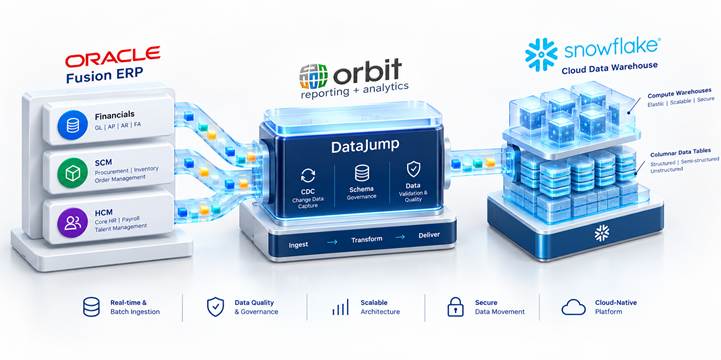
To permanently overcome the friction of manual ERP extraction, forward-thinking enterprises are abandoning fragile scripting in favor of purpose-built automation. This is precisely where Orbit DataJump redefines the data integration landscape. Orbit DataJump is not merely a generic data mover; it is a highly sophisticated, deeply Oracle-aware integration engine engineered exclusively to land Oracle Fusion data safely into the Snowflake Data Cloud.
The foundation of a reliable pipeline begins with intelligent extraction. Within the Orbit DataJump platform, engineering teams connect directly to Oracle Fusion Cloud Applications and seamlessly select their preferred extraction mechanism. Whether leveraging BICC for multi-year historical loads, or employing BI Publisher and REST APIs for specialized edge cases, DataJump inherently understands Oracle’s internal architecture. It entirely bypasses the painful need for engineers to write tedious custom glue code to handle Fusion’s unique structures.
This profoundly means your teams are no longer forced to use generic, decoupled integration tools to decipher a complex ERP. The essential metadata intelligence and native API understandings are already seamlessly built directly into the core platform, accelerating deployment timelines from months down to a matter of weeks.
Incremental Data Loads, CDC, and Mastering Schema Drift
Beyond extracting data, the most significant architectural advantage of Orbit DataJump is its intelligent handling of complex incremental loads and unpredictable schema drift. Once the initial full load is pushed into the Snowflake environment, the pipeline automatically shifts into an optimized incremental extraction mode.
The platform’s sophisticated watermark strategy is fully configurable on a per-table basis. This critical feature enables finance operations to consistently achieve near-real-time visibility into mission-critical subject areas—such as the General Ledger and Accounts Payable—without incurring the prohibitive Snowflake compute costs associated with daily full-refresh extractions. Updates, inserts, and soft deletes are intelligently captured and seamlessly merged into target tables using highly optimized Snowflake `MERGE` statements.
Additionally, when Oracle introduces mandatory quarterly schema changes, Orbit DataJump’s resilient schema drift handling instantly engages. The pipeline automatically detects newly added columns, adjusts the target schema in Snowflake on the fly, and flags deprecated fields without dropping the pipeline. This vital capability prevents silent data failures and maintains the strict Service Level Agreements (SLAs) demanded by modern enterprises.
The Missing Link: Prebuilt Data Models & The Semantic Layer

Moving massive datasets efficiently into Snowflake is only the first step. Simply landing highly normalized, thoroughly cryptic ERP tables into a powerful data warehouse is exactly where ambitious data initiatives stall. The true strategic objective is to radically accelerate time-to-insight. Implementing comprehensive prebuilt analytics models is the undeniable differentiator separating successful deployments from costly engineering sinkholes.
Oracle Fusion data structures are notoriously complex, heavily relying on abstract PVO names, intricate hierarchical joins, and deeply nested date semantics. If business analysts are directly forced to query these raw tables within Snowflake, the result is inevitably a chaotic sprawl of conflicting SQL calculations, inaccurate reports, and a complete loss of trust. Orbit Analytics solves this systemic problem by actively delivering a highly governed semantic layer that lands natively alongside your Fusion data directly inside Snowflake.
This powerful semantic layer systematically applies highly refined transformations to normalize confusing Oracle constructs, efficiently flatten nested reporting hierarchies, and seamlessly execute fundamental business logic. This includes complex, globally aware operations like multi-currency conversions, automated cross-validation rules, and aggregated balance calculations. By abstracting the confusing ERP complexity, the technical data is beautifully translated into intuitive, business-friendly terms like Customer, Invoice, Supplier, and General Ledger Balance.
Activating Analytics: High-Value Use Cases for Finance and Operations
With automated pipelines and a highly optimized semantic layer established natively within Snowflake, the enterprise is flawlessly positioned to unlock genuinely transformative use cases. By liberating critical data from the uncompromising constraints of the ERP system, organizations transition from reactive operational reporting to proactive, predictive enterprise analytics.
For large-scale global finance teams, the traditional month-end close is typically a grueling, high-stress exercise involving intense manual spreadsheet consolidation and endless data reconciliation. By strategically combining Snowflake’s immense computing power with Orbit’s highly automated data pipelines, finance teams confidently achieve real-time, multi-entity consolidation on a global scale. Intricate intercompany transactions and nuanced currency conversions are processed completely seamlessly and flawlessly accurately.
For organizations desperately seeking to rapidly modernize their legacy Oracle Fusion Financial Statement Generator (FSG) processes, Orbit GLSense offers an unparalleled, highly intuitive self-service reporting solution. GLSense specifically empowers professionals to independently construct, manipulate, and instantly refresh dynamic Excel reports connected directly against live Oracle Fusion Cloud GL data. Crucially, this includes the indispensable ability to execute deep, investigative drill-downs directly into granular sub-ledgers, Trial Balances, and comprehensive Profit and Loss statements, drastically accelerating the close cycle while heavily reducing audit risk.
AI Readiness and Uncompromising Data Governance
Trusted, flawlessly accurate data is the non-negotiable prerequisite for successful enterprise Artificial Intelligence initiatives. With Orbit’s standardized, high-quality data products securely within the optimized Snowflake environment, advanced data science teams immediately bypass the tedious data-wrangling phase. They instantly begin deploying Machine Learning models directly on top of the clean data. Whether the corporate goal is predictive revenue forecasting, intelligent supply chain anomaly detection, or dynamic workforce capacity planning, the powerful integration of clean Oracle ERP data and Snowflake’s computational engine makes enterprise AI a tangible reality.
Furthermore, as this invaluable data democratizes across the enterprise, rigorously maintaining strict data governance, zero-trust security protocols, and total observability becomes absolutely paramount. Trusting an executive financial report implicitly requires the ability to definitively prove exactly where every single financial figure originated. When enterprises build these robust pipelines utilizing Orbit DataJump, vital forward and backward data lineage is continuously documented by the intelligent pipeline itself.
Conclusion: Elevating Your Enterprise Data Strategy
Migrating massive volumes of mission-critical Oracle Fusion data into Snowflake should never require months of bespoke custom development, fragile manual ETL scripts, or a paralyzing fear of unannounced schema drift breaking executive analytics. By strategically leveraging the proven power of Orbit DataJump to fully automate extraction, and seamlessly deploying Orbit’s world-class prebuilt data models to immediately establish a governed semantic layer, enterprises dramatically reduce their time-to-value from years to mere weeks.
The transformative result is a highly reliable, scalable architecture that continuously empowers business leaders with a single, undeniable version of the truth. It accelerates financial reporting cycles, thoroughly eliminates data silos, and proactively builds the essential foundational infrastructure required for modern AI workloads. It is decisively time to stop managing broken pipelines and start driving proactive, high-value insights. The future of agile, high-performance finance fundamentally depends on transforming raw data into reliable intelligence today. Discover how to start realizing immediate ROI by exploring our comprehensive modernization pipelines and strategies.