
Finance teams often use the words “plan” and “forecast” interchangeably, and that confusion costs real money. A budget gets treated like a forecast, a forecast gets treated like a target, and by Q3 nobody trusts either number. Strong planning and forecasting discipline keeps the two distinct, because each answers a different question for the business.
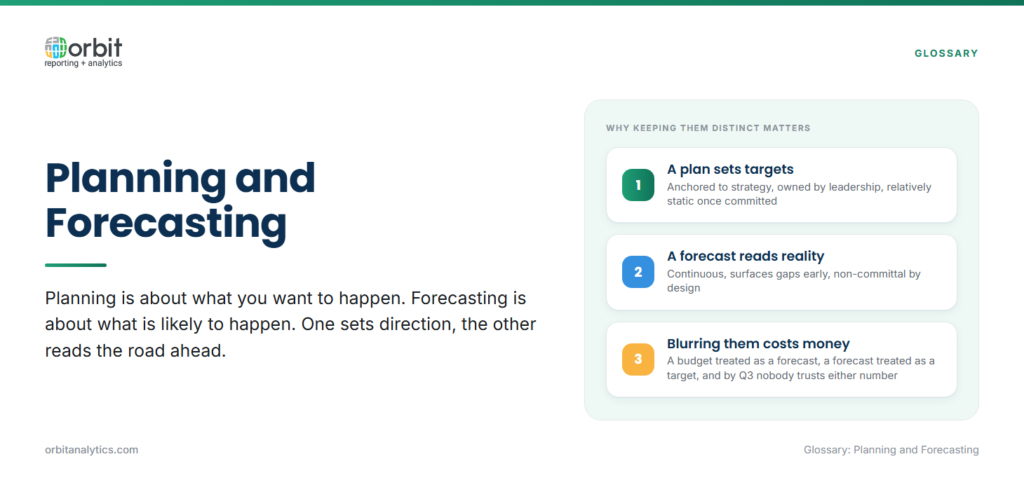
Planning is about what you want to happen. Forecasting is about what is likely to happen. One sets direction; the other reads the road ahead. When finance leaders confuse the two, accountability blurs and resource allocation suffers.
This guide breaks down the practical differences between planning and forecasting, when to use each, and how a modern FP&A team runs both processes together. It is written for finance leaders, controllers, and BI analysts who work with Oracle ERP data and want a clean operating model rather than a textbook definition.
Quick overview: planning vs forecasting
| Aspect | Planning | Forecasting |
| Purpose | Set goals and allocate resources | Predict future outcomes |
| Time horizon | Fixed periods (annual, quarterly) | Continuous, rolling updates |
| Flexibility | More rigid, target-oriented | Adaptive, adjusts to new data |
| Data focus | Historical actuals plus strategic goals | Historical trends and patterns |
| Output | Budgets, targets, action plans | Projections, scenarios, estimates |
| Ownership | Leadership and finance | FP&A and business units |
| Update frequency | Annual or quarterly | Monthly, weekly, or real-time |
What is planning?
Planning is the structured process of setting goals, allocating resources, and deciding what the organisation will do over a defined period. It produces commitments: revenue targets, headcount budgets, capital plans, and operating expense limits. Planning is prescriptive, it says what should happen.
Key characteristics of planning
- Anchored to strategy: A plan reflects deliberate choices about which markets to pursue, which products to invest in, and which costs to hold flat.
- Owned by leadership: Plans are typically owned by executive leadership and signed off by the board.
- Relatively static: Once approved, the annual operating plan becomes a contract between functions and finance. Changing it mid-year requires re-forecasting and a formal reallocation.
Types of planning
- Strategic planning (3-5 years): high-level direction, market entry, M&A, capital structure.
- Tactical planning (1-2 years): annual operating plan, departmental budgets, hiring plans.
- Operational planning (daily, weekly, monthly): production schedules, inventory targets, sales pipeline goals.
What is forecasting?
Forecasting is the process of estimating future outcomes based on data, trends, and assumptions. Unlike a plan, a forecast is not a commitment, it is a best-guess view of where the business is heading if current conditions continue.
Key characteristics of forecasting
- Continuous: A good FP&A team refreshes the forecast every month, sometimes every week, as new actuals land in the ERP. The output is a moving picture rather than a fixed line.
- Surfaces gaps early: When this month’s forecast lands below plan, finance can flag the variance early, investigate the driver, and recommend corrective action long before the gap shows up in the year-end results.
- Non-committal by design: A forecast informs decisions but does not lock the business into a number.
Types of forecasting
- Qualitative forecasting: judgement-based, used when historical data is thin (new product launches, market entries).
- Quantitative forecasting: time-series models, regression, and statistical methods applied to historical data.
- Causal or driver-based forecasting: forecasts built from underlying drivers (units sold x price, headcount x average salary). Driver-based models are the most defensible because each line ties back to an operational input.
Planning vs forecasting: key differences
The differences fall along six dimensions:
| Dimension | Planning | Forecasting |
| Question | What do we want to achieve? | What are we likely to achieve? |
| Time horizon | Fixed fiscal period or 3-5 year window | Rolling 12 to 18 months |
| Flexibility | Rigid by design; departments commit | Must flex with new data |
| Data requirements | Strategic assumptions, top-down targets | Granular operational actuals |
| Owner | Executive leadership, finalised by finance | FP&A with business unit input |
| Output | Budget document, approved targets, action plan | Scenario, projection, variance commentary |
Purpose and time horizon
Planning answers “what do we want to achieve?” Forecasting answers “what are we likely to achieve?” Plans cover a fixed period (fiscal year, five-year strategic window, or quarterly cycle), while forecasts extend 12 to 18 months on a rolling basis, dropping the oldest month and adding a new one each cycle.
Flexibility and data requirements
Plans are deliberately rigid; the whole point of a budget is that departments commit to it. Forecasts must flex, and a forecast that never moves is just a stale plan. Plans lean on strategic assumptions and top-down targets, while forecasts demand clean, granular operational data: actuals by cost centre, units by SKU, headcount by department. Orbit Analytics pulls live Oracle Fusion Cloud and EBS actuals into a single curated layer, so the forecast model is never starved of recent data or stuck behind an IT ticket.
Ownership and output
Plans are owned by executive leadership and finalised by finance. Forecasts are typically owned by FP&A but built collaboratively with business unit leaders who own the drivers. A plan produces a budget document and approved targets; a forecast produces a scenario, a projection, and variance commentary against plan.
When to use planning vs forecasting
Use each process in the situations it was built for:
- Use planning when you need to commit resources, set targets, or align the organisation on a shared goal.
- Use forecasting when you need to anticipate variances, test sensitivity, or recalibrate expectations mid-period.
In practice, most finance teams need both running in parallel. The plan is the baseline; the forecast is the early-warning system that tells you when the baseline is at risk.
How planning and forecasting work together
The planning-forecasting cycle
A mature FP&A function follows a repeatable cadence:
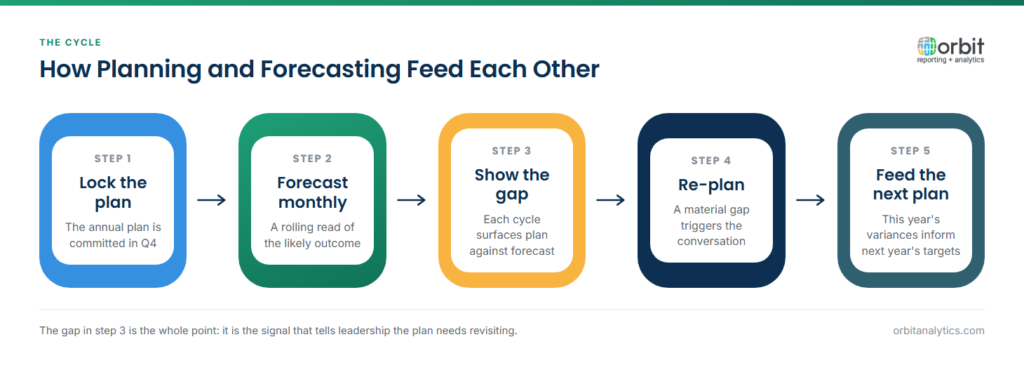
- Lock the annual plan in Q4 with sign-off from executive leadership.
- Run monthly forecasts against that plan for the next twelve months.
- Highlight gaps each cycle with variance commentary on the drivers.
- Trigger re-planning conversations when variance crosses a material threshold.
- Feed insights into the next plan cycle so it starts from a better base.
Rolling forecasts and continuous planning
Rolling forecasts replace the rigid annual cycle with a continuous 12 to 18-month outlook that refreshes every month. Continuous planning takes the idea further; both plan and forecast are updated together whenever the business environment shifts materially.
Building an integrated FP&A process
The integration only works when actuals, plan, and forecast share the same data model. Many teams stall here because their ERP data lives in one system, their plan in a spreadsheet, and their forecast in a third tool. A unified business intelligence platform closes the loop by pulling Oracle ERP actuals, plan figures, and forecast scenarios into one view, so variance analysis takes minutes rather than days. Orbit Analytics also includes GL Sense and an Excel reporting add-in so finance teams can refresh the forecast directly from live general ledger data without leaving familiar tools.
Frequently Asked Questions
Q1. What is the main difference between planning and forecasting?
Planning sets goals and allocates resources for a fixed period. Forecasting estimates what will likely happen based on current data and trends. Planning is prescriptive; forecasting is predictive.
Q2. Which comes first, planning or forecasting?
Planning typically comes first because it establishes the targets the forecast is measured against. Once the plan is approved, forecasting begins and runs continuously alongside it for the rest of the period.
Q3. What is a rolling forecast and how does it relate to planning?
A rolling forecast is a continuously updated 12 to 18-month projection that drops the oldest month and adds a new one each cycle. It works alongside the annual plan, the plan provides the target, while the rolling forecast tracks whether you are likely to hit it.
Q4. How often should you update your forecast vs your plan?
Most organisations refresh the forecast monthly, with weekly updates during volatile periods. The annual plan is usually updated once a year, with quarterly re-plans if business conditions shift materially.
Q5. What is driver-based planning and forecasting?
Driver-based planning and forecasting builds financial outputs from operational drivers, units sold times price, headcount times average salary, transactions times unit cost. It is more accurate and easier to defend than top-down percentage adjustments.
Q6. What is the difference between a budget and a forecast?
A budget is the financial expression of a plan, a committed target for revenue, costs, and capital. A forecast is an unbiased estimate of what will actually happen, regardless of whether it meets the budget.
Strong planning and forecasting depends on one thing more than any model or framework: trustworthy, timely data. Request a demo to see how Orbit Analytics helps your FP&A team close the gap between plan, forecast, and reality.
