
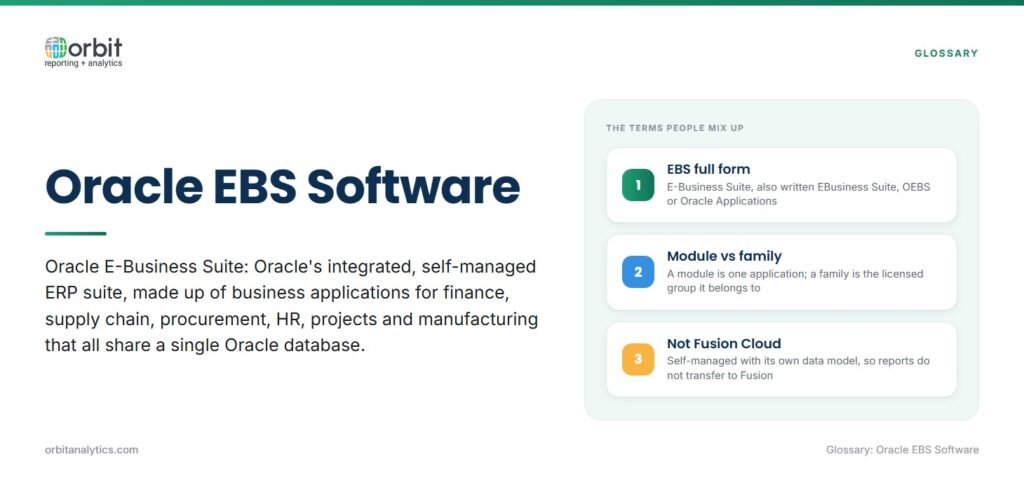
Oracle EBS software is Oracle E-Business Suite: Oracle’s integrated, self-managed ERP suite, made up of business applications for finance, supply chain, procurement, human resources, projects, and manufacturing that all share a single Oracle database.
The EBS full form is E-Business Suite, and EBS stands for exactly that. The same product appears in writing as Oracle EBusiness Suite, OEBS, Oracle Enterprise Business Suite, and simply Oracle Applications, all of which refer to the same suite.
One distinction is worth getting right early. A module is a functional application such as General Ledger or Purchasing. An application family is the group those modules belong to, such as Financials or Procurement. People use the words interchangeably, but Oracle’s licensing and documentation are organized by family.
Who runs it: predominantly large enterprises and public bodies that implemented EBS years ago, customized it substantially, and now run core finance and payroll on it. Many run it alongside Oracle Fusion Cloud during a phased migration.
A Short History of Oracle E-Business Suite
EBS grew out of the Oracle Applications product line of the 1990s, which bundled separately sold financial and manufacturing applications into one suite. The rebrand to E-Business Suite came with the shift to a browser-based, internet-architecture release.
Three release lines still matter in practice. 11i is the long-lived earlier generation, 12.1 brought the Release 12 architecture with a shared global ledger structure, and 12.2 introduced online patching, which allows most patches to be applied without taking the system down.
Oracle’s Applications Unlimited commitment is why EBS is still being developed rather than merely maintained. It removes the forced end-of-life deadline that would otherwise drive migration timing, and it is the main reason so many organizations are unhurried about moving.
The Core Modules of Oracle EBS Software
The suite is broad, but most estates are built from a familiar core:
- Financials: General Ledger, Payables, Receivables, Fixed Assets, and Cash Management, tied together by Subledger Accounting.
- Supply chain and procurement: Inventory, Order Management, Purchasing, and shipping execution.
- Human capital management: Core HR, Payroll, Time and Labor, and self-service HR.
- Manufacturing, projects, and CRM: Bill of Materials and Work in Process, Project Costing and Billing, and Service Contracts.
What matters analytically is the last point in the definition: every module writes to the same underlying database. A module boundary is a functional boundary, not a data boundary, which is why cross-module reporting is technically possible and practically difficult.
How Oracle EBS Is Architected
Image title: The Three Tiers, and Where the Data Sits
Alt text: Diagram of the Oracle EBS three-tier architecture: the desktop tier holding the browser or Java client, the application tier running forms, concurrent managers and reporting services, and the database tier where one Oracle database holds a separate schema per module.
Asset: https://drive.google.com/file/d/1UrxkGoUPF3yzyofA15IcS_AqTHVu_b3W/view
EBS runs on a three-tier architecture. The desktop tier is the browser or Java client, the application tier holds the forms, concurrent managers, and reporting services, and the database tier holds the Oracle database where all the data lives.
Inside that database, each module owns its own schema, so Payables objects sit under one schema and General Ledger under another, running to tens of thousands of tables across a full installation. Layered over it are multi-org and multi-ledger structures: operating units, legal entities, and ledgers that determine which rows a given user or report is entitled to see.
Deployment is on-premises by default, though many organizations now run the same estate on Oracle Cloud Infrastructure or Cloud@Customer. That changes where the hardware sits, not the application or its data model.
Oracle EBS Support Timelines and What They Mean
Oracle’s support tiers are worth understanding plainly, because they shape planning more than they change day-to-day operation:
- Premier Support: Full service, including new fixes, security updates, and certification with new third-party releases.
- Extended Support: Continued fixes and updates, usually at an additional fee, for a defined period after Premier ends.
- Sustaining Support: Indefinite access to existing fixes and documentation, but no new updates, security patches, or certifications.
Crossing a milestone does not stop a running system. It changes the risk profile: no new security patches means compensating controls, and no new certifications means the surrounding technology stack has to stay put.
This is also where reporting modernization is often confused with re-platforming. Orbit Analytics modernizes EBS reporting without changing the ERP, unifying EBS and Oracle Fusion Cloud data in one reporting layer, which lets a team improve reporting on its own schedule rather than waiting for a migration to finish.
The Reporting Problem Every EBS Shop Hits
Ask an EBS team what frustrates them and the answer is almost never the ERP itself:
- Standard reports stop at the delivered layout. Anything beyond it needs a new definition, which usually means a development request.
- Custom SQL and BI Publisher requests pile up. Each question becomes a ticket, and the backlog sets the pace of analysis.
- The schema resists casual querying. Normalized tables, multi-org structures, and flexfields that carry business meaning in generic column names make correct joins genuinely hard.
- Self-service is hard to offer safely. Giving business users direct access risks both wrong answers and exposed data, so most organizations do not.
Self-service reporting is the capability EBS teams most often say they lost when Oracle Discoverer was retired.
How to Report On and Analyze Oracle EBS Data
Four approaches are in common use, and most estates run more than one:
- Native EBS tools. Standard reports, Oracle Reports, and BI Publisher handle prescribed outputs well and cross-module analysis poorly.
- Direct SQL against the schema. Maximum flexibility, entirely dependent on people who know the data model, and unreviewable once it spreads into spreadsheets.
- Generic BI tools. Tableau or Power BI can read EBS, but need the schema modelled first, which is where most of the effort goes.
- An Oracle-native reporting layer. The data model is already understood, so work starts from delivered content rather than from table names.
Orbit Analytics sits in that fourth category: an Oracle Gold Partner platform for Oracle EBS reporting and analytics that reads the EBS schema natively, ships 1,000+ pre-built reports and 200+ pre-built connectors, and gives business users self-service access without hand-written SQL.
Common Challenges in Long-Running Oracle EBS Estates
- Customization drift. Years of extensions make every upgrade a regression-testing exercise, and undocumented changes surface only when something breaks.
- Data volume and query performance. Decades of transactions make archiving strategy a reporting concern as much as a storage one.
- Integration with cloud systems. EBS increasingly has to exchange data with SaaS applications and cloud warehouses it was not designed to talk to.
- A shrinking skills pool. Deep EBS knowledge is concentrated in people who have worked with it for years, and that group is not growing.
Oracle EBS vs. Oracle Fusion Cloud and Other Oracle ERP Products
Image title: Oracle EBS vs Oracle Fusion Cloud
Alt text: Comparison table of Oracle EBS and Oracle Fusion Cloud across six dimensions: who runs and upgrades the system, customization depth, whether direct database access is available, the native reporting stack, and the underlying data model. The two use different data models, so reports do not transfer between them.
Asset: https://drive.google.com/file/d/15JKxQ5tEnNOE3Zzspjwws5TOmPKjilHG/view
Oracle Fusion Cloud Applications is Oracle’s SaaS ERP, delivered and upgraded by Oracle on a fixed release cadence, with a different data model and a different reporting stack (OTBI and BI Publisher rather than Discoverer and Oracle Reports). EBS is self-managed, upgraded on the customer’s schedule, and customizable at a depth Fusion Cloud deliberately does not allow.
NetSuite and PeopleSoft are separate Oracle ERP products with their own data models, not versions of EBS. Organizations acquire a mix through acquisition, which is how one company ends up reporting across three Oracle ERPs.
The data-model difference is what matters for analytics: a report written against EBS tables does not transfer to Fusion Cloud, so any organization running both needs a reporting layer that understands each.
Frequently Asked Questions
Q1. What does EBS stand for in Oracle, and what is the EBS full form?
EBS stands for E-Business Suite. The full product name is Oracle E-Business Suite, and it also appears as Oracle EBusiness Suite, OEBS, or Oracle Applications.
Q2. Is Oracle E-Business Suite an ERP system?
Yes. It is a full ERP suite covering finance, supply chain, procurement, HR, projects, and manufacturing on a shared database, and it is Oracle’s long-established self-managed ERP product.
Q3. What is the difference between Oracle EBS and Oracle Fusion Cloud?
EBS is self-managed software the customer runs and upgrades, deeply customizable, with its own data model. Fusion Cloud is SaaS that Oracle runs and upgrades on a set cadence, with a different data model and reporting stack. Reports do not transfer between them.
Q4. Is Oracle EBS an on-premise or a cloud application?
EBS is an on-premise application by design, though it is frequently hosted on Oracle Cloud Infrastructure or Cloud@Customer. That changes where the infrastructure runs, not the application architecture or the data model.
Q5. What database and schema does Oracle EBS use?
It runs on the Oracle Database, with each module owning its own schema. A full installation spans tens of thousands of tables, layered with multi-org and multi-ledger structures and flexfields, which is what makes reporting on it demanding.
Q6. Is Oracle still developing Oracle E-Business Suite?
Yes. Under Applications Unlimited, Oracle continues to release updates for EBS, which is why organizations can stay on it without a forced migration deadline.
Oracle EBS software holds excellent data; the difficulty is getting it out. Request a demo to see how Orbit Analytics delivers self-service reporting on live EBS data, and across Oracle Fusion Cloud in the same view.
