
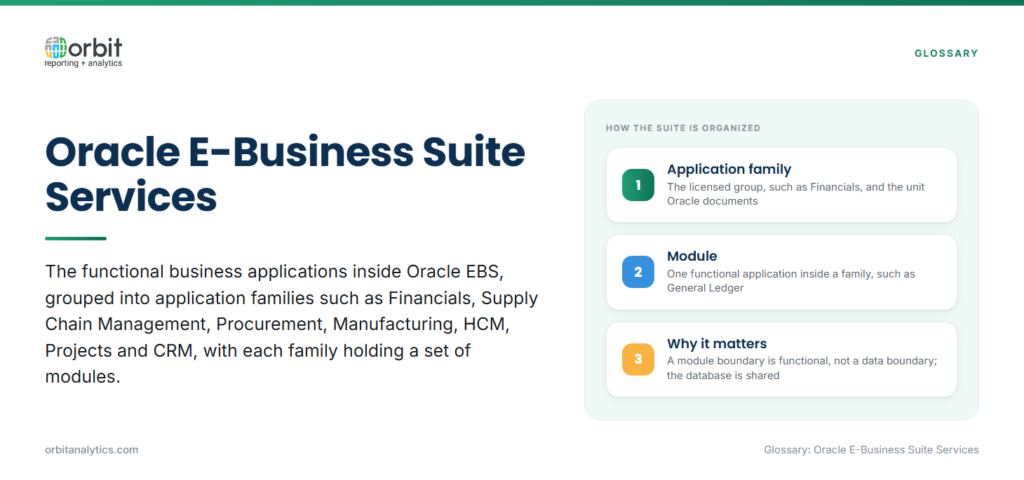
Oracle E-Business Suite services are the functional business applications inside Oracle EBS, grouped into application families such as Financials, Supply Chain Management, Procurement, Manufacturing, Human Capital Management, Projects, and CRM. Each family holds a set of modules, and each module covers one business process.
The word “services” carries two meanings in EBS conversations, which is worth separating. It usually means these functional service areas, the modules themselves. It sometimes means the technology-stack services underneath them: concurrent managers, workflow, and the application services that keep the suite running.
Anyone new to an EBS estate meets the vocabulary before the software. A module is an application such as General Ledger. An application family is the group it belongs to, in this case Financials. Oracle licenses and documents the suite by family, so the family is the unit that matters when working out what an organization actually runs.
R12 is the release generation still in service, and it organized these families around shared structures: one global ledger model, one Subledger Accounting engine, and one set of multi-org definitions used across every family.
What Are Oracle E-Business Suite Services and Modules?
Oracle EBS is a suite of integrated business applications sharing one Oracle database. The families divide it by function, not by data: a module boundary tells you who owns a process, not where the records live.
That distinction is the whole reason reporting on EBS is harder than it looks. Because each family stores its data across its own schema, running to hundreds of tables per family, a question that spans General Ledger, Payables, and Inventory has to join across schemas that were never designed to be queried together. A reporting layer purpose-built for Oracle EBS, such as Orbit Analytics, is what makes that a query rather than an export-and-merge exercise.
Quick Reference: Oracle E-Business Suite Modules and Abbreviations
| Abbreviation | Module name | Application family |
| GL | General Ledger | Financials |
| AP | Payables | Financials |
| AR | Receivables | Financials |
| FA | Fixed Assets | Financials |
| CE | Cash Management | Financials |
| ZX | E-Business Tax | Financials |
| INV | Inventory | Supply Chain Management |
| PO | Purchasing | Procurement |
| OM (ONT) | Order Management | Supply Chain Management |
| WSH | Shipping Execution | Supply Chain Management |
| BOM | Bill of Materials | Manufacturing |
| WIP | Work in Process | Manufacturing |
| MRP | Material Requirements Planning | Value Chain Planning |
| OPM | Process Manufacturing | Manufacturing |
| PER (HR) | Human Resources | Human Capital Management |
| PAY | Payroll | Human Capital Management |
| PA | Projects | Projects |
| EAM | Enterprise Asset Management | Asset Lifecycle |
| OKS | Service Contracts | CRM / Service |
| CS | Service (Customer Support) | CRM / Service |
Oracle EBS Financials Modules
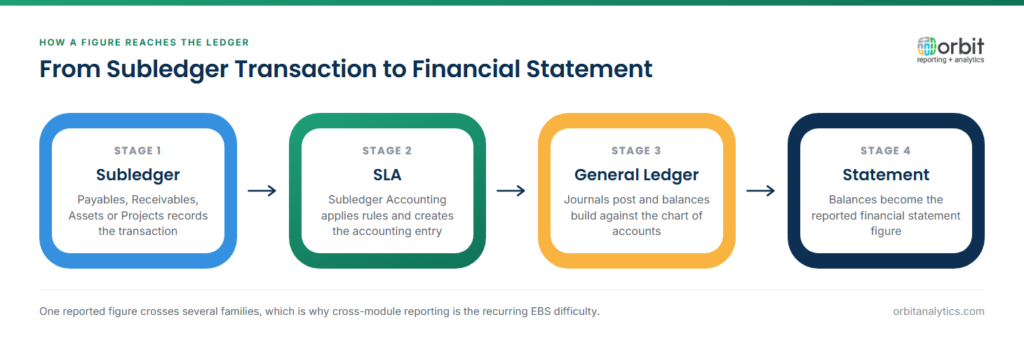
The Financials family is the EBS system finance backbone, and every other family eventually posts into it.
- General Ledger (GL): The accounting hub, holding the chart of accounts, journals, and the balances that produce financial statements.
- Subledger Accounting (SLA): The engine that turns subledger transactions into GL journals under configurable rules, introduced as a shared service in R12.
- Payables (AP) and Receivables (AR): Supplier invoices and payments on one side, customer invoicing, receipts, and collections on the other.
- Fixed Assets (FA) and Cash Management (CE): Asset additions, depreciation, and retirements; bank reconciliation and cash positioning.
- E-Business Tax (ZX): A single tax engine serving both order-to-cash and procure-to-pay.
Oracle EBS Supply Chain and Procurement Modules
- Inventory (INV): Item master, on-hand balances, transactions, and min-max planning.
- Order Management (OM): Sales orders, pricing, holds, and the order-to-cash flow.
- Purchasing (PO): Requisitions, purchase orders, receipts, and approval hierarchies.
- iProcurement, Sourcing, iSupplier Portal: Self-service buying, RFQ events, and supplier collaboration.
- Shipping Execution (WSH) and WMS: Pick, pack, ship, and warehouse operations.
Oracle EBS Manufacturing and Value Chain Planning Modules
- Bill of Materials (BOM) and Work in Process (WIP): Product structures, routings, and discrete production execution.
- Oracle Process Manufacturing (OPM): Formula and recipe-based production for process industries.
- MRP and Advanced Supply Chain Planning (ASCP): Demand and supply planning across the network.
- Cost Management and Quality: Standard and average costing, plus quality collection plans.
Oracle EBS Human Capital Management (HRMS) Modules
- Core HR (PER) and Self-Service HR (SSHR): Worker records, organization structures, and employee or manager self-service.
- Payroll (PAY): Earnings, deductions, statutory processing, and payroll runs.
- Time and Labor (OTL), iRecruitment, Learning Management (OLM): Timecards, hiring, and training administration.
Oracle EBS Projects and Asset Lifecycle Modules
- Project Costing and Project Billing (PA): Cost capture against projects, revenue recognition, and customer invoicing.
- Project Management and Resource Management: Planning, budgeting, and staffing.
- Enterprise Asset Management (eAM) and Property Manager (PN): Maintenance work orders and lease administration.
Oracle EBS Customer Relationship Management and Service Modules
- Sales, Marketing, TeleSales: Pipeline, campaigns, and lead-to-opportunity handling.
- Service Contracts (OKS) and Field Service: The EBS service module set, covering warranties, entitlements, and dispatch.
- Depot Repair, TeleService, Install Base: Repair workflows, the support desk, and installed-product tracking.
How Do You Report Across Oracle EBS R12 Modules?
The module list is the easy part. Reporting across it is the recurring difficulty:
- Data spread across hundreds of tables per family. A spend analysis touching Purchasing, Payables, and General Ledger crosses three schemas with different grains and keys.
- Native tools were not built for it. Oracle Discoverer is retired, BI Publisher is oriented to formatted single-source output, and hand-written SQL leaves the organization dependent on whoever wrote it.
- Generic BI needs the schema modelled first. Tableau or Power BI will read EBS, but only after someone maps the tables, flexfields, and multi-org rules.
Orbit Analytics is the Oracle-native answer to that specific problem: an Oracle Gold Partner platform for Oracle EBS reporting and analytics with 1,000+ pre-built reports and 200+ pre-built connectors spanning every application family, plus the ability to push that data on to Snowflake, Databricks, Redshift, or Power BI.
Frequently Asked Questions
Q1. What are the main Oracle EBS application families in R12?
Financials, Supply Chain Management, Procurement, Manufacturing, Value Chain Planning, Human Capital Management, Projects, Asset Lifecycle Management, and Customer Relationship Management including Service.
Q2. What is the difference between an EBS application family and a module?
A module is a single functional application such as Payables. A family is the licensed group it belongs to, such as Financials. Oracle organizes documentation and licensing by family, so the family is usually the unit under discussion.
Q3. What are the common Oracle E-Business Suite module abbreviations?
The most frequently used are GL (General Ledger), AP (Payables), AR (Receivables), FA (Fixed Assets), PO (Purchasing), INV (Inventory), OM or ONT (Order Management), BOM (Bill of Materials), WIP (Work in Process), PER or HR (Human Resources), PAY (Payroll), and PA (Projects).
Q4. What does the Oracle EBS service module do?
The EBS service modules manage post-sale support: Service Contracts (OKS) holds warranties and entitlements, Field Service handles dispatch and technician scheduling, Depot Repair covers workshop repairs, and Install Base tracks products in the field.
Q5. Is Oracle E-Business Suite the same as Oracle Fusion Cloud?
No. EBS is Oracle’s self-managed, on-premise suite that customers run and upgrade themselves. Oracle Fusion Cloud is SaaS ERP that Oracle runs on a fixed release cadence, with a different data model and a different reporting stack.
Q6. How do you report and pull data across multiple Oracle EBS modules?
Cross-module reporting requires joining across each family’s own schema, respecting multi-org and ledger rules. Native tools handle single-module output well, so most organizations either write custom SQL or add a reporting layer that already understands the R12 data model.
Knowing the module list is one thing; reporting across it is another. Request a demo to see how Orbit Analytics unifies data from every Oracle EBS application family into reports finance and operations teams can run themselves.
