
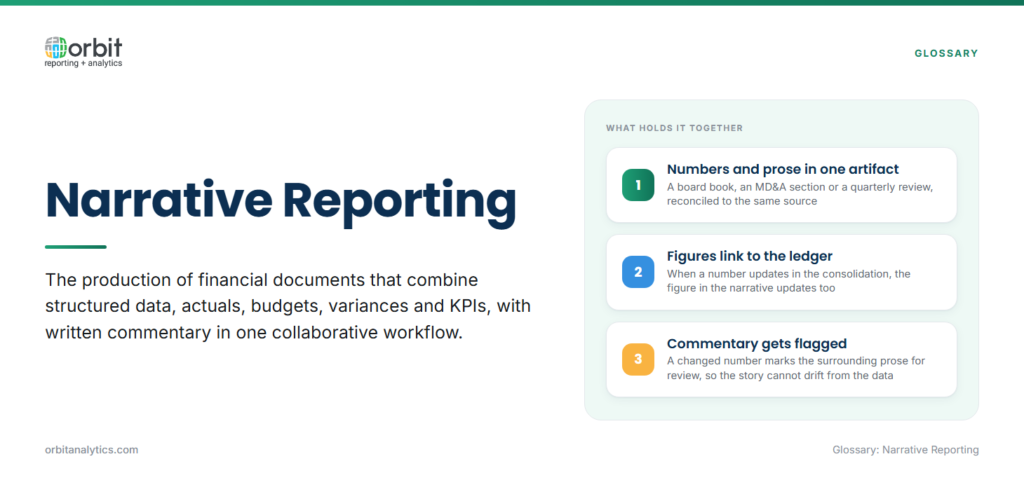
Narrative reporting is the production of financial documents that combine structured data, actuals, budgets, variances, KPIs, with written commentary in one collaborative workflow. The output is a single artifact (a board book, an MD&A section, a quarterly review) where numbers and prose are bound together and reconciled to the same source.
It works by linking data points to their ERP source. When a revenue number updates in the consolidation, the figure in the narrative updates and the surrounding commentary is flagged for review.
Traditional financial reporting splits the work across tools. The table below shows how narrative reporting collapses that loop:
| Dimension | Traditional reporting | Narrative reporting |
| Data authoring | Spreadsheet (Excel) | Live ERP-linked data layer |
| Commentary authoring | Separate Word file | Same tool as the data |
| Reconciliation | Manual, every cycle | Automatic on data refresh |
| Audit trail | Email threads, file versions | Timestamped per-edit log |
| Version of truth | Reconciled at end | Single source throughout |
Why is narrative reporting important?
Three drivers make narrative reporting strategic rather than optional:
- Context for the numbers. A 12% revenue growth headline tells the reader almost nothing without the breakdown, how much was volume, how much was price, how much came from M&A, how much was FX. The narrative turns the figure into a decision-grade insight.
- Stakeholder communication. Boards, investors, lenders, and regulators read financial documents looking for the story, not just the table.
- Regulatory compliance. The SEC’s MD&A requirement, IFRS Management Commentary, ESG disclosure regimes, and jurisdiction-specific rules all demand structured commentary alongside the financial tables. Spreadsheet-and-Word workflows cannot meet these requirements at scale.
What are the key components of narrative reporting?
A complete narrative reporting capability has four core components:
- Data integration and validation: connections to the ERP, consolidation system, and operational sources, with automated reconciliation so document numbers match the system of record.
- Collaborative authoring: a shared environment where multiple contributors write, comment, and review without emailing Word files.
- Workflow and approvals: defined ownership, deadlines, and review steps per section, with status tracking that surfaces what is late or blocked.
- Version control and audit trail: every change captured with author, timestamp, and rationale for internal audit, external audit, and the SEC.
In Oracle ERP environments, these components are most useful on a unified reporting platform rather than a stand-alone narrative tool. Orbit Analytics provides narrative reporting capabilities alongside its operational reporting stack, so finance teams can author commentary against live Fusion Cloud, EBS, or NetSuite data, and the audit trail covers both the numbers and the prose.
What are common narrative reporting use cases?
The format adapts to most finance and disclosure workflows:
- Management Discussion & Analysis (MD&A): the SEC-mandated narrative in 10-Q and 10-K filings that explains results, liquidity, and risk in management’s own words.
- Annual reports and 10-K filings: full-year financials wrapped in a narrative for shareholders, lenders, and regulators.
- Board books and executive summaries: packaged commentary, KPIs, and variance analysis for board meetings and audit committees.
- Investor communications: earnings releases, investor decks, and lender updates where the data must reconcile precisely to the filing.
Each has different cadence, but they share the same requirement: numbers and narrative linked to the ERP, with controlled workflow around both. Teams already using Oracle Fusion financial reporting typically add narrative reporting on top, rather than running a parallel commentary process.
What are the benefits of narrative reporting?
Four benefits compound when the workflow is mature:
- Better stakeholder understanding. Boards and investors comprehend the business faster when the narrative is anchored to the data, with variances broken down and assumptions documented.
- Faster assembly. Mature tools cut preparation time by 50%+ by eliminating manual reconciliation between the spreadsheet and the Word file. When a number changes in the consolidation, the document updates and the affected commentary is flagged.
- Stronger compliance and accuracy. The audit trail covers both data and prose. Tying changes to authors and approvers with timestamped versions is what auditors and the SEC want to see.
- Cross-functional collaboration. Accounting, FP&A, treasury, IR, and legal can work in the same document without exchanging draft attachments. Each owner gets their section, reviewers see full context, and nobody reconciles a fifth-generation copy.
What challenges come with narrative reporting?
Three pain points show up in nearly every implementation:
- Coordinating multiple contributors. A 10-K has dozens of contributors across accounting, FP&A, treasury, IR, legal, and external audit. Without ownership and deadlines, the schedule slips.
- Data consistency. If the commentary references a number that no longer matches the table, the document loses credibility. Source every figure from the same ERP-linked data layer, never re-typed.
- Review cycles. Mature processes need three or more rounds without devolving into red-line emails. Workflow tooling solves it; manual processes do not.
What are narrative reporting best practices?
Four practices separate a controlled close from a chaotic one:
- Establish clear ownership and deadlines per section. Each piece of commentary needs a named author, a reviewer, and a due date, tracked in the tool, not a side spreadsheet.
- Link narratives to source data, not snapshots. If a number is mentioned in the prose, it should pull from the same source as the table next to it. When the source updates, the narrative is flagged for review.
- Implement clear review workflows. Use defined stages and visible status. Build the workflow once per report type and reuse it.
- Use templates for consistency. Recurring documents should ship from a template with standard sections and stable formatting so each cycle reuses the prior structure.
How do you implement narrative reporting?
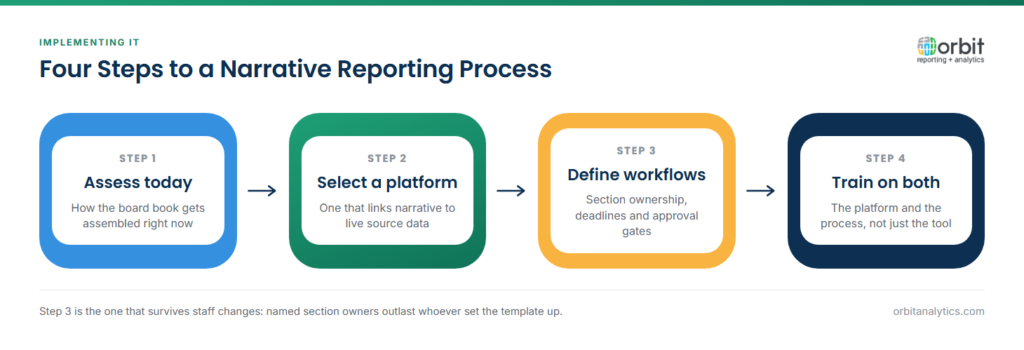
A reliable rollout follows four sequential steps:
- Assess current processes. Map the recurring documents, monthly review, quarterly board book, annual MD&A, and their pain points: reconciliation effort, review delays, version control. The biggest pain becomes the first deployment.
- Select the right platform. For Oracle ERP shops, the platform must speak Fusion Cloud, EBS, NetSuite, or PeopleSoft natively, support the consolidation system, and provide the workflow and audit features finance and external audit need. Orbit Analytics is built for Oracle ERP environments, with 200+ pre-built connectors and a unified platform that ties data, narrative, and operational reporting into one workflow.
- Define workflows and templates. Pick the highest-value document for the first rollout, build the template, define ownership, and run a full cycle end-to-end before scaling.
- Train users on the platform and the process. The technology is rarely the constraint, the constraint is changing the habits of contributors who have authored Word files for years.
Frequently Asked Questions
Q1. What is narrative reporting in simple terms?
Narrative reporting is producing financial documents that combine numbers and explanation in one place. Instead of a spreadsheet for data and a Word file for commentary, you get a single deliverable, a board book, an MD&A, an earnings release, where figures and story tie to the same source.
Q2. How does narrative reporting differ from financial reporting?
Financial reporting produces the structured data, balance sheet, income statement, variance table. Narrative reporting wraps that data in the explanation that makes it useful: why margin moved, what drove the variance, what management expects next.
Q3. What is MD&A in narrative reporting?
MD&A, Management Discussion & Analysis, is the SEC-required section in 10-Q and 10-K filings where management explains results, liquidity, capital resources, and known risks. It is the canonical narrative reporting use case because data, prose, and audit trail all have to be regulator-grade.
Q4. Can narrative reporting integrate with Oracle ERP?
Yes. Modern platforms connect to Oracle Fusion Cloud, EBS, NetSuite, and PeopleSoft through pre-built connectors, so the figures in the document pull from the same ERP source as the underlying financial statements. When the ERP updates, the document updates with it.
Q5. How do you ensure narrative accuracy?
Source every figure from the ERP-linked data layer rather than re-typing, lock the review workflow so unreviewed changes do not publish, and keep an audit trail tying every edit to an author and timestamp.
Q6. Can narrative reporting be automated?
Partially. Data refresh, variance calculations, and template population can be fully automated. The commentary still requires human authorship, but the time spent reconciling numbers and chasing reviewers is largely eliminated by workflow tooling.
Ready to bring narrative reporting to your Oracle ERP close and disclosure process? Request a demo to see how Orbit Analytics consolidates data integration, collaborative authoring, and audit-grade workflow on one platform tuned for Oracle Fusion Cloud, EBS, NetSuite, and PeopleSoft.
