
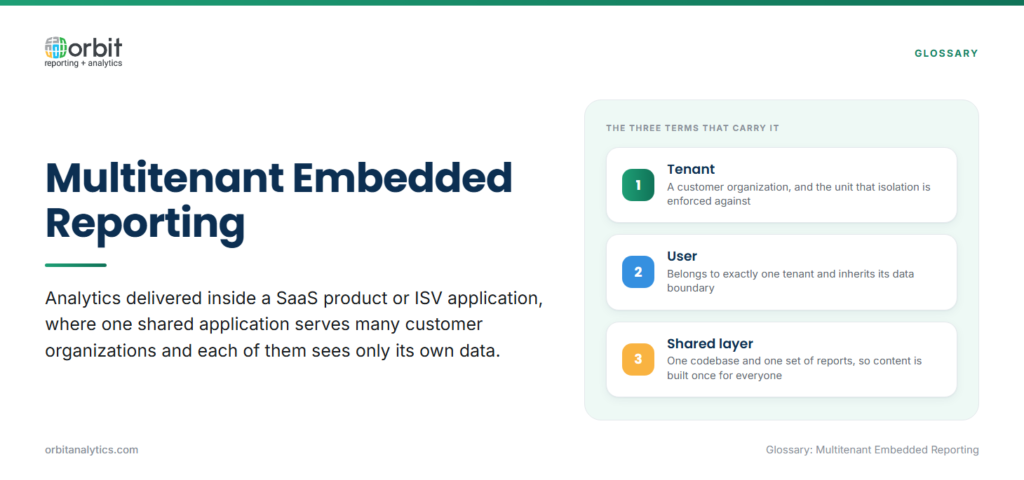
Multitenant embedded reporting is analytics delivered inside a SaaS product or ISV application, where one shared application serves many customer organizations and each of them sees only its own data. The reports live in the product; the isolation between customers is what makes the arrangement multitenant.
Multi-tenancy in a reporting context means one deployment, one set of report definitions, and one upgrade path, serving many separate datasets. The alternative is a copy of everything per customer, which works until the tenth customer and then stops scaling.
Three terms carry the weight. A tenant is a customer organization. A user belongs to exactly one tenant and inherits its data boundary. The shared application layer is the code and report content everyone runs, which is why a report built once appears for every tenant without being rebuilt.
The reader for this page is a product, engineering, or data team shipping analytics to their own customers, which is a different problem from an internal finance team running reports for itself.
Why SaaS Products and ISVs Need Multitenant Analytics
- Customers expect reporting inside the product. Exporting to a spreadsheet reads as a gap in the product, not a neutral choice.
- One codebase, many datasets. Report logic is maintained once and applies to every tenant, so the engineering cost of analytics stops scaling with the customer count.
- Analytics becomes part of the product. Reporting is frequently the feature that justifies a higher tier, which makes it revenue rather than overhead.
- Without a multitenant layer, the work lands on engineering. Teams end up writing bespoke queries per customer, and each new tenant adds permanent maintenance.
How Multitenant Embedded Reporting Works
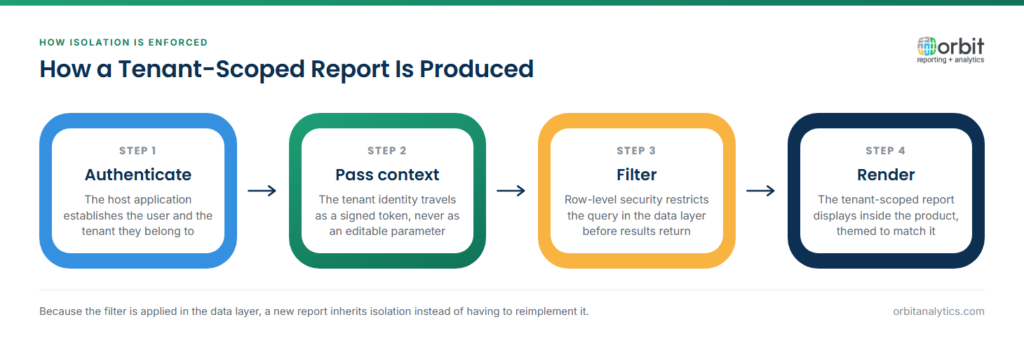
The mechanism is a tenant identifier travelling with every request, and everything else follows from it.
- The user authenticates against the host application, which establishes both who they are and which tenant they belong to.
- The tenant context is passed to the reporting layer, usually as a signed token, never as a parameter a browser could alter.
- Row-level security filters the query before results are returned, so the restriction is applied in the data layer rather than in the interface.
- The tenant-scoped report renders inside the product, visually consistent with the host application.
Provisioning a new tenant should be configuration, not development: register the tenant, map its data boundary, and the existing report content applies. Where the underlying data is Oracle Fusion Cloud or E-Business Suite, the reporting layer also has to understand those schemas, or every tenant onboarding turns into a modelling exercise.
Components of a Multitenant Embedded Reporting Layer
- The semantic or metadata layer: Where source tables become business terms and where the tenant filter is defined once for every report to inherit.
- Embed surfaces: iFrames for fastest delivery, SDKs for control over appearance and interaction, APIs when the host application renders its own visuals.
- Self-service report building: A governed query surface so end customers can answer their own questions without a support request.
- Governance, auditing, and per-tenant metering: Who viewed what, and how much each tenant consumes, which matters for both compliance and pricing.
Orbit Analytics provides an OEM-ready embedded reporting layer covering all four: white-label branding, row-level tenant isolation, and 200+ pre-built Oracle connectors, so a product team ships tenant-scoped reporting without building the isolation machinery itself.
Single-Tenant vs. Multitenant Embedded Analytics Architectures
Three data models sit behind the choice, and the trade is infrastructure cost against strength of isolation.
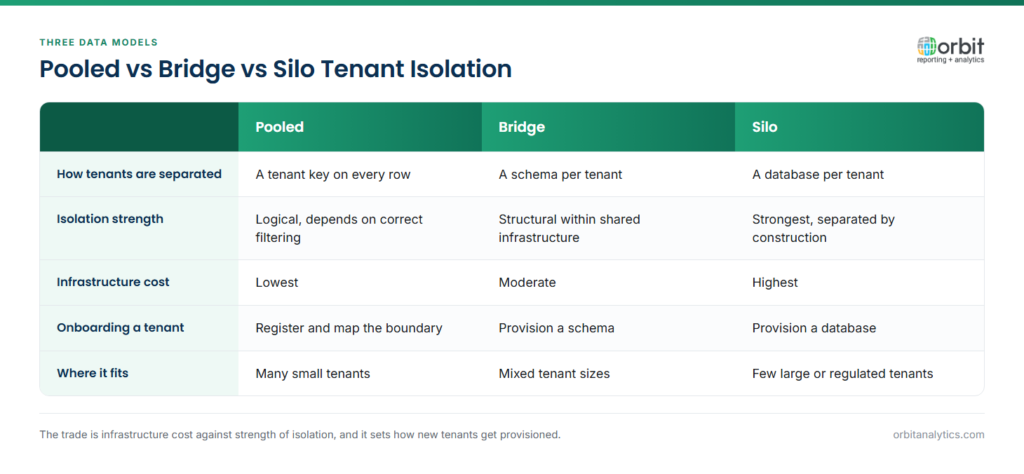
Pooled shares one database with a tenant key on every row, which is the cheapest to run and depends entirely on correct filtering. Silo gives each tenant its own database, which is the strongest isolation and the most expensive to operate. Bridge sits between them, sharing infrastructure while separating schemas.
Deployment follows the same logic: cloud-native for elastic scaling, single-region where data residency is contractual, hybrid where some tenants require their data to stay in their own environment. Whichever model applies, adding a tenant should never mean rebuilding reports.
White-Label Branding in Embedded Analytics
Branding is what decides whether embedded reporting reads as part of the product or as a third-party tool wearing a costume:
- Logos, colour themes, and in-app styling so charts and tables match the host application’s design.
- Custom domains and vendor-neutral URLs, because a hostname belonging to the analytics vendor undoes the rest of the effort.
- Localization and per-tenant configuration, including language, date and number formats, and which report content each tenant sees.
- Where it usually breaks down: export artifacts and emailed reports. Teams theme the in-app view and forget the PDF, and the vendor’s branding reappears in the one place customers file and forward.
Security and Data Isolation in Multitenant Reporting
- Tenant isolation and leakage: Cross-tenant exposure is the failure that ends a SaaS contract. It comes from a missing filter on a new report or a cached result reused across tenants, so enforcement belongs in the semantic layer, not in each report.
- Authentication, SSO, and role-based access: The reporting layer trusts the host application’s identity, and roles apply within a tenant.
- Encryption, residency, and compliance: In transit and at rest as a baseline, with residency commitments shaping deployment.
- Audit trails: For regulated ERP data, being able to show who accessed which figures is part of the requirement, not an extra.
Orbit Analytics is ISO 27001 certified and an Oracle Gold Partner, with per-tenant access control and audit trails over Oracle ERP data, which is what makes multitenant deployment viable where the source is regulated financial information. Broader context on the controls involved sits in data security.
Common Challenges in Multitenant Embedded Reporting
- Concurrent query load. A report that is fast for one tenant can degrade for all of them when several run it simultaneously, so caching and query governance are architectural decisions.
- Schema drift. Tenants customize, add fields, and diverge, and shared report content has to tolerate that without breaking.
- Upgrading a shared codebase. One deployment serves everyone, so a change ships to every tenant at once, which raises the bar on regression testing.
- Tenant-specific requests. Every product team faces the request for one bespoke report. Absorbing too many of them turns a shared layer back into per-customer development.
Multitenant Embedded Reporting vs. Related Approaches
Single-tenant embedded reporting removes the isolation problem by giving each customer its own deployment, and replaces it with an operational one: every upgrade runs many times. A standalone BI portal outside the product is simpler to build and consistently less used, because it sits outside the workflow. Self-service reporting for internal teams solves a different problem, since everyone shares one data boundary. Reporting built into the ERP, such as OTBI or BI Publisher, was designed for internal users within a single organization, and has no concept of an external tenant to isolate.
Frequently Asked Questions
Q1. What is a tenant in multitenant embedded reporting?
A tenant is a customer organization using the shared application. Every user belongs to one tenant and inherits its data boundary, so the tenant is the unit that isolation is enforced against.
Q2. What is the difference between single-tenant and multitenant embedded analytics?
Single-tenant gives each customer a separate deployment, which isolates data by construction but multiplies operational work. Multitenant serves all customers from one deployment and enforces separation logically, which scales better but makes correct filtering critical.
Q3. How does an embedded reporting layer keep each tenant’s data isolated?
The tenant identity travels with each request as a signed token, and row-level security applies the filter in the data layer before results are returned. Defining that rule once in the semantic layer, rather than per report, is what prevents a new report from leaking.
Q4. What is white-label embedded analytics for SaaS?
Embedded analytics restyled to look like the host product: its logo, colours, typography, and a custom domain, with no visible reference to the analytics vendor. Done fully, it extends to exported files and emailed reports.
Q5. Is multitenant embedded reporting secure enough for regulated industries?
Yes, when isolation is enforced in the data layer, access is authenticated through the host application, data is encrypted in transit and at rest, and access is logged. Certifications such as ISO 27001 and stated data-residency options are what regulated customers ask to see.
Q6. How does multitenant embedded reporting perform when many tenants query at once?
Performance depends on the data model and query governance rather than tenant count alone. Pooled models rely on partitioning and caching, silo models isolate load naturally, and most platforms add result caching and concurrency limits per tenant.
Multitenant embedded reporting stands or falls on tenant isolation and how quickly a new customer can be onboarded. Request a demo to see how Orbit Analytics delivers white-labelled, tenant-isolated reporting on Oracle Fusion Cloud and EBS data inside your own product.
