
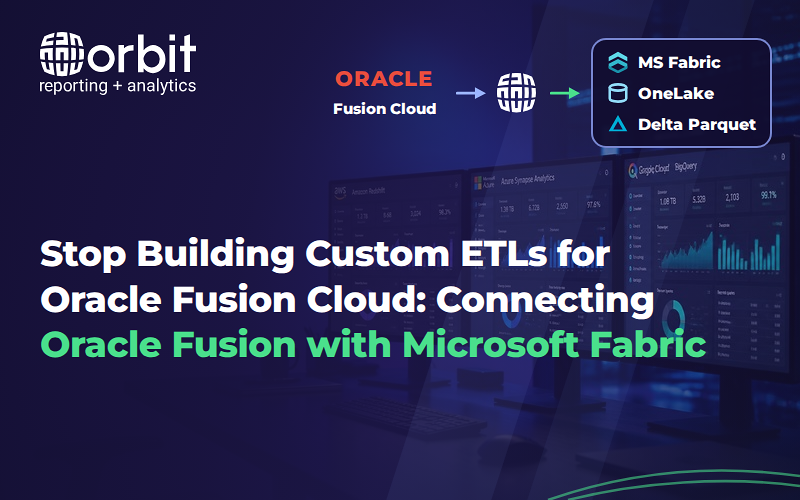
For Chief Data Officers (CDOs), IT Directors, and Data Architects, integrating Oracle Fusion Cloud data into modern analytics platforms is often treated as an engineering inevitability. When migrating to a unified analytics foundation like Microsoft Fabric, the default instinct for many IT teams is to rely on familiar, yet increasingly burdensome, methodologies: custom-built extraction scripts, manual API pipelines, and brittle OTBI (Oracle Transactional Business Intelligence) or BICC (Business Intelligence Cloud Connector) exports.
However, treating cloud ERP data integration as a custom engineering project is no longer a viable long-term strategy. It delays time-to-insight, drains highly skilled engineering resources, and masks a ballooning Total Cost of Ownership (TCO). To truly capitalize on the power of Microsoft Fabric, enterprise data leaders must transition their teams from building pipelines to deploying them.
The Data Paradox: Modern Ambitions vs. Legacy Pipelines
In the current enterprise landscape, data is the ultimate currency. Organizations are investing heavily in modern data stacks to drive predictive analytics, machine learning, and AI-driven decision-making. Microsoft Fabric has emerged as a frontrunner in this space, offering a unified SaaS platform that brings together data engineering, data warehousing, and Power BI into a single, cohesive environment built around OneLake.
Simultaneously, Oracle Fusion Cloud ERP serves as the operational beating heart for countless enterprises, housing the most mission-critical financial, supply chain, and human capital data.
The paradox lies in the space between these two powerhouses: the integration layer.
While organizations possess a modern destination (Fabric) and a world-class source system (Oracle Fusion), the bridge connecting them is often a fragile, hand-coded relic of the past. Data engineering teams spend thousands of hours attempting to force Oracle’s highly complex, proprietary data structures into Fabric using custom ETL (Extract, Transform, Load) pipelines. This approach fundamentally undermines the agility and ROI that Microsoft Fabric was purchased to deliver in the first place.

Anatomy of a Failure: Why Custom Oracle-to-Fabric ETLs Drain ROI
The appeal of building a custom ETL solution often stems from a desire for absolute control. Teams stitch together BICC extracts, SOAP/REST API calls, and custom Python scripts to land Fusion data into their data lake. On paper, this appears cost-effective because it utilizes existing in-house engineering payroll. In reality, it introduces severe operational friction across three distinct vectors.
1. The BICC and API Extraction Bottlenecks
Oracle Fusion is not designed to easily surrender massive volumes of raw data via simple queries. Extracting data via native tools like BICC involves scheduling jobs that dump CSV files into Oracle WebCenter Content (UCM) or an external cloud storage bucket. Your engineering team must then build a secondary pipeline to retrieve these files, parse them, handle data type conversions, and load them into Fabric.
Alternatively, using REST or SOAP APIs for large-scale extraction introduces severe rate-limiting and performance throttling. Incremental loading, extracting only the data that has changed since the last run requires building complex, stateful logic to track timestamps and watermarks. When these custom extraction jobs inevitably fail or time out, data engineers are forced to manually intervene, turning highly paid architects into glorified data plumbers.
2. The Nightmare of Schema Drift
Oracle Fusion receives regular quarterly updates from Oracle. These updates sometimes introduce modifications to the underlying application data models, including altered table structures, deprecated fields, and new object relationships.
A custom pipeline that works flawlessly today can easily break tomorrow due to a minor, unannounced schema change. This phenomenon, known as schema drift, forces data engineering teams into a perpetual, reactive break-fix cycle. Instead of building new analytics capabilities, your team spends its sprints deciphering why the supply chain dashboard crashed after the latest Oracle patch.
3. The “Hero Engineer” Trap
Custom ETLs are rarely documented to enterprise standards. They rely on the specialized, undocumented knowledge of the one or two “hero engineers” who originally wrote the scripts. This creates a massive point of failure for the organization. If those engineers depart, the pipeline becomes an opaque black box. Onboarding new engineers to untangle a bespoke web of BICC exports, custom Python parsing scripts, and hardcoded mapping logic is an expensive, high-risk endeavor that stalls BI initiatives for months.
The Microsoft Fabric Promise (And How Raw Oracle Data Breaks It)
Microsoft Fabric’s architecture is built around OneLake, a unified, logical data lake for the entire organization and relies heavily on modern, open data formats like Delta Parquet. Fabric’s revolutionary DirectLake mode allows Power BI to query massive datasets directly from OneLake without the need to import data or build separate tabular models, offering unprecedented performance.

However, pouring raw, untransformed Oracle Fusion data directly into Fabric’s OneLake destroys this value proposition.
Oracle ERP data structures are notoriously complex, highly normalized, and virtually incomprehensible to business users. A single business concept, such as an “Invoice,” might be scattered across dozens of underlying relational tables. If your custom pipeline simply moves raw tables from Oracle into Fabric, you have not created a data lake; you have created a data swamp.
To make this data usable in Power BI, data engineers must perform grueling transformations, manually mapping thousands of Oracle column names to business logic. This transformation phase in a custom ETL build often takes longer than the extraction itself, significantly delaying the delivery of actionable insights to the C-suite.
The Paradigm Shift: From Pipeline Construction to Data Consumption
The mandate for Chief Data Officers is clear: the competitive advantage of your organization lies in analyzing data, not moving it. Every hour your data engineers spend writing custom extraction scripts for Oracle Fusion is an hour stolen from building predictive models, optimizing supply chain analytics, or driving financial forecasting.
To accelerate time-to-value, enterprises must shift their mindset from “build” to “buy,” treating the data pipeline not as a software development project, but as a turnkey infrastructural component.
The Orbit Data Pipelines Advantage: The Native Accelerator
At Orbit Analytics, we recognize the specific, localized pain points of integrating Oracle ERP data. Orbit Data Pipelines acts as a strategic accelerator, effectively bypassing the engineering bottlenecks of custom integration and fundamentally changing the economics of data movement.
Designed explicitly for the Oracle ecosystem, Orbit eliminates the friction between Oracle Fusion Cloud and Microsoft Fabric through a suite of enterprise-grade capabilities:
• Automated, Frictionless Extraction: Orbit replaces manual BICC configurations and brittle API scripts with native, resilient connectivity. It handles the complexities of Oracle’s security model, extraction limits, and data types automatically, providing a reliable flow of data into Microsoft Fabric without requiring a single line of custom code.
• Resilient Change Data Capture (CDC): Tracking inserts, updates, and deletes (CDC) in a SaaS application like Oracle Fusion is notoriously difficult. Orbit Data Pipelines manages incremental loading natively. It intelligently syncs only the changed data into Fabric, drastically reducing compute costs, lowering network bandwidth, and ensuring your OneLake data is always current.
• Immunity to Schema Drift: Because Orbit is purpose-built for Oracle, our platform understands Oracle’s underlying architecture. When Oracle pushes quarterly updates, Orbit handles the schema changes gracefully, ensuring that your downstream data flows into Fabric remain uninterrupted.
• Historical Data Unification: Many enterprises migrating to Oracle Fusion still possess years of legacy data in Oracle E-Business Suite (EBS), PeopleSoft, or JD Edwards. Orbit easily ingests and merges this historical on-premise data with live Fusion cloud data, providing a complete, uninterrupted timeline of enterprise performance within Microsoft Fabric.
The Missing Link: Orbit’s Unified Data Models
Moving data efficiently is only half the solution; making it instantly understandable is the ultimate goal. This is where the true ROI of Orbit Analytics is realized.
Instead of landing raw, cryptic Oracle tables into OneLake and forcing your team to build complex SQL transformations from scratch, Orbit provides Unified Data Models out of the box.
These analytics-ready semantic models automatically translate the hyper-normalized chaos of Oracle Fusion into clean, business-friendly star schemas. Orbit provides pre-built, reusable data sets specifically aligned to how enterprise departments actually function and report:
- Financial Analytics: Pre-built models for General Ledger, Accounts Payable, Accounts Receivable, and Fixed Assets.
- Supply Chain & Procurement: Ready-to-use models for Inventory, Purchasing, and Order Management.
- Human Capital Management: Unified views for Workforce Analytics, and HR operations.
Because Orbit delivers these dimensional structures directly into Microsoft Fabric in an optimized format, your data is Power BI-ready from Day One. BI developers and analysts no longer need to submit IT tickets to understand table joins or reverse-engineer Oracle’s logic. They can simply connect Power BI to the Orbit-generated models in Fabric and begin building executive dashboards immediately.
Measuring the Impact: Total Cost of Ownership (TCO) Reimagined
When evaluating a custom ETL against Orbit Data Pipelines, organizations must look beyond the initial capital expenditure and evaluate the true Total Cost of Ownership over a 3-to-5-year horizon.
| Cost Category | Custom Built ETL Strategy | Orbit Data Pipelines |
| Initial Engineering Time | 6 to 12 months of dedicated data engineering sprints to map, build, and test extractions. | Deployed and operational in weeks, not months. |
| Maintenance & Break-Fix | High. Requires perpetual monitoring, manual intervention for failed jobs, and constant code updates. | Minimal. Automated CDC and schema drift resilience eliminates daily pipeline babysitting. |
| Oracle Quarterly Updates | High Risk. Updates frequently break custom mappings, causing analytics downtime. | Handled seamlessly by the Orbit platform with no disruption to business users. |
| Transformation Effort | Extreme. Engineers must manually reverse-engineer and map thousands of Oracle tables to business logic. | Zero. Unified Data Models deliver pre-mapped, analytics-ready star schemas out of the box. |
| Opportunity Cost | Severe. Data engineers are trapped doing pipeline maintenance instead of driving AI and predictive analytics. | Eliminated. Engineering teams are freed to focus on high-value data science and Fabric utilization. |
Conclusion: Deploy, Don’t Build
The migration to Microsoft Fabric represents a pivotal opportunity to modernize your enterprise data strategy, democratize insights, and break down operational silos. However, tying this modern, high-performance engine to a brittle, custom-built Oracle ETL pipeline is a recipe for stalled initiatives and inflated IT budgets.
For Chief Data Officers and IT leaders, the path forward requires eliminating the friction of data ingestion. Building custom ETLs for Oracle Fusion creates a fragile architecture that consumes valuable engineering resources and obscures your true costs.
By leveraging Orbit Data Pipelines and pre-built Unified Data Models, organizations can rapidly and securely connect Oracle Fusion to Microsoft Fabric. It transforms a complex, multi-year integration nightmare into a ready-to-use data foundation—accelerating time to insight, lowering TCO, and allowing your enterprise to finally unleash the full potential of both Oracle Cloud and Microsoft Fabric.
Stop managing pipelines.
Start democratizing your enterprise data. Ready to stop building and start deploying? Request a demo of Orbit Data Pipelines today.


