Many Oracle Fusion Cloud customers are rapidly modernizing their analytics by migrating core ERP, HCM, SCM, procurement, and financial data directly into Databricks. The objective is strategic: establish Databricks as the unified Data Intelligence Platform where data analysts, data scientists, and engineers collaborate on Lakehouse data to solve high-value business, analytics, and AI challenges.
Oracle officially recognizes this multicloud pattern, noting in its architecture guidance that customers regularly replicate Oracle Fusion ERP data into third-party platforms like Databricks to drive data-centric decisions.
However, enterprise data engineering teams quickly hit a roadblock: there is a massive operational difference between simply moving Oracle Fusion data and making that data truly reliable, governed, and AI-ready inside Databricks. A basic data connector merely moves files; an intelligent reliability layer makes enterprise ERP data usable.
If you treat Oracle Fusion Cloud to Databricks integration as a simple connectivity task, you expose your data pipelines to hidden operational risks. This article explores why standard connectors fail at enterprise scale and why a dedicated Lakehouse Reliability Layer is critical for downstream analytical success.
The Hidden Risks of the “Connector-Only” Approach
Oracle Fusion data is structurally complex. It is designed to run highly normalized enterprise applications across finance, supply chain, and HR—not to serve as a clean, flattened analytics schema.
When teams rely on a standard connector, they inevitably encounter a familiar, frustrating data engineering lifecycle:
- They build an initial extract script.
- They realize they must add complex custom logic.
- They attempt to schedule incremental loads.
- They discover unpredictable schema drift.
- Finance adds a new Descriptive Flexfield, and the entire Databricks table structure breaks.
- Business users complain that their dashboard numbers do not match the Oracle Fusion source of truth.
The issue is not Databricks; the issue is that Oracle Fusion extraction requires deep, application-aware orchestration, not just a generic connector.
Oracle Fusion natively supports multiple extraction methods, including BICC (Business Intelligence Cloud Connector), BI Publisher, and REST APIs.
- BICC: Oracle documentation specifically recommends BICC as the best integration option for high-volume, downstream bulk data exports.
- BI Publisher (BIP): Oracle strongly cautions that BI Publisher is strictly a reporting tool and is not recommended for large-scale data extraction.
- APIs: While useful for singular events, they are severely rate-limited and incapable of massive historical migrations.
A successful extraction strategy demands an ERP-aware pipeline that deeply understands these varied mechanisms while simultaneously meeting Databricks Lakehouse architectural expectations.
What is a Lakehouse Reliability Layer?
An Oracle Fusion-to-Databricks reliability layer is the intelligent, operational buffer positioned between the source ERP and the analytical target. It systematically transforms raw data into a dependable, governed, and AI-ready Lakehouse asset.
Instead of forcing your data engineers to write fragile custom scripts, a reliability layer handles:
- Intelligent Extraction: Leveraging the correct Oracle-native method (like BICC) automatically.
- Stateful Loading: Managing both full historical drops and precise incremental loads.
- Schema Evolution: Dynamically handling schema drift and new custom flexfields without crashing the pipeline.
- Continuous Observability: Validating pipeline runs, handling error retries, and monitoring refresh cycles.
- Analytics-Ready Preparation: Formatting Delta tables specifically for downstream analytics.
- Enterprise Governance: Integrating seamlessly with Databricks Unity Catalog.
Without a reliability layer, data teams accumulate fragile Python scripts, duplicated ETL logic, and raw data swamps that different analytics departments must manually (and inconsistently) interpret.
The Architecture Landscape: Connecting Oracle to Databricks
At a high level, a true reliability layer creates a seamless, governed data flow from source application to analytical output. The architecture implemented by Orbit Analytics follows a robust, Fusion-aware pattern:
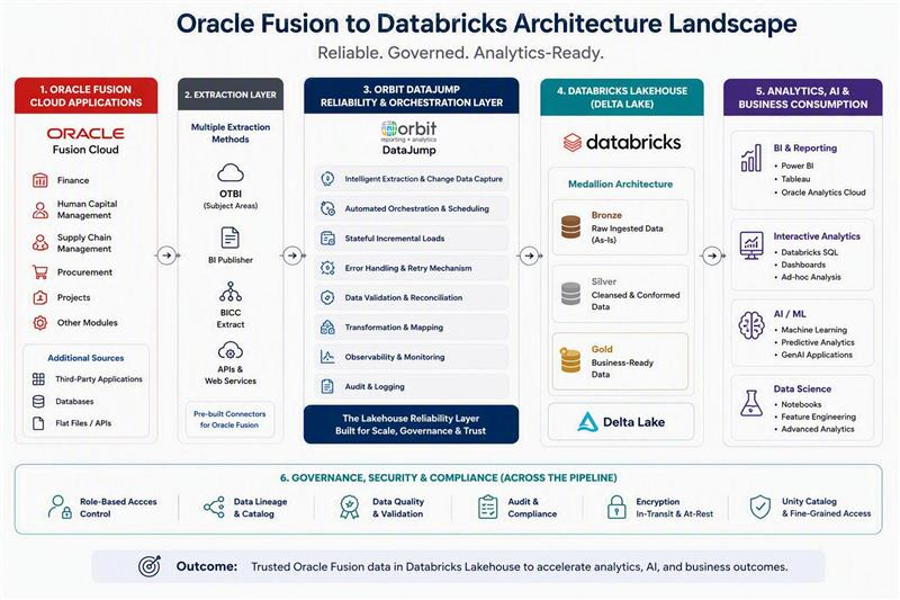
Source Layer (Oracle Fusion): Extraction natively targets Oracle Fusion Cloud Applications (Finance, HCM, Supply Chain). Data is reliably pulled using the optimal method—whether that is BICC PVOs for bulk data, BI Publisher data models, or Fusion-aware custom SQLs.
Pipeline Layer (Orbit DataJump): Acting as the intelligent orchestration engine, Orbit automates scheduling, dependency management, and incremental loading logic that strictly respects Fusion-specific keys and change patterns.
Destination Layer (Databricks Medallion Architecture): Data lands in Databricks and is meticulously structured via the modern Lakehouse Medallion pattern:
- Bronze: Raw, landed data precisely preserving Oracle historical extracts.
- Silver: Deduplicated, quality-checked, and conformed datasets ready for cross-functional use.
Gold: Curated, business-friendly star schemas optimized for BI and machine learning models.
Governance Layer (Unity Catalog): All objects are automatically registered in Databricks Unity Catalog. This ensures centralized governance, fine-grained access control, column-level lineage, and complete traceability from the ERP extract directly to the final BI report.
Enterprise in Action: How MARTA Powers Data-Driven Transit
To understand the immense business value of this reliability layer, consider the Metropolitan Atlanta Rapid Transit Authority (MARTA). MARTA contributes an estimated $2.6 billion in economic impact annually, keeping Atlanta moving across 48 miles of rail and massive bus networks.
The Challenge: MARTA standardized on Oracle Fusion Cloud ERP and HCM for core finance and HR, and selected Databricks as its central analytics platform. They needed to move rich financial and HR data into Databricks incrementally and reliably—specifically handling complex BICC PVOs—without turning every new data flow into a custom, time-consuming development project.
The Solution: By implementing Orbit Data Pipelines, MARTA completely transformed their integration strategy. Orbit provided a transparent, no-code, end-to-end flow from Oracle Fusion to Databricks’ Medallion architecture, completely aligned with Unity Catalog governance.
The Result: Today, MARTA configures pipelines rather than hand-coding them. They have achieved faster delivery of Fusion data, proactive pipeline monitoring, and vastly improved operational confidence. As Madhu Chava, Cloud Solutions Expert at MARTA, stated: “Orbit Analytics has greatly simplified our Oracle Fusion to Databricks integration. It is very user-friendly and significantly reduces development effort.”
Orbit DataJump: Your Purpose-Built Reliability Layer
Orbit DataJump is engineered specifically to act as the ultimate reliability layer between Oracle Fusion and Databricks. It empowers enterprise customers to transition from brittle exports and manual glue-code to governed, monitored, and automated ERP pipelines.
Here is how DataJump establishes absolute pipeline reliability:
Oracle-Aware Extraction
Orbit DataJump does not treat Oracle as a generic database. Users select Oracle Fusion as their source, and DataJump inherently understands Fusion extraction mechanisms—including BICC, BI Publisher, Custom SQL, and EDM/EPM REST APIs. It natively handles complex authentication and schema discovery, establishing an incredibly stable ingestion foundation for complex datasets like BICC PVOs.
Databricks-Ready Loading and Incremental Syncs
Once the source is mapped, DataJump connects directly to your target Databricks workspace. It automatically provisions the schema and optimizes the write paths for both bulk initial loads and continuous incremental loads. DataJump meticulously handles automated error retries, ongoing schema drift, and data validation through the Orbit console, ensuring business users have predictable, dependable data for their financial closes and executive dashboards.
Delta Lake and Unity Catalog Integration
A generic connector simply moves bytes. Orbit Data pipelines are purpose-built and ERP-aware, landing highly curated ERP data into Delta Lake with end-to-end governance enforced through Unity Catalog. This native integration allows teams to immediately begin querying ERP data using SQL, Python, or advanced AI models.
Pre-Built Analytics Models
Generic ETL tools move data, but they lack the business context to model complex GL, AP, AR, or HCM structures. Orbit emphasizes providing analytics-ready models and no-code data pipelines. This drastically accelerates the timeline for finance, HR, and supply chain teams to move from raw extracts to usable, AI-powered decision-making datasets.
Why Partner Credibility Matters
Integrating Oracle Fusion Cloud with Databricks bridges two highly specialized enterprise ecosystems. Partner credibility is crucial to ensure architectural success.
Orbit Analytics is recognized as both an Oracle Gold Partner (acknowledged for deep expertise across Oracle solutions) and a strategic Databricks Data Partner. Orbit combines the Databricks Data Intelligence Platform with its direct-connect integration capabilities to deliver faster, smarter data intelligence.
This dual-expertise guarantees customers receive a deeply integrated reliability layer designed by experts who understand the nuances of both platforms.
Connector vs. Reliability Layer: The Enterprise Difference
| Feature | Connector-Only Approach | Orbit DataJump (Reliability Layer) |
| Scope of Work | Moves data from Oracle Fusion to Databricks. | Manages the full end-to-end Fusion-to-Databricks pipeline lifecycle. |
| Configuration | Often requires heavy custom scripting. | Supports guided, no-code pipeline configuration. |
| Schema Changes | Struggles or fails with schema drift. | Automatically handles schema drift and evolving reporting needs. |
| Data State | Lands raw, unstructured data. | Supports governed, curated ERP data optimized for the Lakehouse. |
| Data Modeling | Leaves all data modeling to internal engineering. | Helps create analytics-ready ERP datasets immediately. |
| Pipeline Health | Limited visibility into failures. | Provides proactive monitoring, validation, retries, and run visibility. |
The Ultimate Outcome: ERP Data Ready for AI
Oracle Fusion houses the critical transactional data that explains exactly how your enterprise operates: revenue, cash flow, supply chains, and operational performance. Databricks provides the ultimate intelligence platform to turn that raw data into predictive AI and analytics.
However, the bridge connecting these platforms must be unbreakable.
Orbit DataJump provides enterprise customers with a purpose-built architecture to extract Fusion data, orchestrate incremental refreshes, navigate complex schema changes, and dynamically prepare analytics-ready datasets. For organizations seeking to modernize their data ecosystem, implementing a reliability layer is the exact difference between simply migrating data and finally making your ERP data trusted, governed, and AI-ready.
Ready to make your Oracle Fusion data reliable in Databricks? Request a demo today to see how Orbit DataJump helps enterprises abandon brittle scripts and disconnected ETL jobs in favor of a true Lakehouse Reliability Layer