
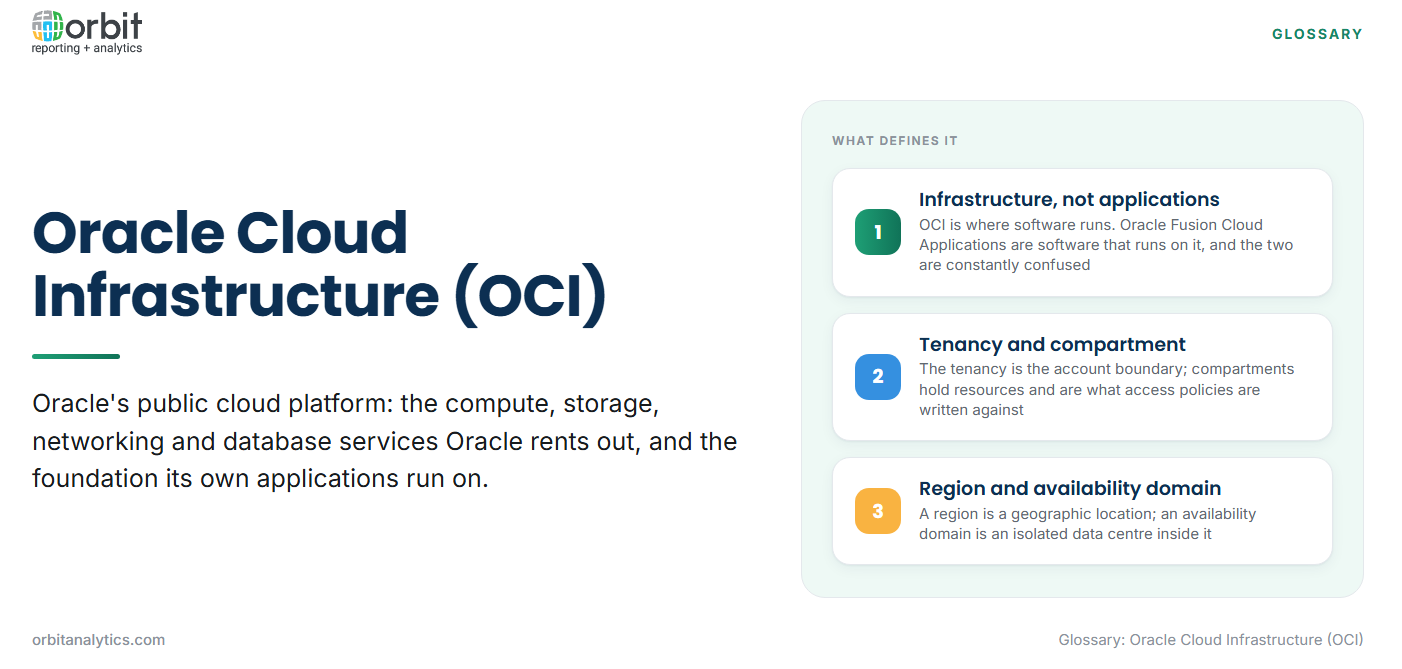
Oracle Cloud Infrastructure (OCI) is Oracle’s public cloud platform: the compute, storage, networking and database services that Oracle rents out, and the foundation its own applications run on. The acronym expands to exactly what it describes. It is infrastructure, not an application, and that distinction is the one this page exists to make.
The confusion is understandable. “Moving to Oracle Cloud” can mean adopting Oracle Fusion Cloud Applications, which is software, or hosting workloads on Oracle Cloud Infrastructure, which is where software runs. The two often happen together, and they answer different questions.
How OCI Is Organized
Four structural terms account for most of Oracle’s cloud documentation, and they nest.
- Region: A geographic location containing Oracle’s data centres. Region choice determines latency and, in practice, where data physically sits.
- Availability domain: An isolated data centre inside a region. A failure in one is designed not to reach another, so workloads needing resilience are spread across them.
- Fault domain: A grouping of hardware inside a single availability domain. It protects against a rack or hardware failure rather than a site failure.
- Tenancy: The account boundary. One organization, one tenancy, holding everything that organization has provisioned.
- Compartment: The unit of isolation inside a tenancy. Resources are placed in compartments, and access policies are written against those compartments rather than against individual resources.
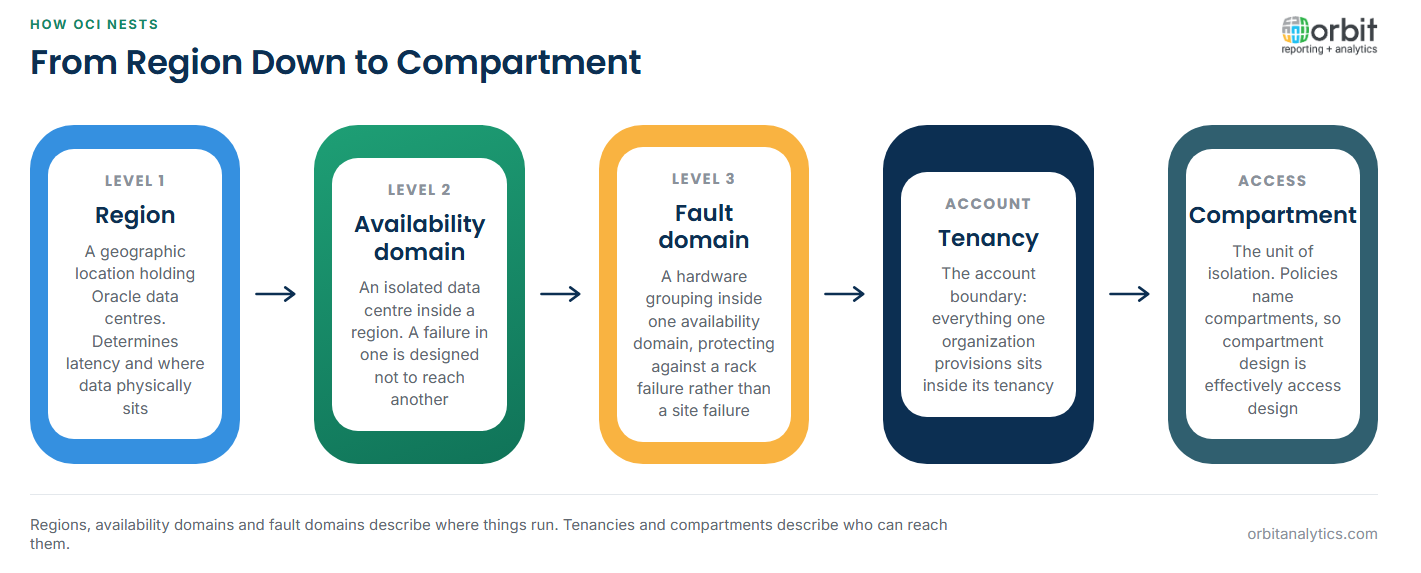
Compartments are worth understanding first. Almost every access question in OCI resolves to which compartment a resource sits in and which policies name it, so a reader who grasps compartments can follow most Oracle cloud material.
The Core Service Categories
OCI publishes a large catalogue, but a finance or reporting reader needs it at the level of five groupings rather than by product name.
| Category | What it provides | Why a reporting team cares |
| Compute | Virtual machines and bare metal servers | Where an application or an extract job actually runs |
| Storage | Block, object and file storage | Where extracts, backups and files land |
| Networking | Virtual cloud networks, routing, connectivity | Whether a reporting tool can reach the data at all |
| Database | Managed and autonomous database services | The layer a warehouse or reporting store sits in |
| Data and analytics | Integration, warehousing and analytics services | The path curated data takes on its way to a report |
The catalogue matters less than the shape: infrastructure services are rented and paid for by consumption, a different relationship from licensing an application.
Identity, Security and Governance
Access in OCI is granted by policy rather than by direct permission on a resource. A policy names a group, an action and a compartment, which is why compartment design effectively becomes access design. Identity domains hold the users and groups those policies refer to.
Encryption is applied to stored data with keys managed by Oracle or held by the customer, and audit logging records API activity across the tenancy. For a reporting project, the practical consequence is that reaching data is a policy question, decided by someone who may not be in the finance team.
Where Oracle Applications Sit on OCI
This is where the distinction earns its keep.
- Oracle Fusion Cloud Applications run on OCI. The applications are SaaS, sold and managed by Oracle. Customers use them without provisioning or seeing the infrastructure underneath.
- EBS and PeopleSoft can be lifted onto OCI. These remain the same applications the organization has always run, now hosted on Oracle’s infrastructure rather than in its own data centre. The application is unchanged; the hosting is not.
- Autonomous Database and the wider data layer are infrastructure services customers provision directly, often as the destination for reporting data rather than as the transactional system.
The reason a finance team should care is narrow and important: being on OCI says nothing about what access they have. A lifted EBS estate usually keeps its familiar database access. Fusion Cloud Applications do not offer it. Orbit Analytics maintains pre-built connectors spanning applications hosted on OCI and systems still running elsewhere, which is what keeps a single report possible across a mixed estate.
How Data Leaves OCI for Reporting
Reporting is a separate question from hosting, and it has a small number of real answers.
- Application-level access: Published interfaces, extracts and APIs offered by the application itself. This is the route for Fusion Cloud Applications, where direct database access is not available.
- Database-level access: Available where the customer owns the database, as with a lifted EBS estate or a provisioned Autonomous Database.
- Curated movement: Data extracted on a schedule into a warehouse or reporting store, which is what most cross-module and historical reporting ultimately runs against.
Governance follows the data rather than staying behind. A user’s visibility in the source application does not automatically reproduce itself in a reporting layer, so row-level rules have to be carried across deliberately. Orbit Analytics reports across Oracle Fusion Cloud reporting and EBS estates without requiring direct database access to the SaaS application, which is the constraint most reporting plans discover late.
How OCI Differs From Oracle’s Earlier Cloud Generations
Oracle’s first cloud generation was a different architecture, and OCI was a rebuild rather than an upgrade of it. That is not historical trivia: a great deal of material written for the earlier generation is still in circulation, describing limits that no longer apply. When two Oracle documents appear to contradict each other, checking which generation each describes usually resolves it.
Common Misconceptions
- OCI is not the same as Oracle Fusion Cloud Applications. One is infrastructure, the other is software. A company can use either without the other.
- A cloud ERP does not mean direct database access. Hosting changes where software runs, not what interfaces it exposes.
- A region is not a data residency approval. Choosing a region places data geographically; whether that satisfies a regulator is a separate legal question.
- Autonomous does not mean unmanaged. Automated patching and tuning remove work; they do not remove the need for design, access control or cost oversight.
OCI, Hybrid Cloud, Multi-Tenant and On-Premises Compared
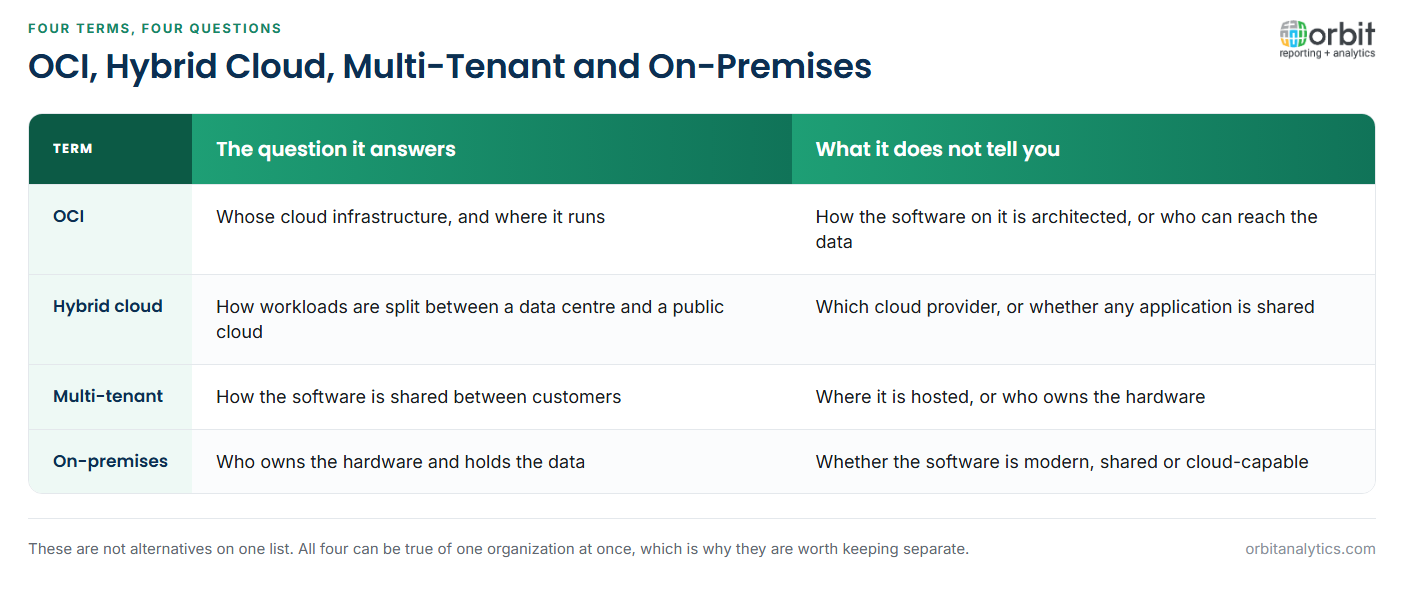
These four terms get used as if they were alternatives on one list. They are not, because they answer different questions.
OCI names a specific public cloud platform: whose infrastructure it is and where it runs.
Hybrid cloud describes a deployment pattern in which some workloads stay in an organization’s own data centre while others run in a public cloud. It answers where workloads are split.
Multi-tenant describes how software is shared, with several customers served by one instance and separated logically. It answers how the software is architected, not where it runs.
On-premises means the organization holds both the hardware and the data in its own facility. It answers who owns the infrastructure.
So a multi-tenant application can run on OCI, as part of a hybrid estate, alongside an on-premises system. All four statements can be true of one organization at once, which is exactly why the terms are worth keeping separate.
Frequently Asked Questions
Q1. What is Oracle Cloud Infrastructure (OCI)?
It is Oracle’s public cloud platform, providing compute, storage, networking, database and analytics services on a consumption basis. It is infrastructure that software runs on, not an application in itself.
Q2. What is the difference between OCI and Oracle Fusion Cloud Applications?
OCI is infrastructure; Fusion Cloud Applications are SaaS business applications. Fusion Cloud Applications run on OCI, but a company can use OCI without using them, and using them does not give access to the infrastructure underneath.
Q3. What is an OCI tenancy?
A tenancy is the account boundary for one organization. Everything that organization provisions in OCI sits inside its tenancy, which is then subdivided into compartments.
Q4. What is a compartment?
A compartment is the unit of isolation inside a tenancy. Resources are placed in compartments and access policies are written against those compartments, so compartment design is effectively access design.
Q5. What is the difference between an availability domain and a fault domain?
An availability domain is an isolated data centre within a region, protecting against a site-level failure. A fault domain is a hardware grouping inside a single availability domain, protecting against a rack or hardware failure.
Q6. Can OCI run alongside on-premises systems?
Yes. Many organizations run a mixed estate, with some applications on OCI and others in their own data centre, which is the pattern described as hybrid cloud.
Understanding OCI settles where an Oracle system runs, but not what a finance team can report on, and those two questions come apart the moment an ERP moves to SaaS. Orbit Analytics reports live across Fusion Cloud and EBS data with drill-down from any figure to the transactions behind it. Request a demo to see it against your own estate.
