
For Chief Data Officers, IT Directors, and BI Architects, the mandate this year is clear: democratize enterprise data and accelerate actionable intelligence. As organizations rely on Oracle Fusion Cloud for critical operations, integrating this rich transactional data into modern analytics ecosystems is a top priority.
Moving Oracle Fusion Cloud data into Microsoft Fabric, Power BI, Snowflake, or Databricks is essential. However, achieving this efficiently remains a persistent challenge. Oracle Fusion is a powerhouse for business operations, but functions as a restricted ‘black box’ when extracting data for external analytical processing.
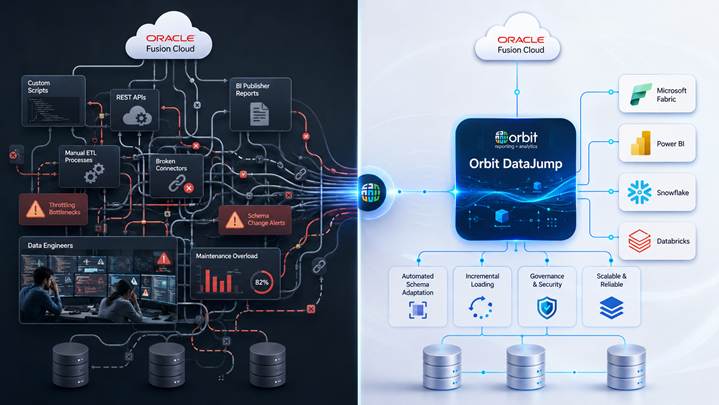
The traditional response has been building custom ETL pipelines. Engineering teams spend countless hours stringing together REST APIs, BI Publisher (BIP) reports, and Oracle’s Business Intelligence Cloud Connector (BICC).
This approach is fundamentally flawed. It creates fragile architectures, skyrockets technical debt, and misallocates expensive engineering resources. If your organization is writing custom scripts to move Oracle Fusion data, you are caught in a dangerous cycle. It is time to stop building custom ETLs. The faster, more scalable way to connect Oracle Fusion to Power BI and Microsoft Fabric is through purpose-built automation.
The Core Problem: The Hidden Costs of Custom-Built ETL Pipelines
Building a custom ETL pipeline seems straightforward at first glance. However, seasoned BI Architects discover that Oracle Fusion integration is complex, fragile, and fraught with hidden operational costs.
Let us dissect the primary architectural hurdles making custom-built ETL pipelines a massive drain on enterprise agility.
1. The Complexity of Oracle BICC (Business Intelligence Cloud Connector)
Oracle’s BICC is the standard method for extracting large data volumes. It excels at dumping massive amounts of raw data into cloud object storage. However, BICC is merely a raw drop-off point, not a complete pipeline.
When relying on BICC, the output requires heavy downstream transformation. The raw data arrives highly normalized, scattering single business concepts across dozens of unlinked files. Configuring reliable incremental logic within BICC is difficult, forcing teams to manually model everything from scratch.
2. Severe API Throttling and Timeout Risks
Many teams attempt to bypass BICC using Oracle Fusion REST APIs or BI Publisher (BIP) reports. This is a critical mistake. Fusion REST APIs are designed for lightweight transactional integrations, not heavy analytical queries requesting millions of records.
Attempting to push multi-million-row financial tables through Fusion APIs is like pushing a boulder through a garden hose. APIs will aggressively throttle requests, causing prolonged extraction times and failed data loads that disrupt overnight batch processing. Similarly, custom BIP reports frequently time out against enterprise-scale data volumes.
3. The Pain of Frequent Quarterly Schema Changes
Oracle updates its Fusion Cloud applications quarterly. While fantastic for end-users, these rolling updates are a nightmare for custom ETL pipelines.
A custom script working flawlessly in Q1 can break in Q2 because a data model changed or a field was deprecated. Data teams find themselves trapped in a continuous break-fix cycle, scrambling to repair pipelines instead of delivering business value.
The “Build vs. Buy” Trap: A Cost-Benefit Analysis
Data leaders routinely underestimate the Total Cost of Ownership (TCO) associated with custom-built integrations. The “Build vs. Buy” trap is the illusion that developing an in-house pipeline is cheaper because it avoids software licensing fees. However, rigorous analysis reveals internal engineering teams waste months maintaining brittle scripts.
The “Build” Reality: High Maintenance, Low Agility
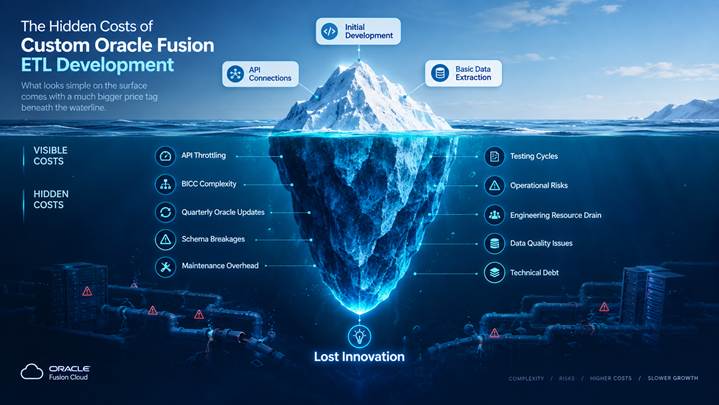
When building a custom ETL pipeline for Oracle Fusion, initial development is just the tip of the iceberg:
- Massive Engineering Hours: Mapping complex Oracle schemas and establishing secure connections takes months of dedicated engineering time.
- Ongoing Maintenance Burden: Because of Oracle’s quarterly updates, you must dedicate permanent engineering resources to keep the lights on. Every API change requires rewriting code and testing.
- The Ultimate Opportunity Cost: Every hour a senior data engineer spends acting as a ‘plumber’ is an hour stolen from high-value tasks. Your team should focus on building predictive machine learning models, not babysitting broken API calls.
The “Buy” Advantage: Rapid Time-to-Value
Purchasing a purpose-built integration platform flips this economic model completely. The implementation timeline shrinks from months to mere days. Maintenance is offloaded to the software vendor, ensuring quarterly Oracle updates are handled seamlessly. The true return on investment of the “Buy” approach is organizational agility: empowering BI Architects to deliver actionable insights immediately.
The Orbit Solution: Stop Building, Start Connecting
To permanently overcome the limitations of Oracle Fusion APIs, BICC extractions, and brittle scripts, organizations require a platform native to the Oracle ecosystem but highly optimized for modern cloud analytics.
Enter Orbit Data Pipelines, powered by our industry-leading DataJump technology.
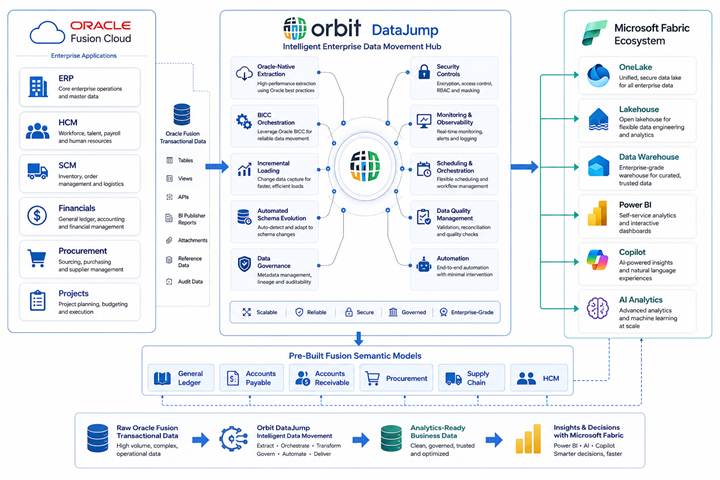
Orbit Data Pipelines is not a generic data integration tool; it is a purpose-built ETL/ELT platform designed specifically to solve the complexities of Oracle Fusion data extraction. It acts as the ultimate enterprise bridge, providing a fully governed, highly scalable pathway to move your enterprise data from Oracle Fusion directly into Microsoft Fabric, Power BI, Databricks, and Snowflake.
By understanding Fusion’s incredibly complex underlying schema, automating extraction processes, and delivering ready-made analytical models, DataJump transforms Oracle Fusion-to-Data Warehouse integration into a clean, frictionless operation.
Key Features to Highlight: Why Orbit Data Pipelines is the Ultimate Solution
For IT Directors and BI Architects actively modernizing enterprise data architecture, Orbit Data Pipelines offers a robust suite of features directly addressing custom ETL pain points.
1. No-Code, Automated Pipelines Natively Built for Oracle Fusion
Unlike generic ETL tools struggling with Oracle’s proprietary structures, Orbit is intimately aware of Oracle’s architecture. It offers a no-code, self-serving platform with an intuitive visual interface. DataJump fully orchestrates and automates BICC extracts, seamlessly handling source configuration, complex cloud authentication, and initial schema discovery natively.
No manual plumbing is required. You simply connect your Oracle Fusion source, select your Microsoft Fabric or Power BI destination, and let the platform handle the heavy lifting. This seamless integration eliminates human error, accelerates deployment times, and drastically reduces long-term IT overhead.
2. Incremental Change Tracking and Automated Schema Evolution Handling
Dealing with massive historical datasets and constantly changing schemas is challenging. Orbit completely eliminates this engineering burden by automating incremental loading. It intelligently handles lastUpdateDate deltas, ensuring only new or modified data is extracted during each run. This critically prevents system timeouts, reduces compute costs, and optimizes overall pipeline performance.
Furthermore, the platform features automated schema evolution handling. When Oracle releases quarterly updates and changes underlying data structures, Orbit adapts automatically. Your pipelines remain robust and unbroken, ensuring data reliability without requiring engineers to rewrite code.
3. Pre-Built Fusion Semantic Data Models (Skipping the Raw-Data Phase)
Perhaps the most powerful feature of Orbit Data Pipelines is allowing your team to skip the raw-data mapping phase entirely. When raw data lands via standard BICC, BI Architects typically spend weeks manually mapping confusing table relationships to create usable dimensions and facts.
Orbit ships out-of-the-box with pre-built Fusion semantic data models for critical business domains, including Financials (GL, AP, AR), Procurement, Projects, HCM, and SCM. These models include meticulously mapped facts, dimensions, and measures designed for business intelligence.
Instead of spending months building complex dimensional data models from scratch, your team receives curated, business-friendly datasets immediately ready for consumption. This semantic layer ensures consistent, governed reporting across the enterprise, drastically accelerating time-to-value for analytics initiatives.
Dive deeper into how this architecture works by exploring a deep dive into Orbit’s DataJump features, benefits, and use cases.
Unlocking the Full Power of Microsoft Fabric and Power BI
By leveraging Orbit Data Pipelines, organizations can fully unlock the game-changing potential of Oracle Fusion to Microsoft Fabric integration. Microsoft Fabric is revolutionizing the industry by combining data movement, data engineering, and real-time analytics into a single, unified SaaS platform.
Paired with Orbit’s highly intelligent, Oracle-aware ingestion layer, you can rapidly establish a strong OneLake data foundation where all your Oracle Fusion datasets are centralized, secure, and instantly ready for advanced AI modeling and Copilot integrations.
For business analysts, this means direct, high-performance access to Oracle Fusion data seamlessly within Power BI. Orbit is widely recognized as the best Power BI to Oracle Fusion Cloud connector available for large-scale enterprise environments. Because Orbit expertly manages the heavy extraction layer and delivers completely Power BI-ready dimensional datasets, you bypass the strict limitations and sluggish performance of Oracle Transactional Business Intelligence (OTBI).
Business users can drill down into operational reporting, track complex key performance indicators (KPIs), and build dynamic visualizations with total confidence, knowing the underlying enterprise data is accurate, highly secure, and automatically refreshed without putting load on the source ERP system.
Reclaim Your Engineering Resources Today
The era of dedicating expensive engineering teams to maintain fragile, custom-built ETL pipelines for Oracle Fusion is officially over. The hidden maintenance costs, severe API throttling, devastating quarterly schema breakages, and endless engineering resource drain make the “Build” approach completely unsustainable for modern enterprises. It is time for forward-thinking CDOs, IT Directors, and BI Architects to embrace the massive strategic advantage of the “Buy” approach.
By deploying Orbit Data Pipelines, you eliminate the complexities of BICC and Fusion APIs, fully automate your enterprise data movement, and deliver pre-built, highly accurate semantic models directly to business users in record time. Stop acting as data plumbers and start driving true strategic value through advanced analytics, machine learning, and AI.
Request a demo today to see exactly how quickly and seamlessly Orbit can route your critical Oracle Fusion data directly into Power BI or Microsoft Fabric. Discover the definitive, frictionless path from raw Oracle transactional data to actionable, enterprise-wide intelligence.


