For the past two decades, the enterprise technology landscape has been completely dominated by a single, unquestioned visualization paradigm: the static dashboard. Across every major global organization, data engineering teams and business intelligence (BI) developers have spent countless hours meticulously designing, structuring, and publishing highly curated charts and graphs. The primary goal was to provide executives, department heads, and operational managers with an at-a-glance view of their most critical business metrics. In theory, this approach promised total transparency and immediate insights. However, in modern, fast-paced enterprise environments running on complex enterprise resource planning (ERP) systems like Oracle Fusion Cloud, the traditional dashboard is rapidly exposing its inherent, structural limitations. The static dashboard is dying, not because it fails to visualize data, but because it fundamentally fails to answer the ad-hoc, investigative questions that actually drive business strategy.
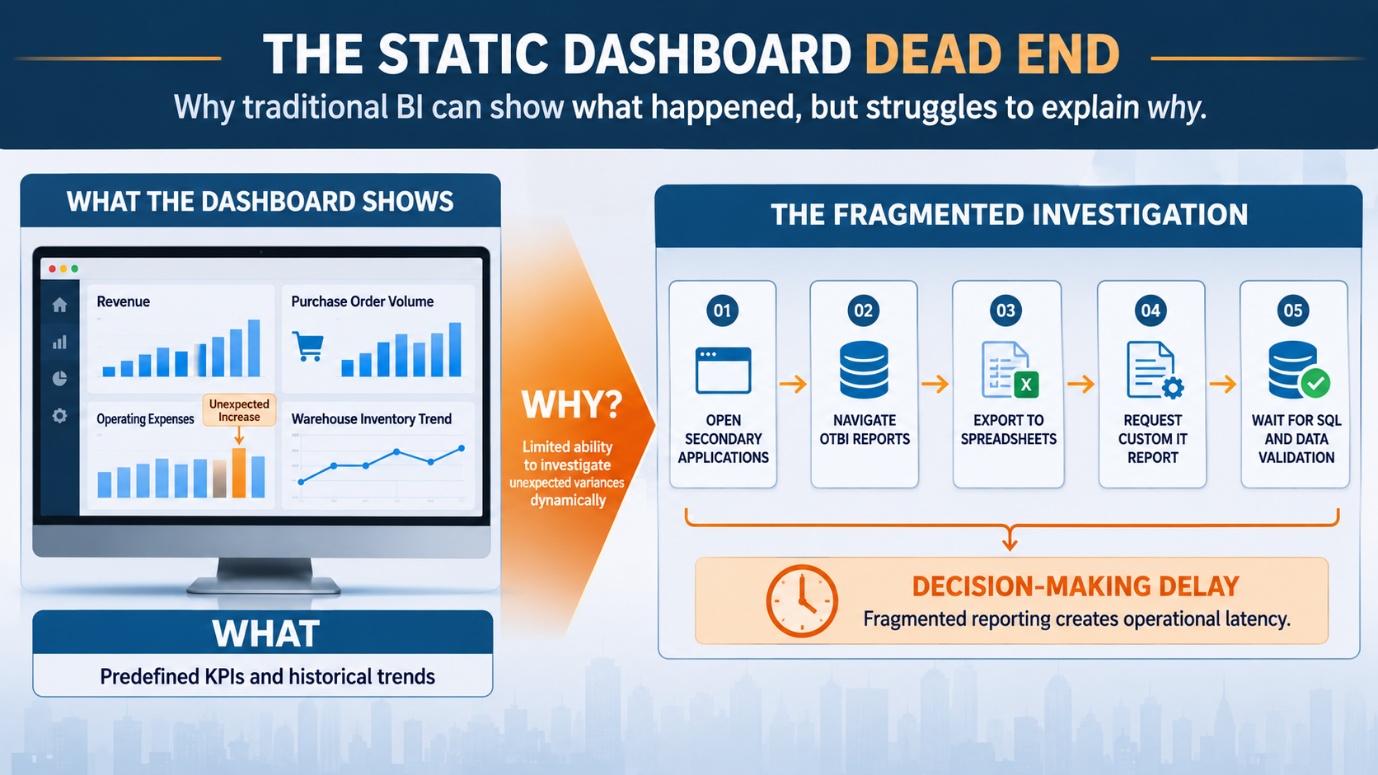
When business users log into their reporting portals every morning, standard dashboards are exceptionally good at confirming what they already know they want to track. If a Chief Financial Officer wants to see the aggregate global revenue for the current quarter, a standard bar chart delivers that metric instantly. If a Supply Chain Director needs to check the total volume of outstanding purchase orders, a pre-configured KPI tile provides that exact number. Dashboards are perfect for answering the “what.” They are entirely incapable of answering the “why.” When an anomaly appears—a sudden, unexpected 18% spike in operating expenses, or an inexplicable drop in warehouse inventory turns—the dashboard abruptly reaches a dead end. It cannot pivot. It cannot think. It merely displays the surface-level variance, leaving the business user stranded at the exact moment they need deeper operational context.
This functional roadblock is where the illusion of true self-service analytics shatters. To investigate the root cause of an unexpected variance, business users are forced to abandon the dashboard and initiate a heavily fragmented, time-consuming reporting exercise. They must open secondary applications, attempt to navigate rigid query paths in tools like Oracle Transactional Business Intelligence (OTBI), or, more commonly, export massive datasets into offline spreadsheets for manual reconciliation. When those workarounds fail to yield a clear answer, the user ultimately files a custom report request ticket with the IT department. By the time the data engineering team modifies the SQL query, validates the underlying data model, and returns the customized report, the window for proactive decision-making has already permanently closed. The executive meeting is over, the financial period is closed, and the supply chain disruption has already impacted the end customer.
The Finance Dilemma: Surviving the Month-End Close
Nowhere is the friction of static reporting more painfully evident than within the finance department. During the critical month-end close cycle, time is the most valuable commodity. Finance leaders, controllers, and analysts are under immense pressure to reconcile the General Ledger, validate subledger entries, and finalize consolidated financial statements. When a discrepancy arises, such as a mysterious budget overrun in a specific regional cost center, the finance team must immediately trace that anomaly back to its originating transaction. Standard financial dashboards lack the dynamic drill-down capabilities required to seamlessly transition from a macro-level ledger balance down to an individual Accounts Payable (AP) invoice.
In a traditional setup, investigating this variance requires navigating across multiple disconnected reporting silos. A finance manager might see the overrun in a high-level summary view, but identifying the specific vendor or purchase that caused the spike requires running a completely separate, highly parameterized transactional report. This constant context-switching introduces massive latency into the financial close process. Modern finance teams can no longer afford to operate on reactive, pre-programmed data paths; they require the ability to interrogate their Oracle Fusion Financial Reporting systems in real time. They need the flexibility to ask sequential, deeply contextual questions: “Which cost centers drove the North American expense variance?” followed immediately by, “Show me the unapproved invoices over $50,000 contributing to that total.” Static tools simply cannot support this fluid, investigative workflow, forcing highly paid financial professionals to act as manual data gatherers rather than strategic business advisors.
Supply Chain Blind Spots: The Cost of Reporting Latency
The limitations of traditional BI are equally devastating within global supply chain and procurement operations. In these highly volatile environments, agility and immediate visibility are not just conveniences; they are critical survival mechanisms. Supply chain networks are constantly shifting due to fluctuating vendor pricing, geopolitical disruptions, and unpredictable consumer demand patterns. When a dashboard alerts a procurement manager to a sudden increase in raw material costs, knowing that the aggregate cost increased is entirely insufficient. The manager must immediately understand which specific suppliers are driving the increase, whether those price hikes violate existing vendor contracts, and how the increased costs will impact downstream manufacturing margins.
Because static dashboards rely on predefined relational data models and fixed dimensional hierarchies, they inherently restrict a supply chain leader’s ability to explore unforeseen operational bottlenecks. If a dashboard was not explicitly programmed by an IT developer to cross-reference supplier lead times with specific warehouse inventory levels, that insight remains completely invisible to the business user. Consequently, procurement teams are often forced to operate with massive operational blind spots. They cannot intuitively ask their Oracle Fusion Analytics environment, “Which of our top tier-one suppliers have consistently delivered late over the last three quarters, and what is the associated cost of those delays?” Instead, they are forced to piece together a fragmented narrative from disparate inventory, order management, and purchasing reports. In modern supply chain management, waiting 48 hours for a customized BI report is functionally equivalent to operating entirely in the dark.
The Pivot: Empowering Users with Domain-Specific Conversational AI
The enterprise software industry is currently undergoing a massive paradigm shift to solve this exact problem. The solution is not to build more complex dashboards with hundreds of confusing drop-down filters. The solution is to completely eliminate the technical barrier between the business user and the underlying ERP database. The future of enterprise intelligence lies in domain-specific conversational AI—a technology that allows professionals to explore their data dynamically through natural language conversation.
Conversational analytics fundamentally changes the relationship between the user and the ERP system. Instead of clicking through a rigid, pre-determined analytical path, the user simply asks a question in plain English, exactly as they would speak to a senior data analyst. However, it is crucial to recognize that plugging a generic, public-facing Large Language Model (LLM) into an enterprise database is a recipe for disaster. Generic AI models lack essential business context. They do not natively understand the complex schema of Oracle Fusion, the difference between an accounted financial amount and an entered transactional amount, or the specific custom hierarchies unique to your organization. To be trustworthy, enterprise AI must be strictly governed, highly contextual, and domain-aware. It must understand the exact definitions, key performance indicators, and fiscal calendars that dictate how your business actually operates.
Enter Orbit Fusion ThinkBoxes: The Next Evolution of Conversational Analytics
This is precisely why we developed Orbit Fusion ThinkBoxes. Designed specifically for the complex architecture of Oracle Fusion Cloud, ThinkBoxes represent the ultimate evolution from static visualization to dynamic, conversational root-cause analysis. An Orbit Fusion ThinkBox is a purpose-built conversational AI application pre-configured for specific, high-value business domains, including General Ledger, Payables, Procurement, Inventory, and Human Capital Management. ThinkBoxes do not just return a single number; they generate a comprehensive analytical response complete with exact metrics, dynamically generated visual trends, contextual plain-language explanations, and a direct drill-down path to the underlying transactions.
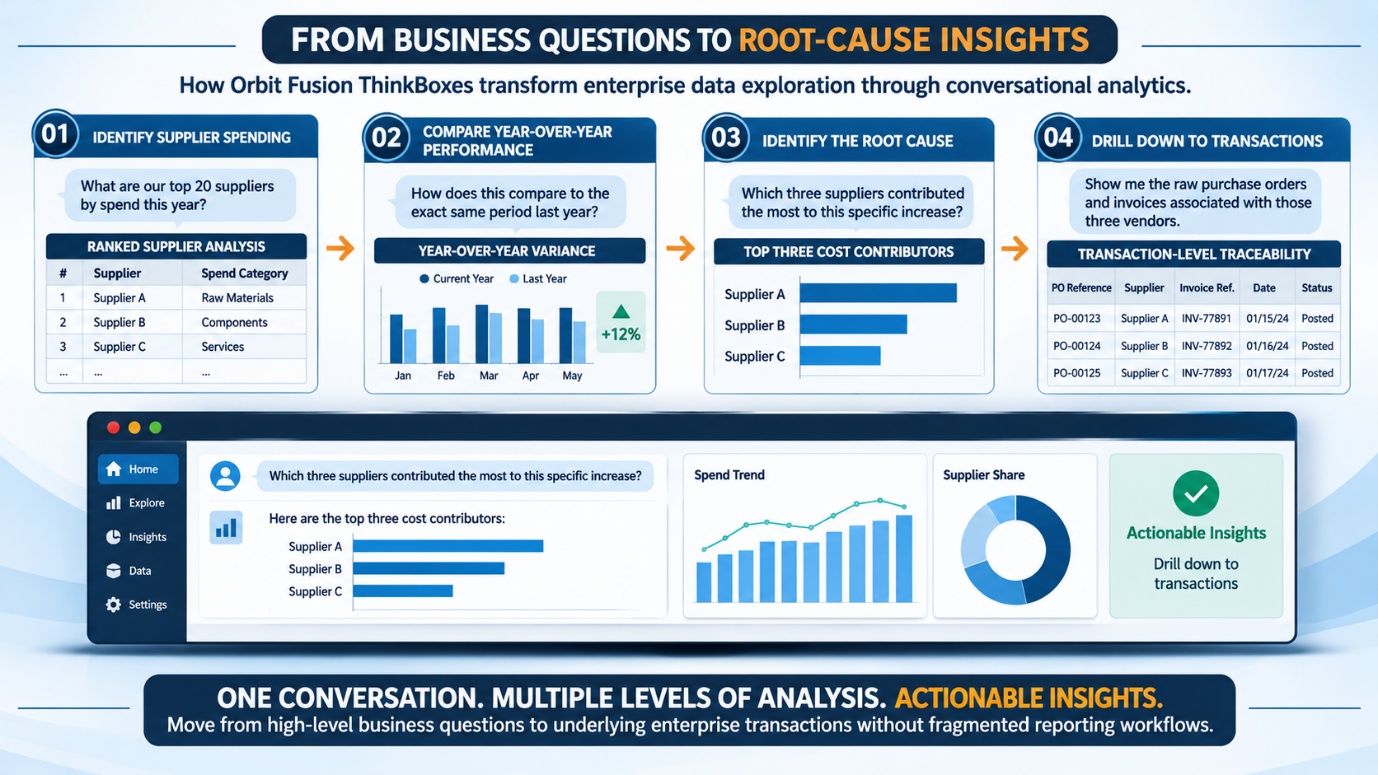
The true power of an Orbit Fusion ThinkBox lies in its ability to support continuous, multi-level conversational workflows. Consider a real-world procurement scenario. A user can begin by asking, “What are our top 20 suppliers by spend this year?” The AI instantly delivers the ranked list. The user can then immediately ask, “How does this compare to the exact same period last year?” The ThinkBox contextualizes the request, understands the time-intelligence requirement, and layers in the year-over-year variance. Uncovering a massive spike, the user investigates further: “Which three suppliers contributed the most to this specific increase?” Finally, the user drills down to the absolute root cause: “Show me the raw purchase orders and invoices associated with those three vendors.” This entire multi-layered investigation occurs in a single, fluid conversational interface within minutes, completely bypassing the IT ticket queue and eliminating the need for offline spreadsheets.
Governed, Secure, and Architecturally Sound AI for Oracle Fusion
For Chief Information Officers and enterprise data architects, the adoption of AI often raises immediate concerns regarding data security, governance, and architectural vendor lock-in. Orbit Fusion ThinkBoxes are built upon a foundation of absolute trust and uncompromised enterprise security. Because ThinkBoxes sit cleanly on top of Orbit’s pre-built Fusion data models, every conversational response is generated from a highly governed semantic layer. The AI does not guess or hallucinate SQL joins from scratch; it leverages your organization’s explicitly defined business rules and calculations to guarantee 100% mathematical accuracy.
Furthermore, this conversational layer respects and inherits all existing corporate security protocols. Orbit Fusion ThinkBoxes integrate seamlessly with Oracle Fusion’s robust role-based access control (RBAC) security framework. A regional sales director asking a broad revenue question will only ever receive answers calculated from the specific regional data they are explicitly authorized to view. Additionally, Orbit Analytics ensures that organizations are never forced to rip and replace their existing modern data stack. Whether an enterprise leverages Snowflake, Databricks, Amazon Redshift, Microsoft Azure SQL, or Oracle Autonomous Data Warehouse (ADW), ThinkBoxes deploy cleanly over your preferred data platform, instantly transforming your existing infrastructure into a highly intuitive, AI-driven powerhouse.
Conclusion: Transforming Questions into Immediate Action
The era of waiting on the IT department to configure, modify, and distribute static dashboards is coming to an end. In an increasingly competitive global market, business agility is strictly defined by how quickly an organization can identify a problem, isolate the root cause, and execute a corrective operational strategy. Finance teams, supply chain directors, and procurement heads can no longer afford to let critical business questions languish in a reporting backlog while they wrestle with inflexible visualization tools.
Conversational AI is not merely a feature enhancement; it is a fundamental re-imagining of how humans interact with enterprise data. By democratizing access to complex ERP systems, governed conversational analytics empowers every business leader to become a self-sufficient data explorer. It is time to stop clicking through rigid filters and start having meaningful, dynamic conversations with your enterprise data.
Ready to see how conversational AI can permanently eliminate your dashboard fatigue and accelerate your reporting workflows? Explore how our solutions, including GLSense, are transforming finance, and contact us to request a personalized ThinkBoxes demo today to witness the future of Oracle Fusion analytics firsthand.