
The myth of the overnight cloud migration is one of the most pervasive—and financially damaging—misconceptions in enterprise technology today. Vendors have historically sold C-suite leaders the utopian vision of a seamless “go-live” weekend. The narrative suggests that on a Friday afternoon, your organization logs out of your legacy on-premise Oracle E-Business Suite (EBS), and by Monday morning, everyone is happily operating within Oracle Fusion Cloud.
The reality of enterprise cloud migrations is vastly different: they are rarely a simple “flip the switch” event. Large organizations possess massive volumes of historical data, intricate custom workflows, and highly entrenched financial processes. Because of this profound complexity, migrations are virtually always executed in prolonged phases. Companies live in a hybrid state—running both Oracle EBS and Oracle Fusion concurrently—for years. You might migrate Human Capital Management (HCM) in phase one, transition Core Financials a year later, and leave Supply Chain Management (SCM) on-premise for another three to five years.
During this extended transitional period, the underlying transactional systems that power your business are fundamentally fractured. If left unaddressed, this creates a catastrophic blind spot for leadership. As ERP Migration Project Managers, IT Leaders, and Operations Directors, your primary mandate isn’t merely to move data; it is to ensure the business can continue to function, make data-driven decisions, and report accurately every single day of the journey. To survive a multi-year cloud transition, you must treat your analytics architecture as a critical operational safety net.
The Core Problem: The Nightmare of Fragmented Reporting
When an organization enters this multi-year hybrid state, business users face the immediate nightmare of fragmented reporting. The seamless, end-to-end visibility that executives rely on to steer the company is split down the middle. Consider the day-to-day reality when half of your enterprise data lives on-premise in legacy Oracle EBS, and the newly generated data lives in Oracle Fusion Cloud.

The most painful casualty of this system fragmentation is the ability to perform accurate Year-over-Year (YoY) comparisons. Executive decision-making depends entirely on historical patterns, from seasonal sales cycles to long-term margin baselines. If your CFO pulls up a dashboard to analyze third-quarter revenue trends, they need the complete, uninterrupted picture. However, if the current year’s transactional data resides in Fusion and the previous five years of crucial history are locked away in EBS, generating a simple YoY trend line becomes a monumental, highly manual task. Your trends aren’t really trends if they start from zero on activation day.
Teams across the enterprise struggle to track operational metrics across this technological divide. Key Performance Indicators (KPIs) become dangerously misleading when they lack historical context. Without closed EBS invoices seamlessly integrated into your current analytics view, metrics like average payment days look artificially skewed. Long-term vendor dispute patterns vanish from view, and early payment discount trends become fundamentally incomplete.
Furthermore, cloud migrations almost always involve structural business changes. A migration is the perfect opportunity to redesign a messy Chart of Accounts (COA), clean up cost centers, or consolidate suppliers. While this optimization is excellent for future operations, it creates a massive “Semantic Gap.” Your leadership wants to compare “then versus now” under the newly defined structures, but historical EBS transactions were recorded under legacy definitions.
When an Operations Director asks for precise inventory turnover comparisons, they do not care about differing COA structures or disjointed tables. They just need the answer to guide procurement. When the reporting team cannot provide it without spending weeks manually stitching together fragile Excel exports, trust in the newly implemented ERP system rapidly collapses.
The Hidden Costs of Native, Siloed Tools
The instinct for many IT teams and project managers is to rely on the native reporting tools provided by the ERP vendors themselves. While tools like Oracle Transactional Business Intelligence (OTBI) and Oracle Fusion Analytics are incredibly powerful for analyzing data strictly generated within the Oracle Cloud, they fall drastically short in a complex hybrid migration scenario.
Relying strictly on built-in, siloed tools forces your business into a fragmented workflow. Fusion reporting tools are built around Fusion’s canonical definitions and typically start their analytical baseline from “Day 1” of the cloud go-live. They do not seamlessly ingest decades of on-premise Oracle EBS history and map it to new semantic models without massive manual intervention and expensive custom consulting. You can extract the legacy data, but you will still be miles away from usable analytics.
As a result, business users inevitably resort to “spreadsheet shadow IT.” They run one massive report out of Oracle EBS, another out of Oracle Fusion, export both to Excel workbooks, and attempt to manually reconcile the data using thousands of VLOOKUPs. This manual extraction is profoundly tedious, highly prone to human error, and completely lacks data governance. By the time the data is formatted for a board meeting, it is already outdated.
Moreover, modern enterprises are increasingly migrating analytical workloads to advanced data platforms. Native ERP reporting tools are simply not designed to act as enterprise-grade data pipelines that feed these broader ecosystems. Attempting to build custom Extract, Transform, Load (ETL) solutions to bridge legacy EBS, modern Fusion, and third-party data warehouses often results in fragile, unmaintainable architecture. This lack of unified visibility paralyzes agile decision-making and turns highly paid financial analysts into full-time data janitors.
The Solution Strategy: Elevating the Reporting Layer
How do organizations prevent this catastrophic loss of visibility? The answer lies in the strategic concept of architectural decoupling. Why organizations need a reporting layer that sits above the migration, rather than relying strictly on built-in siloed tools, ultimately comes down to business continuity.
Instead of trying to force legacy EBS data into new Fusion reporting tools, or attempting to backport Fusion data into legacy data warehouses, IT leaders must implement an overarching analytics umbrella. You need a unified reporting solution that is completely agnostic to the underlying transactional systems.

By elevating the reporting layer above the ERP level, you effectively insulate the broader business from the technical disruption of the migration. When the reporting layer connects to both the legacy on-premise databases and the modern cloud applications simultaneously, the end-user experience remains completely stable. To the CFO, the Financial Controller, or the Operations Director, the critical dashboards look exactly the same on the day before the cloud migration as they do on the day after. The only difference is the intricate data plumbing running underneath.
This strategic abstraction layer acts as the ultimate operational safety net. It empowers the IT department to transition data to the cloud at their own careful pace, safely knowing that executive reporting will not break during the process. Furthermore, this strategy eliminates the immense pressure to execute a risky “big bang” data conversion. You no longer need to force 15 years of legacy EBS data into your new Oracle Cloud environment just to satisfy basic reporting requirements. You can keep your Fusion environment lean, fast, and optimized for current operations, while the overarching analytics layer handles the heavy lifting of historical trend analysis.
The Orbit Solution: The Ultimate Migration Bridge
To execute this decoupling strategy successfully, enterprises require a specialized platform engineered for the immense complexities of hybrid ERP environments. This is precisely where Orbit Analytics acts as the ultimate migration bridge. By deploying Orbit alongside your ERP migration strategy, you empower your organization with a scalable, strictly governed, and highly intuitive reporting foundation that spans both the past and the future.
Here is how Orbit Analytics secures your operational safety net through three critical, fully verified capabilities:
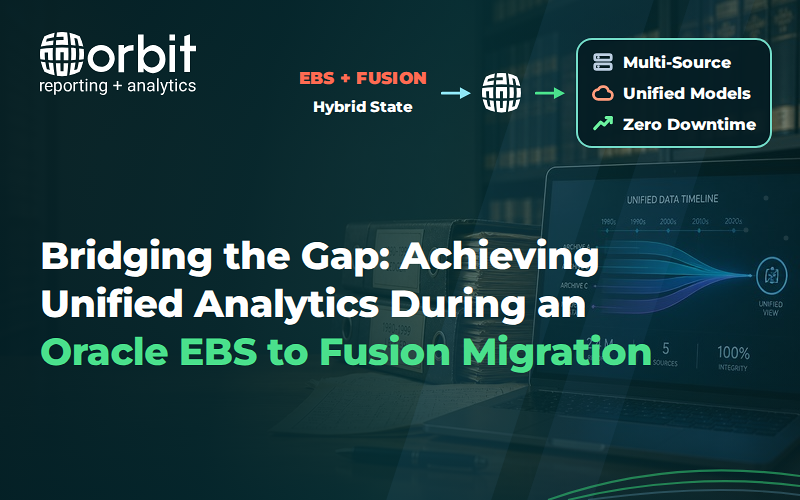
1. Multi-Source Reporting Capability
The bedrock foundation of a successful hybrid state is the ability to view data across disparate systems in true real-time. Orbit provides unparalleled multi-source reporting capability, allowing business users to query live Oracle Fusion data and historical Oracle EBS data simultaneously from a single, unified interface. You no longer have to wait for overnight batch loads or rely on fragile, custom-coded scripts to see a complete picture of your enterprise.
Whether a finance manager is cross-referencing a newly generated open invoice in Oracle Cloud ERP or a closed transaction from five years ago in Oracle EBS, the data is instantly accessible. By leveraging advanced ETL/ELT solutions like Orbit DataJump, organizations seamlessly automate complex data pipelines. DataJump efficiently handles large volumes of data, routing enterprise intelligence to modern cloud platforms like Snowflake, Databricks, Amazon Redshift, and Microsoft Fabric without compromising on speed or requiring multiple disparate tools.
2. Unified Data Models
Connecting to two different databases is only half the battle; the real, monumental challenge is making that data make sense together. Oracle EBS and Oracle Fusion do not inherently share the same semantic models, financial hierarchies, or granular structures.
Orbit Analytics solves this complex issue through sophisticated, out-of-the-box unified data models that intuitively translate differing structures from both systems into a single, business-friendly view. Orbit harmonizes master data—such as intricate Charts of Accounts, suppliers, and customers—across the entire migration timeline. If your organization changed reporting structures during the move, Orbit’s intelligent mapping ensures historical EBS data is viewed precisely through the lens of your new Fusion KPIs.
For finance teams specifically, Orbit GLSense brings this unified, highly agile financial reporting directly into the familiar interface of Microsoft Excel. GLSense delivers live GL reporting with Excel-like ease, allowing users to instantly refresh statements with data from their ERP, utilize hundreds of pre-built sub-ledger reports, and perform secure ad-hoc drill-downs without the inherent risks of managing manual spreadsheets.

3. Ensuring Zero Reporting Downtime
The ultimate measure of any successful enterprise migration is uninterrupted business continuity. With Orbit Analytics sitting strategically above the ERP layer, we ensure zero reporting downtime or business disruption during the actual migration process.
Because Orbit integrates flawlessly with your underlying infrastructure, the transition for end-users is entirely frictionless. As your IT team gradually decommissions legacy Oracle EBS modules and spins up their modern Oracle Fusion counterparts, the business continues to run daily operational reports, critical month-end close reconciliations, and vital executive dashboards without experiencing a reporting blackout.
Once the migration is fully complete, Orbit serves as the perfect Legacy Data Reporting solution. You can safely retire the expensive hardware keeping your old EBS application alive while seamlessly moving legacy data into staging databases or cloud warehouses. This allows you to retain full, governed access to all historical data for audit, compliance, reconciliations, and long-term analysis without relying on the source application.
Secure Your Migration Journey Today
An Oracle EBS to Fusion Cloud migration is a profound journey that will redefine how your enterprise operates for the next decade. However, the true success of that transformation hinges entirely on your ability to maintain visibility, trust, and reporting continuity during the complex years it takes to get there.
Do not let legacy reporting bottlenecks dictate the speed of your business, and do not let fragmented data destroy executive confidence in your massive cloud investment. By deploying a unified analytics layer, you protect your historical assets, empower your operations, and provide your leadership with the uninterrupted, end-to-end truth they require.
Ready to see how you can bridge the gap and achieve true data continuity? Register now to visit our website and explore our unified enterprise reporting platform.


