
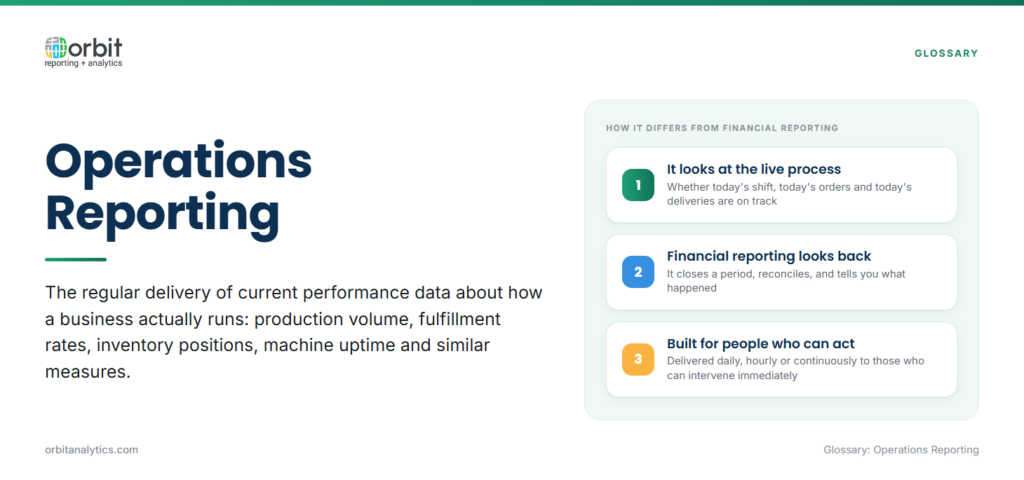
Operations reporting is the regular delivery of current performance data about how a business actually runs, production volume, fulfillment rates, inventory positions, machine uptime, and similar measures. The reports are usually generated daily, hourly, or in some cases continuously, and they target the people who can intervene immediately when something drifts.
It differs sharply from financial reporting. Financial reports look backward, they close a period, reconcile, and tell you what happened. Operations reporting looks at the live process and asks whether today’s shift, today’s orders, and today’s deliveries are on track. Both matter, but they serve different decisions and different audiences.
Inside the business, operations reporting sits between transaction processing and strategic analytics. It turns the raw stream of ERP events into a view that an ops manager can read in two minutes and act on in five.
Why is Operations Reporting Critical for Business Success?
Without it, operational decisions lag the events that triggered them. A line goes down at 9 a.m., the daily summary lands at 6 p.m., and a full day of throughput is lost. Real-time visibility shrinks that gap to minutes.
Strong operations reporting also exposes bottlenecks before they harden into chronic problems. When the same workstation shows queue spikes every Tuesday, or a single supplier is responsible for 70% of late receipts, that pattern only surfaces if the data is being watched. Finally, continuous-improvement programs like Lean and Six Sigma run on the same data, operations reporting is the measurement layer those initiatives depend on.
Key Metrics in Operations Reporting
Different functions track different numbers, but a complete operations report usually pulls from four families of metrics:
- Production and manufacturing: throughput, yield, scrap rate, overall equipment effectiveness (OEE), changeover time. Targets vary by industry, but OEE above 85% is generally considered world-class.
- Inventory and supply chain: inventory turns, days on hand, stockout rate, fill rate, supplier on-time delivery, and aged stock value.
- Order fulfillment and delivery: on-time-in-full (OTIF), order cycle time, perfect order rate, and back-order aging.
- Quality and compliance: first-pass yield, defect parts per million, non-conformance count, audit findings open, and corrective-action close rate.
These metrics live across multiple Oracle modules, Manufacturing Cloud, Inventory, Order Management, Procurement, and Quality. Orbit Analytics connects to each of those modules through pre-built connectors so the operations report draws from one consistent dataset instead of four disconnected exports.
Benefits of Effective Operations Reporting
When the reporting layer works, the rest of the business feels it. Issues surface earlier, so they cost less to fix. Process owners stop arguing over whose number is right and start arguing about what to do next, because everyone is reading the same definitions.
Cross-functional alignment improves as well. When manufacturing, supply chain, and customer service all see the same OTIF or fill-rate number, planning meetings get shorter and decisions get firmer. Resource allocation, overtime, expediting, capacity shifts, moves from instinct to evidence.
Common Challenges in Operations Reporting
The same problems show up at almost every enterprise that tries to roll this out:
- Fragmentation: Operational data sits in ERP, MES, WMS, point-of-sale, scanners, and spreadsheets, and joining it cleanly is non-trivial.
- Latency: Even when data is collected, it often lands in reports hours or days after the underlying event.
- Definition drift: Three departments using three different formulas for “on-time delivery” makes the report worse than useless.
- Tool sprawl: Each team builds its own version on a different platform.
Overcoming these challenges means consolidating sources into a governed reporting layer, automating refreshes so reports stay current, publishing standard KPI definitions, and choosing a platform that can serve every operational team from one foundation.
Operations Reporting by Industry
The discipline looks slightly different in each sector:
| Industry | Core metrics | Typical refresh cadence |
| Manufacturing | Production efficiency, yield, OEE, quality | Per shift or per hour |
| Retail | Inventory turns, stockouts, sell-through, store-level sales velocity | Daily |
| Logistics | On-time delivery, dock-to-stock cycle time, fleet utilization, route adherence | Hourly to daily |
| Healthcare | Patient flow, bed utilization, average length of stay, clinician productivity | Per shift or daily |
Different metrics, same discipline: a current view of how the operation is running, refreshed often enough to act on.
Best Practices for Operations Reporting
Start by defining a short list of KPIs that map to real decisions someone in the business actually makes. A dashboard with 40 tiles is a dashboard nobody reads. Five to eight numbers per audience is usually plenty.
Automate the data collection so analysts are not exporting, joining, and emailing every morning. Use visual dashboards, gauges, trend lines, traffic lights, for at-a-glance comprehension, and reserve dense tables for drill-down. Finally, set a regular review cadence. A daily 10-minute standup against the operations report institutionalizes the habit of acting on the data.
How to Get Started with Operations Reporting
A workable rollout follows three steps:
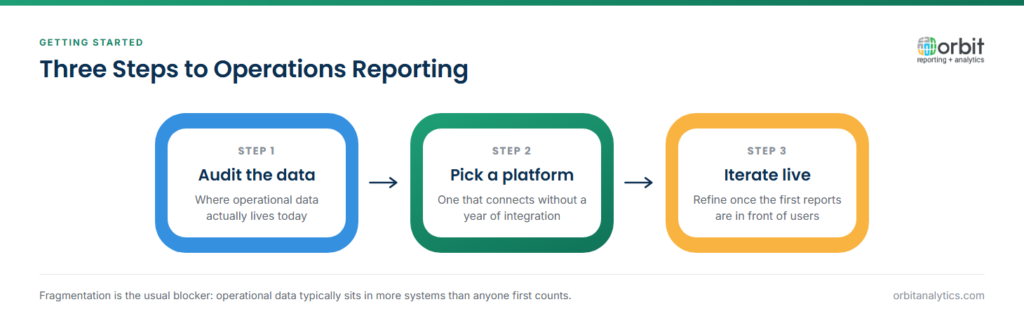
- Audit where operational data lives today across Oracle modules, side systems, and spreadsheets. Prioritize the two or three KPIs that, if visible in real time, would change the most decisions this quarter. Don’t try to boil the ocean.
- Choose a platform that connects to your operational systems without a year of integration work. Orbit Analytics is purpose-built for Oracle ERP environments and ships operational reporting capabilities with 200+ pre-built connectors and 1,000+ pre-built reports across Manufacturing, Inventory, Procurement, and Order Management. That collapses the typical “first useful report” timeline from months to weeks. Teams can also extend the standard library through self-service reporting, so business users build their own views without waiting on IT.
- Iterate once the first reports are live. Capture feedback from the people consuming them, prune metrics that nobody uses, and add the ones that get requested twice.
Frequently Asked Questions
Q1. What is operations reporting in simple terms?
Operations reporting is the practice of producing current, regularly refreshed reports about how a business is running day to day, production output, inventory levels, fulfillment performance, and quality. It is meant to be read and acted on quickly, not filed away.
Q2. What is the difference between operations reporting and business intelligence?
Business intelligence is the broader category that covers historical analysis, ad-hoc exploration, and strategic dashboards. Operations reporting is a subset focused on near-real-time visibility into current processes and the metrics that operational staff manage directly.
Q3. What are examples of operations reports?
Typical examples include daily production summaries, shift OEE reports, open work-order aging, inventory days-on-hand by SKU, supplier on-time delivery scorecards, OTIF dashboards, and quality non-conformance logs.
Q4. Who uses operations reporting?
Plant managers, supply chain leaders, warehouse supervisors, customer service heads, and operations executives are the primary consumers. Finance and IT typically support the underlying data layer.
Q5. Can operations reporting be automated?
Yes. Most enterprises automate data extraction, refresh, and distribution on a schedule, with alerts for threshold breaches. Automation is what makes the difference between a report that arrives in time to be useful and one that does not.
Q6. What data sources feed operations reports?
For Oracle environments, the primary sources are Oracle Fusion Cloud or EBS modules covering Manufacturing, Inventory, Procurement, Order Management, and Quality, often supplemented by MES, WMS, and scanner data.
Strong operations reporting is the difference between knowing what happened last month and steering what is happening today. Orbit Analytics gives Oracle ERP teams a single platform for live operational visibility, pre-built KPIs, and self-service reporting across every module that runs the business. Request a demo to see how it works on your data.
