
Finance teams use forecasts and projections every day, and the two terms get swapped so often that even experienced controllers lose track of which is which. The distinction is not academic; auditors, lenders, and the SEC treat them differently, and using the wrong one in a board pack damages credibility. A clear understanding of forecast vs projection keeps internal planning honest.
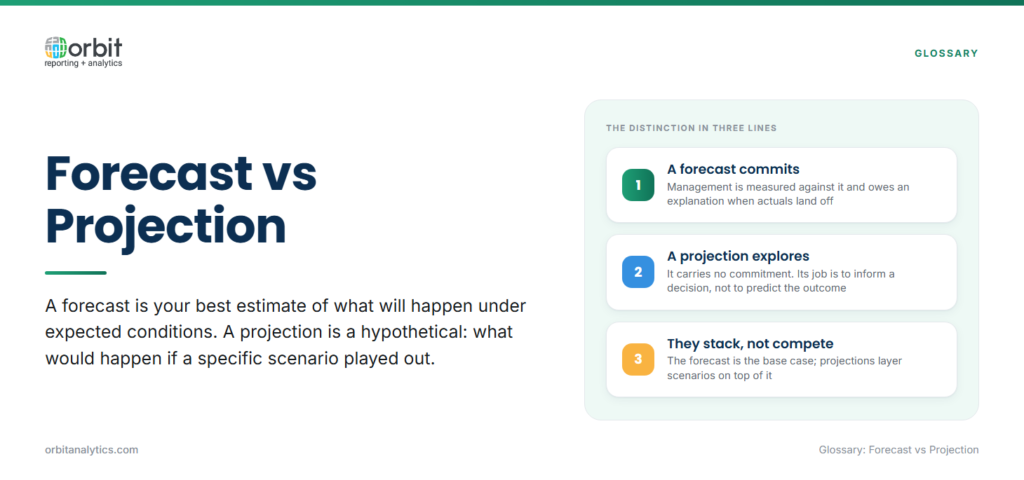
A forecast is your best estimate of what will happen under expected conditions. A projection is a hypothetical “what if”: what would happen if a specific scenario played out. One commits the business; the other explores a possibility.
This guide compares forecasts and projections side by side and explains how mature finance teams use them together. It is written for FP&A leaders, controllers, and CFO office teams running planning cycles on Oracle ERP data..
Quick overview: forecast vs projection
| Factor | Forecast | Projection |
| Assumptions | Based on expected conditions | Based on hypothetical scenarios |
| Purpose | Predict likely outcomes | Explore what-if scenarios |
| Accountability | Management commits to the result | No commitment expected |
| Time horizon | Typically shorter-term | Can be any timeframe |
| Update frequency | Regular (monthly or quarterly) | As needed for analysis |
| Best for | Budgeting, targets, operations | Strategy, risk, M&A |
What is a forecast?
A forecast is an unbiased estimate of likely financial performance based on expected conditions and current trends. It assumes the business continues operating as it does today, with reasonable adjustments for known changes.
Key characteristics
- Anchored in expected reality: Assumptions reflect current pricing, cost structure, and demand. No aspirational stretch and no worst-case stress.
- Carries accountability: When actuals land off forecast, finance owes the audience an explanation.
- Refreshed on a regular cycle: Forecasts are revisited every month or quarter to stay current with actuals.
How forecasts are created
Most enterprise forecasts blend three inputs: historical actuals from the general ledger, driver-based assumptions (units, headcount, price), and known commitments (contracts, hiring plans, capital projects). The model rolls these forward 12 to 18 months and surfaces variances against the plan.
Pros and cons of forecasting
| Strengths | Weaknesses |
| Defensible, directly comparable to actuals | Tied to current assumptions |
| Regularly updated each cycle | Can miss disruptive shifts |
What is a projection?
A projection is a hypothetical view of what would happen under a specific set of assumptions that may or may not reflect expected reality. Projections are exploratory tools that let teams test the impact of decisions before committing to them.
Key characteristics
- Starts with “what if”: Each projection represents one possible future, not the most likely. What if revenue grows 30%? What if interest rates rise 200 basis points?
- No accountability: The projection’s job is to inform a decision, not to predict the outcome.
- Built on a base case: A projection layers scenario assumptions on the forecast rather than starting from scratch.
How projections are created
A projection is built on a base case (often the forecast) and then layered with scenario assumptions. Common types include best case, worst case, and sensitivity runs across two or three key variables. M&A models and lender packs almost always include projections rather than forecasts.
Pros and cons of projections
| Strengths | Weaknesses |
| Flexible across scenarios | Easy to abuse via cherry-picking |
| Expose risk exposure | Can mislead if labelled as forecasts |
Forecast vs projection: key differences
Assumptions and purpose
Forecasts use expected conditions; projections use hypothetical conditions. This single difference drives everything else. A forecast tells you where you are heading. A projection tells you where you could end up under a particular set of choices or shocks.
Accountability and audience
Management commits to forecasts and is measured against them. Projections carry no such commitment, and confusing the two erodes trust quickly. Forecasts mostly serve internal operations: budget reviews, variance analysis, executive dashboards. Projections often serve external audiences (lenders, investors, regulators) who want to understand sensitivity rather than commitment.
When to choose a forecast
Choose a forecast when the question is “what is most likely to happen?” Common use cases include:
- Operational planning for the next quarter
- Monthly variance reviews against budget
- Performance targets for sales and operations leaders
- Sales compensation plans tied to a defensible number
- Inventory and capacity planning needing a single point estimate
FP&A leaders, controllers, and operations teams benefit most because they need a realistic view of the next quarter.
When to choose a projection
Choose a projection when the question is “what if?” Typical scenarios include:
- Scenario analysis for upside, downside, and stress cases
- M&A modelling for acquisitions, divestitures, or financing
- Stress testing against macro or input-cost shocks
- Capital allocation decisions across competing investments
- Risk assessment for board and audit committee reviews
CFOs, treasurers, and risk officers benefit most because they need to understand a range of possibilities.
Forecast vs projection: how they work together
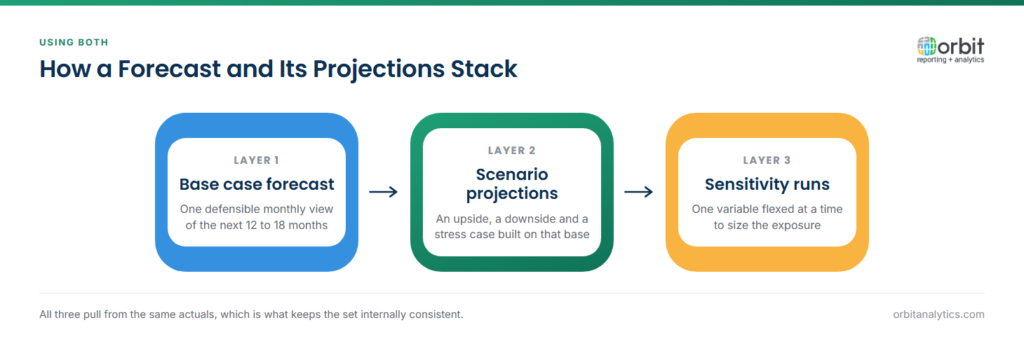
Mature finance teams use both in tandem. The forecast becomes the base case; projections layer scenarios on top. Together they answer “where are we heading, and how bad could it get?”
Base case forecast plus scenarios
Start with a defensible monthly forecast. Then build two or three projections around it: typically an upside, a downside, and a stress case tied to a specific risk (input cost spike, customer concentration, regulatory change).
Sensitivity analysis
Sensitivity analysis flexes one variable at a time against the forecast. What does a 5% revenue miss do to operating cash? What does a 200 basis point rate move do to interest expense? Sensitivities turn the forecast into a decision-support tool.
Creating a complete planning picture
The full picture needs live data from the ERP, a defensible forecast model, and a flexible scenario layer. A modern business intelligence for financial planning platform unifies these by pulling actuals directly from Oracle Fusion Cloud or EBS and powering scenario dashboards finance teams can rebuild without IT. Orbit Analytics ships pre-built connectors and over 1,000 finance reports that shortcut the data-gathering step.
Common mistakes when using forecasts and projections
The most damaging mistakes share a pattern: blurring the line between the two documents.
- Labelling a projection as a forecast: Presenting an aspirational best-case to the board as “the forecast” destroys credibility once actuals diverge.
- Treating a forecast as a fixed target: Refusing to update when conditions change turns it into a stale plan.
- Mixing assumption sets in one document: When some lines are expected and others aspirational, no audience can interpret the result.
Avoid all three by being explicit about which document you are sharing, what assumptions it carries, and what update cadence applies.
Our recommendation
Run a monthly driver-based forecast as your single defensible view of the next 12 to 18 months. Layer projections on top (at minimum an upside, a downside, and a stress case) for strategic conversations. Keep them clearly labelled, never substitute one for the other, and refresh both from the same actuals source. With GL Sense and the Excel reporting add-in, Orbit Analytics gives Oracle ERP teams a single source of actuals that feeds both forecast and scenario models.
Frequently Asked Questions
Q1. What is the difference between a forecast and a projection?
A forecast reflects expected conditions and what management believes will likely happen. A projection reflects hypothetical conditions used to explore what would happen under a specific scenario. Forecasts commit; projections explore.
Q2. Which is better, a forecast or a projection?
Neither is universally better, they answer different questions. Use a forecast when you need a defensible view of the most likely outcome. Use a projection when you need to test alternative scenarios or stress assumptions.
Q3. Can I use forecasts and projections together?
Yes, and most mature finance teams do. The forecast acts as the base case, and projections layer scenarios on top to show upside, downside, and stress conditions. Both should pull from the same actuals data to stay consistent.
Q4. Is a projection more optimistic than a forecast?
Not necessarily, a projection can be optimistic, pessimistic, or neutral depending on the scenario being tested. Confusing optimistic projections with forecasts is a common mistake that damages credibility with boards and lenders.
Q5. What assumptions go into a forecast?
A forecast uses expected conditions: current pricing, current cost structure, known commitments, and reasonable adjustments for trends visible in the data. Assumptions are defensible and tied to actuals from the general ledger.
Q6. Which do investors prefer, forecasts or projections?
Investors typically expect forecasts for short-term operating performance and projections for strategic or long-term scenarios. Lenders and regulators usually require projections because they want to see sensitivity, not a single point estimate.
Whether you need a precise forecast vs projection workflow for monthly close or a full scenario library for the board, the foundation is the same: clean, live data from your ERP. Request a demo to see how Orbit Analytics powers both forecasts and projections for Oracle ERP teams.
