Enterprises are pouring millions of dollars into migrating their complex, on-premise data into high-performance cloud data warehouses like Amazon Redshift. The underlying assumption driving these massive digital transformations is simple: once the data safely lands in a centralized cloud environment, business users will finally have the instant access they need to drive rapid, data-backed decisions.
However, the reality of the modern enterprise data stack is vastly different. In practice, if a CFO needs an updated financial consolidation, or a Supply Chain Director requires a daily operational logistics report, they are often forced to submit a ticket to the IT department and wait days—or even weeks—for a custom SQL query to be written and executed.
The hard truth is this: storing your enterprise data in the cloud is only half the battle.

A data warehouse, no matter how technologically advanced, is only as valuable as the actual business insights it delivers to the frontline workforce. If your decision-makers are struggling with rigid BI plug-ins, manually stitching together stale CSV exports, or constantly waiting on IT bottlenecks, your Amazon Redshift investment is functioning as an expensive data swamp rather than a strategic business asset.
To extract true ROI from Amazon Redshift, organizations must completely bridge the gap between backend storage and frontline consumption. Here is a deep dive into how Orbit Analytics sits natively on top of Amazon Redshift to transform raw warehouse data into an enterprise-wide, self-service reporting powerhouse.
The Analytics Gap: Why Raw Compute Power Is Never Enough
From an engineering and architectural perspective, Amazon Redshift is an undeniable marvel. As a petabyte-scale, fully managed cloud data warehouse, it delivers massive computing power. Cutting-edge features such as Massively Parallel Processing (MPP), the independent scaling of compute and storage (RA3 managed storage), and automated capacity adjustments (Redshift Serverless) make it the ultimate backend environment for enterprise analytics.
Despite this unparalleled computational power, a persistent and costly “analytics gap” exists between Redshift’s infrastructure and the everyday business user. This gap manifests in four critical ways:

- The Semantic Complexity Trap: Raw enterprise data landed in Redshift—especially from multi-module ERP systems like Oracle Fusion or E-Business Suite—is highly normalized. It is spread across thousands of tables with cryptic naming conventions that mean nothing to a business user.
- The SQL Barrier: Non-technical business users (finance, HR, operations) cannot write the complex database queries required to join these tables, nor can they safely explore raw database environments independently.
- The IT Bottleneck: Traditional Business Intelligence (BI) tools are often too rigid. They require IT teams to build custom semantic models, cubes, and brittle data pipelines for every single new reporting request, turning IT professionals into full-time report writers.
- The Risk of Shadow IT and Stale Data: When direct access to the warehouse is too difficult, business users default to the path of least resistance: downloading static spreadsheets. This immediately introduces severe data governance risks, version control nightmares, and a total loss of the “single source of truth.”
Having data inside Amazon Redshift does not mean business users can actively consume it. To activate your data, you need an intelligent semantic layer designed specifically for the workforce.
The Architecture of Activation: Orbit Analytics
Orbit Analytics provides a comprehensive, platform-agnostic reporting and business intelligence layer that turns Amazon Redshift into an interactive, self-service environment. By providing curated business views, an intuitive drag-and-drop interface, and deep ERP integrations, Orbit completely removes the technical friction between your users and your data.
Here is how Orbit translates Redshift’s raw power into everyday business value.
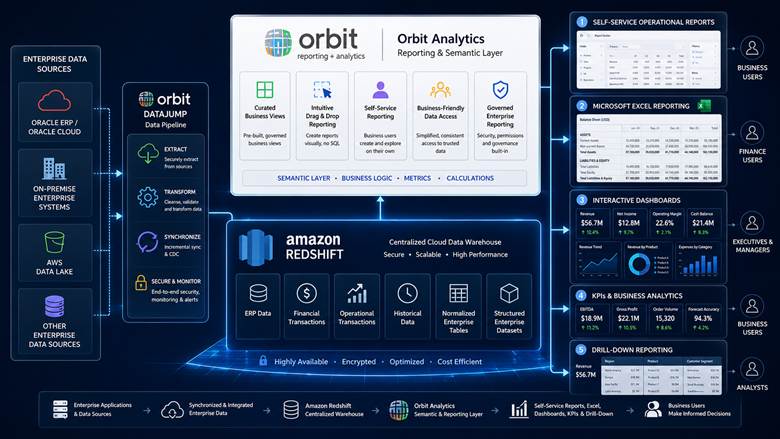
- Zero-IT Self-Service Operational Reporting
The core philosophy of Orbit is empowerment. Orbit equips non-technical business users with true self-service capabilities to generate real-time transactional and operational reports on demand. Business teams no longer need to depend on IT to run analytics, drastically speeding up the enterprise decision-making process. Users can easily build, modify, and schedule reports at predefined daily, weekly, or monthly frequencies without writing a single line of code. - Live Financial Reporting Inside Microsoft Excel
Finance and accounting teams live and breathe in spreadsheets—and they universally despise manual data dumps. Orbit respects this workflow by providing specialized, AI-powered plugins: GLSense for financial reporting and Excel Edge for comprehensive Excel reporting.
These sophisticated plugins allow users to embed real-time ERP and data warehouse queries directly into Microsoft Excel. Instead of exporting a static CSV from Redshift, a financial controller can open Excel, securely query Redshift through Orbit, and dynamically refresh their balance sheets and income statements. They can even drill down into journal line details without ever leaving the Excel interface.. - Unified Multi-Source Data Mashups
In a modern enterprise, data rarely lives in a single, isolated location. A company might have current operations running through Oracle Cloud, legacy data in an on-premise system, and unstructured logs in an AWS data lake.
Orbit natively pulls relevant data scattered across these different systems and formats—from both on-premise and cloud-based applications—to provide a unified, single source of truth. It connects seamlessly to Amazon Redshift, Amazon Athena, Teradata, and Oracle ERPs, allowing users to build cross-platform reports without manual reconciliation. - Interactive Dashboards & Deep Drill-Downs
Data is most impactful when it tells a visual story. Orbit offers powerful visualization tools for building reports and tracking critical business metrics and KPIs in real-time via mobile-ready dashboards.
However, unlike static dashboarding tools that only show high-level summaries, Orbit understands that the devil is in the details. Crucially, it empowers users to drill down from high-level visual summaries straight down to the lowest level of transactional detail in any report. If a regional sales chart shows a sudden dip, a manager can click that data point and drill down to the exact invoice lines stored in Redshift to find the root cause. - Bulletproof Data Pipelines with Orbit DataJump
A reporting powerhouse requires a flawless supply of data. To ensure the data inside Redshift is always accurate and up-to-date, Orbit utilizes DataJump for continuous data extracts.
DataJump acts as a highly efficient ETL/ELT engine to securely connect on-premise ERPs to cloud data warehouses using IAM authentication. It features built-in orchestration tools (Jobflows) to map complex dependencies and reliably trigger downstream Redshift stored procedures. This ensures that your business users are always querying the most accurate, synchronized version of reality

Proven Impact: How Global Enterprises Activate Redshift Data
The theory of a cloud data warehouse is great, but execution is what matters. Leading global companies rely on the powerful combination of Amazon Redshift and Orbit Analytics to systematically eliminate reporting bottlenecks and drive measurable operational efficiency. You can explore these transformations in depth on our Case Studies page.
Dish Network: Unified Analytics Across a Fractured Landscape
Dish Network is a Fortune 250 pay-TV service provider based in Englewood, Colorado. Employing 16,000 people in the U.S. with 12 million subscribers and approximately $13 billion in annual revenue, their data infrastructure is predictably massive.
- The Challenge: Dish’s critical operational data was highly fractured. It was scattered across Oracle Field Service Cloud, Teradata, Oracle GoldenGate (used to backup critical data to Amazon S3), Amazon Athena, and Amazon Redshift. They desperately needed a centralized solution to provide a unified view and enable self-service analytics for business users. After experimenting with traditional tools like Tableau and Power BI on their Athena and Redshift data, Dish found they simply did not satisfy their complex operational reporting requirements.
- The Impact: Dish deployed Orbit’s platform-agnostic operational reporting and analytics solution because of its unique ability to sit directly on top of Oracle ERPs, Amazon Athena, Amazon Redshift, and Teradata simultaneously.
- The Outcome: Orbit successfully empowered Dish’s business users to generate their reports in real-time, entirely eliminating their dependence on IT. Today, users can keep track of business metrics on mobile-ready dashboards, drill down to the lowest level of detail, and seamlessly collaborate by sharing reports for faster, data-driven decisions.
Helena Agri-Enterprises, LLC: Zero-Impact Data Pipeline Synchronization
Helena Agri-Enterprises (HAE) recognized they needed to bring critical data from their core ERP systems into their centralized data warehouse to modernize their analytics. However, they faced a severe technical hurdle.
- The Challenge: HAE needed to migrate vast amounts of historical data while continually extracting near real-time incremental updates (like Customer Dimensions and AR Transactions) from their on-premise Oracle E-Business Suite directly to their Amazon Redshift raw zone. The non-negotiable constraint was that these extraction operations had to be lightweight; they could absolutely not burden the underlying Oracle EBS application or impact day-to-day business operations.
- The Impact: HAE selected Orbit Datajump as their primary ETL/ELT engine. Orbit instituted optimized extraction strategies utilizing Materialized Views inside EBS, and established secure remote pipelines syncing the EBS source directly into Redshift staging tables.
- The Outcome: HAE achieved a fully automated extraction, transformation, and loading ecosystem that minimized manual intervention. Rigorous validation scripts guaranteed absolute data accuracy between Redshift and the Oracle source. Most impressively, successful hourly and daily incremental loads were achieved with zero negative impact on their mission-critical Oracle EBS application’s performance.
Apparel Group: Accelerating Global Enterprise Reporting at Scale
Apparel Group—a global fashion and lifestyle conglomerate operating over 2,200 stores and 85+ brands across 14 countries—faced complex, massive-scale data integration challenges when moving Oracle Fusion Cloud Applications data into Amazon Redshift.
For an enterprise of this immense scale, attempting to manually map reporting structures from a cloud ERP into a cloud data warehouse creates massive integration friction. By leveraging Orbit DataJump to orchestrate the pipeline from Oracle Fusion directly to Redshift, Apparel Group seamlessly handled complex schema discovery and standardized their enterprise extractions. This vastly enhanced their enterprise reporting capabilities by providing a highly scalable, friction-free pathway from their ERP directly to their business users’ screens.
From Warehouse to Workforce: Activating Your Redshift Investment
Investing in Amazon Redshift gives your enterprise world-class data storage, unparalleled security, and breathtaking computational speed. However, speed and scale are entirely useless if your business teams cannot quickly convert that data into timely, informed decisions.
A data warehouse that only IT can navigate is a missed opportunity. To truly modernize your business intelligence, you must shift your focus from simply warehousing data to actively deploying it to the workforce.
By placing Orbit Analytics directly on top of Amazon Redshift, you tear down technical barriers, permanently eliminate IT reporting backlogs, and deliver business-ready intelligence directly into the hands of the people who need it most.
Stop hiding your most valuable insights inside your data warehouse.
Request a Live Demo of Orbit Analytics Today and see exactly how we can turn your Amazon Redshift environment into a self-service reporting powerhouse.